How to Clean and Maintain Your Money Counter: A Daily, Weekly and Quarterly Care Guide
Why Money Counter Maintenance Matters More Than Most Buyers Expect
A banknote counter is a precision machine. Every note that passes through it is gripped by rubber feeding wheels, read by optical and magnetic sensors, and stacked at speeds of up to 1,000–1,500 notes per minute. Paper dust, ink particles, tape glue and humidity residue accumulate inside that path every single working day. In our after-sales records, the large majority of "machine fault" reports from banks, supermarkets and cash-in-transit companies turn out not to be hardware failures at all — they are maintenance issues: a dusty counting sensor, a glazed feeding wheel, or a hopper adjusted to the wrong tension.
The good news is that a disciplined cleaning routine takes less than five minutes a day and prevents most of those stoppages. This guide explains exactly how to clean and maintain a money counter — daily, weekly and quarterly — based on the service practice we apply to our own back-feeding bill counters and front-feeding currency counters.
Safety First: The Two Rules Before Any Cleaning
Rule 1 — Power off and unplug. Never clean a counter while it is connected to mains power. Cleaning rollers or sensors under power risks both personal injury and short circuits on the control board.
Rule 2 — No liquid inside the machine. Use a dry or barely damp lint-free cloth on external panels only. Inside the counting path, use a soft brush, a blower (manual bulb type, not compressed-air cans that spray propellant), and cotton swabs lightly moistened with isopropyl alcohol for stubborn glue on rollers. Never spray anything into the chassis.
The Daily Routine (3–5 Minutes, End of Shift)
- Empty and wipe the hopper. Remove leftover notes, then brush out paper dust from the hopper plate and side guides. Dust here changes feeding friction and is the most common cause of double-feeding.
- Brush the counting path. Open the upper cover and brush the channel between the feeding wheels and the stacking wheel, following the direction notes travel.
- Wipe the stacking wheel and stacker plate. These collect the most dust because every note touches them at full speed.
- Check the display for error logs. Note any recurring jam or count-error codes so weekly maintenance can target them.
The Weekly Routine (15 Minutes)
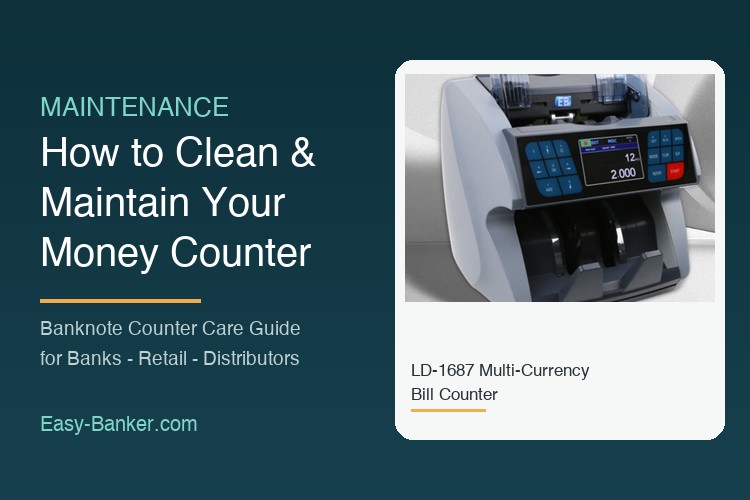
- Clean the detection sensors. On machines with UV, MG and IR heads — such as the LD-1687 multi-currency bill counter — dust film on the sensor windows causes false rejects. Use a dry cotton swab on the optical windows; never use abrasive tissue.
- Inspect the feeding wheels. Look for glazing, cracks or flat spots. A glazed rubber wheel slips on new, crisp notes and grips old notes too hard — both produce miscounts.
- Verify hopper tension. Feed a mixed test batch: 10 new notes, 10 circulated notes, 10 slightly worn notes. If the machine double-feeds or jams on one group only, adjust the hopper gap screw in small steps and retest.
- Clean the exterior and keypad with a barely damp cloth; disinfectant wipes are acceptable on panels if wrung out fully.
The Monthly and Quarterly Routine
- Count-accuracy test. Run a known bundle (for example 100 notes counted three times) and compare results. A consistent deviation points to sensor drift, not random error.
- Detection test with suspect notes. Keep a small set of marked test notes (a known counterfeit specimen where legally permitted, or notes with damaged security features) and confirm the machine still flags them.
- Firmware and parameter check. On CIS-equipped models, confirm currency profiles are up to date; new note series require profile updates, not hardware changes.
- Inspect power cable, fuse and interfaces (USB / RS232 where fitted) for corrosion in humid climates.
Maintenance-Related Faults and What They Usually Mean
| Symptom | Most likely maintenance cause | First action |
|---|---|---|
| Frequent jamming | Dust in counting path or wrong hopper tension | Full path cleaning, then tension retest |
| Double-feeding (count too low) | Worn or glazed feeding wheels | Clean wheels; replace if glazed |
| False counterfeit rejects | Dust film on UV/MG/IR sensor windows | Dry-swab the sensor windows |
| Notes not stacking neatly | Dust on stacking wheel / bent stacker plate | Clean stacker, straighten plate |
| Machine stops with no error | Loose power connector or blown fuse | Check cable and fuse before opening chassis |
If cleaning does not resolve a fault, stop there — our troubleshooting guide Why Does a Money Counter Reject Banknotes (and How to Fix It)? walks through the diagnostic sequence step by step.
A Note for Distributors and Service Partners
Maintenance is also a revenue line. We supply wearing-part kits (feeding wheels, stacking wheels, sensor brushes) and service manuals for our counter range, and we train distributor technicians remotely. If you resell banknote counters, bundling a maintenance kit and a one-page cleaning card with every unit measurably reduces warranty claims — most "failures" never reach your bench. Choosing the right machine in the first place matters too; see our practical buying guide for B2B buyers.
When to Call for Service Instead of Cleaning
Open the chassis only if you are a trained technician. Call for service when: the machine reports a sensor or motor error after a full cleaning; counting accuracy drifts after calibration; or the unit has been exposed to liquid, fire smoke or flooding. For spare parts, firmware files or a service quote, contact our export team via the inquiry form — include the model number and serial number from the rear label.
Easy-Banker manufactures banknote counters, currency detectors and cash handling equipment for B2B distributors worldwide, with OEM/ODM support and factory-direct supply.