Banking Equipment 2026: ATM Consolidation, White-Label Networks and the Cash-Recycling Branch
October 2026 was a turning point for banking equipment. In a few weeks the ATM industry saw its biggest consolidation in years, a central bank committed to turning a whole national fleet into shared, neutral-branded machines, and cash recycling spread from bank branches into fintech and telecom touchpoints. For anyone who buys, distributes or operates cash-handling equipment these are not isolated headlines — they are one story about how cash infrastructure is being rebuilt around recycling, authentication and shared networks. Here is what happened, and what it means for the counter and sorter side of the business.
The ATM industry consolidates: OKI and Hitachi launch OH Channel Innovations
On 1 October 2026, Oki Electric Industry (TSE:6703) and Hitachi (TSE:6501) completed the integration of their ATM and automated-equipment businesses into a new joint venture, OH Channel Innovations Ltd. (formerly Hitachi Channel Solutions, Corp.), headquartered in Tokyo. According to the companies' joint announcement, OKI holds a 60% stake and Hitachi the remaining 40%, with capital of JPY 8.6 billion and Shotaro Nakatsu as Representative Director and President. The transaction was an absorption-type company split: OKI transferred its ATM development and production business into the Hitachi unit, then acquired shares to reach 60% of voting rights.
The strategic logic is telling. Media coverage put the combined venture's revenue at roughly JPY 150 billion (around USD 947 million) and its global ATM share above 20% on a simple pre-merger sum. Crucially, the new company positions overseas expansion in Asia and North America as a key growth pillar — that is where demand for cash-recycling ATMs is expected to grow. Many machines across Southeast Asia and India are still withdrawal-only, or accept deposits that cannot be recirculated, driving high replenishment costs. Consolidation at the top of the market is, in effect, a bet that recycling becomes the default.
White-label and shared networks: South Africa's National Cash Utility
The clearest signal that shared infrastructure is becoming policy came from South Africa. At a media briefing on 16 October 2026, Pradeep Maharaj, executive director of the South African Reserve Bank's Payments Ecosystem Modernisation (PEM) programme, told journalists plainly: “We are asking banks to white-label all ATMs.” Under the plan, a white-label ATM pilot starts in January 2027, and a National Cash Utility, wholly owned by the Reserve Bank, is to be established by March 2027, with privately run cash centres moving into it from the middle of that year. Full rollout is targeted for 2028.
The numbers explain the urgency. South Africa has roughly 30,000 ATMs and about 109 cash centres — a figure Maharaj said should be rationalised to no more than 50. Cash still accounts for around 56% of consumer transactions by volume, according to the Reserve Bank's cost-of-cash study, and its Cash Smart paper puts the cost of dispensing R100 at about 12 cents for retailer cash-back, 68 cents for an ATM and R1.53 for a branch. Every white-label machine would have to accept deposits, withdrawals and balance enquiries, with transactions below a set threshold free. Reuters also reported the payments system will open to non-bank operators — telecoms, fintechs and retailers — from mid-2027.
For suppliers the implication is direct: a shared network must handle deposits as reliably as withdrawals, so every machine needs deposit-capable authentication and fitness handling.
Recycling reaches the branch and the fintech kiosk
Three deployments show recycling moving beyond the branch. In Warsaw, Hitachi and Bank Pekao S.A. completed the first Hitachi cash-recycling ATM in the European Union on 30 June 2026, part of what the bank called a conscious diversification of suppliers to increase resilience. In Bahrain, Diebold Nixdorf announced on 8 October 2026, at Fintech Forward 2026, that stc pay Bahrain — a telecom-affiliated mobile-wallet provider — will build its first self-service network on DN Series cash recyclers (some with Interactive Teller Machine kits) and DN Vynamic software. And in Austria, KEBA marked its 10,000th evo cash-recycling system, installed at a Sparkasse Oberösterreich branch in Linz, using dual-cassette technology to recycle all euro denominations.
The common thread: recyclers cut cash-in-transit runs and idle vault cash by feeding deposited notes straight back into circulation. But they only work if the notes going in are properly authenticated and graded for fitness — which pushes demand down the chain to the counters and sorters on the teller line and in the cash centre.
What recycling means for counters and sorters
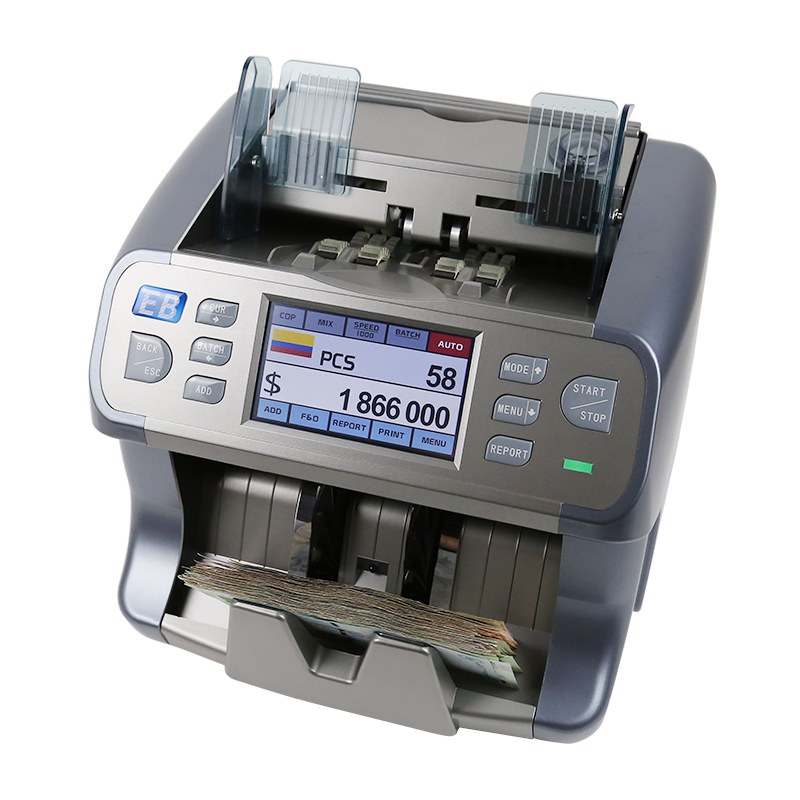
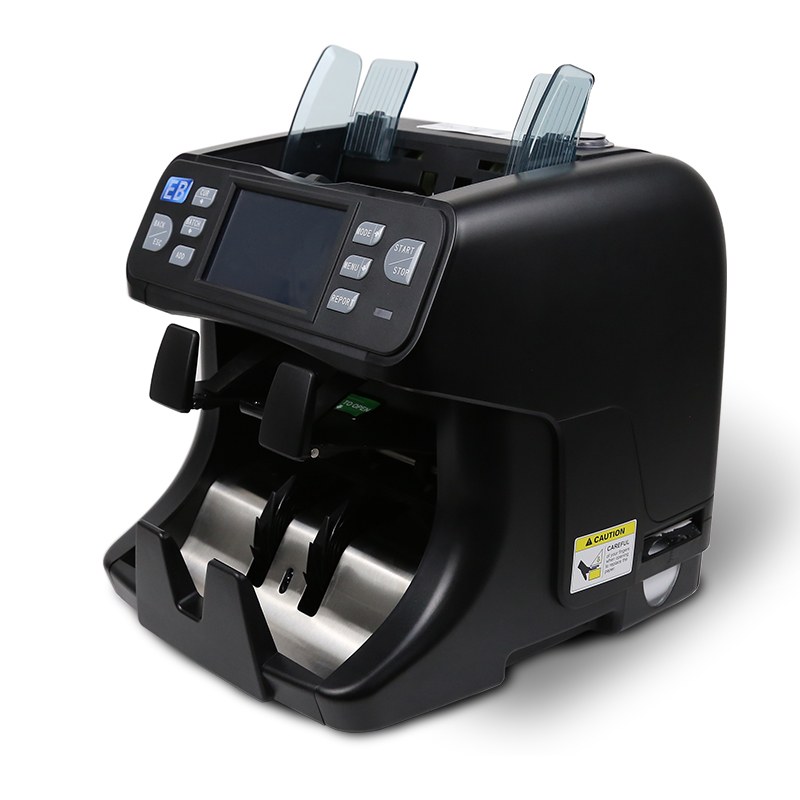
Recycling raises the bar for back-office equipment: notes must be authenticated against multiple sensors, sorted by fitness so only fit notes re-enter circulation, and made traceable. This is exactly what Easy-Banker builds. The LD-2700G value counter uses 2 CIS sensors on a 4.3-inch TFT touch screen, with mix-value counting plus denomination and version sorting, serial-number (SN) code recording, and automatic half-note, chained-note and double-note detection. It runs at 800/1000/1200 pieces per minute with a 500-piece hopper and 200-piece stacker, counts notes from 110–185mm long and 50–85mm wide (0.075–0.15mm thick), and works across most world currencies on 100–240V at 60W.
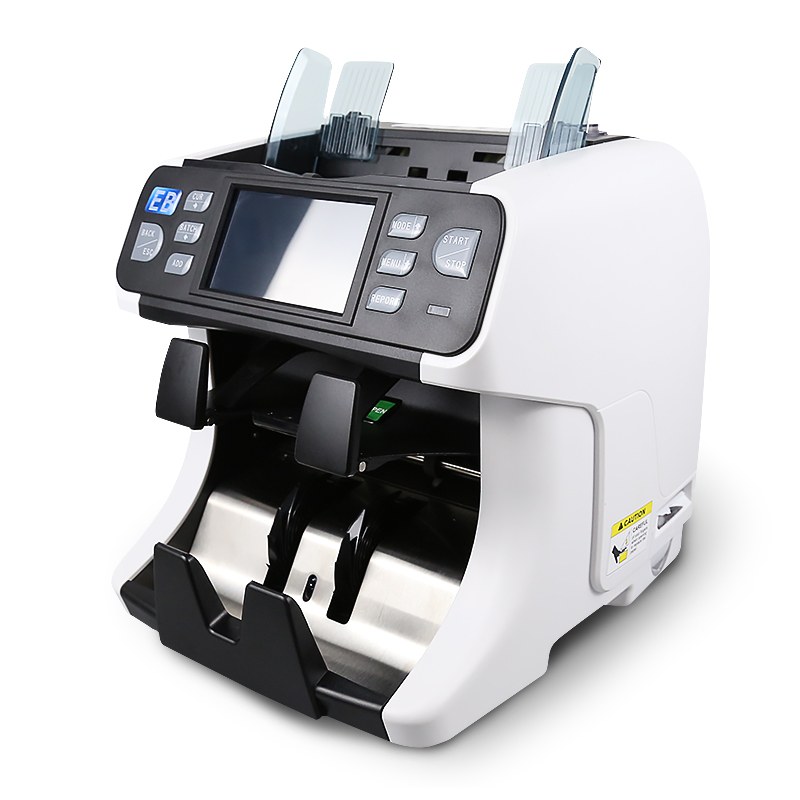
The compact BS-2080B and BS-2080W 1+1 pocket sorters both carry dual CIS with SN code recording and an optional built-in printer, analyse each note through optical, IR, UV and MG sensors for authentication, valuation and sorting by denomination, orientation and facing, and include washed-banknote checking. They process at 800/1000/1200 notes per minute over LAN/RS232/USB/PC, on a tactile screen, at around 9kg. For high-volume cash centres, the multi-pocket BS-2090 sorter (10kg, 262×293×302mm) scales the same sensor suite into a larger configuration.
What buyers should watch next
Five takeaways for distributors, banks and cash-in-transit operators. First, supplier diversification is now a stated resilience goal — Bank Pekao said as much — which keeps the door open for factory-direct OEM partners alongside the consolidating giants. Second, deposit-capable recycling is becoming the baseline for shared fleets, so authentication and fitness sorting are non-negotiable. Third, serial-number traceability is moving from a premium feature to a compliance expectation. Fourth, multi-currency readiness matters as recyclers cross borders. Fifth, connectivity (LAN/RS232/USB) is assumed, not optional.
Easy-Banker builds counters, sorters and detectors to exactly this specification as a factory-direct OEM partner. If your network is preparing for recycling, white-label sharing or a consolidated cash centre, contact our team for specifications, MOQ, lead times and OEM options on the LD-2700G, BS-2080B/2080W and BS-2090.
Sources: OKI–Hitachi joint release (1 October 2026); SARB PEM media briefing, 16 October 2026 (TechCentral, Reuters, Bloomberg) and the SARB cost-of-cash / Cash Smart papers; Hitachi–Bank Pekao announcement (30 June 2026); Diebold Nixdorf–stc pay Bahrain announcement (8 October 2026, Fintech Forward 2026); KEBA evo milestone. Easy-Banker specifications are taken from the live product pages.