UV, MG, IR or CIS: How Banknote Detector Sensors Actually Work
1. Why Sensor Choice Matters More Than Feature Lists
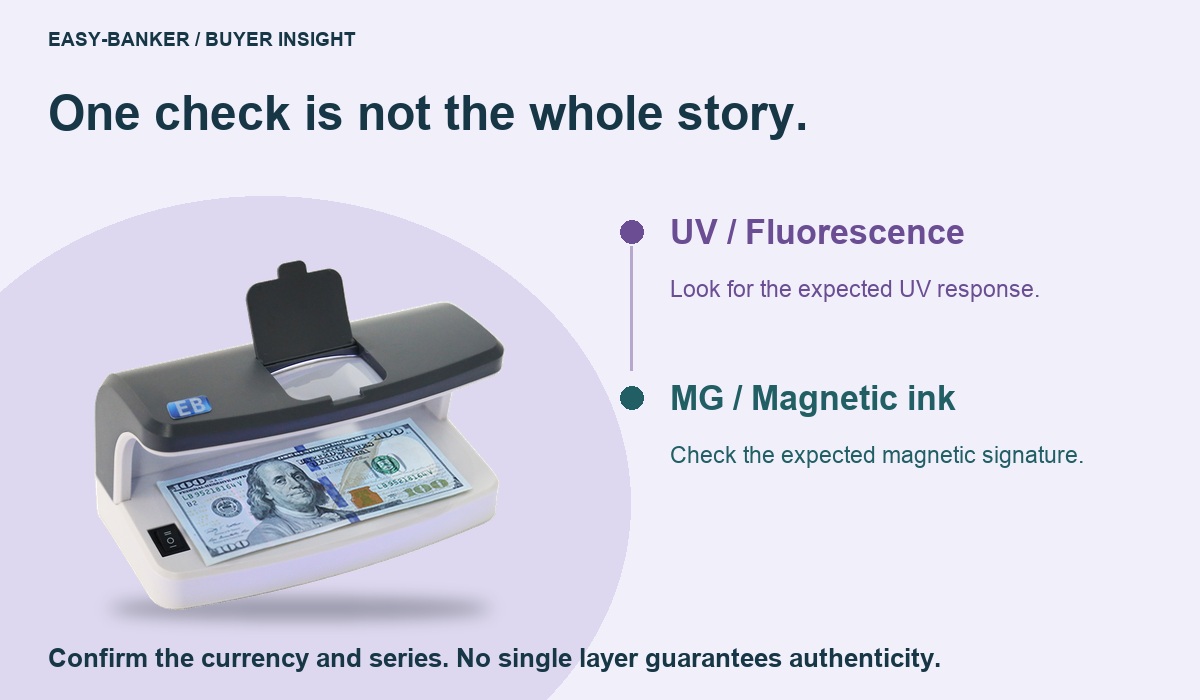
Every banknote detector on the market claims "counterfeit detection." Almost none explain how. For distributors, the difference is commercial: a UV-only lamp cannot pass the scrutiny of a bank or cash-centre buyer, while an over-specified machine kills the margin on a retail counter deal. Understanding the four mainstream sensor technologies — ultraviolet (UV), magnetic ink (MG), infrared (IR) and contact image sensing (CIS) — lets you match each machine class to the right customer tier.
The technology story is also being rewritten by regulation. The European Central Bank publishes and continuously updates its "successfully tested types of banknote handling machines" lists under its banknote professionals framework — the staff-operated machines list was refreshed as recently as June 2026, with machine-by-machine entries showing denominations processed, test date and fitness-sorting capability. The Bank of England runs its own parallel framework, whose October 2022 revision explicitly classifies "desktop note counters with authentication sensors," "desktop fitness sorters" and POS note validators as testable categories. If your buyers serve banks in these markets, sensor architecture is no longer a spec-sheet decoration — it is the entry ticket.
2. UV Detection: The First Line, Not the Last
Ultraviolet sensors excite fluorescent elements in the note. Genuine banknotes are printed on paper that does not fluoresce uniformly, with selective UV-reactive inks, fibres and security threads; most counterfeits printed on commercial offset paper glow bright and even under 365 nm light. That wavelength is the industry norm — the Easy-Banker DC-5100 detector, for example, combines a 365 nm UV lamp with a magnetic ink sensor and a 5X magnifier for micro-printing inspection, plus a ruler area for measuring note dimensions, in a 200×105×105 mm desk unit. It runs on a 1200 mAh rechargeable battery for roughly four hours or on DC 5V/AC power, weighing just 0.55 kg.
UV alone is cheap to defeat: a skilled counterfeiter can source non-fluorescent stock and bleach paper. UV is therefore a screening layer. Always ask what else the machine pairs it with.
3. Magnetic (MG) Detection: Sensing the Ink Itself
Most currency series use intaglio printing with magnetic inks on serial-number bands or specific design elements. An MG head reads that magnetic signature as the note passes. Desktop counters such as the Easy-Banker LD-2110 (900 notes/min, 4-digit TFT count display) combine UV and MG precisely for this reason: counterfeit notes often use white or bleached paper with the wrong UV response, while genuine notes carry magnetic ink that low-quality fakes cannot reproduce. Because intaglio plates are among the hardest parts of a banknote to replicate, MG has historically been the workhorse sensor that catches photocopied and offset forgeries.
4. IR and CIS: Reading the Note Like a Camera
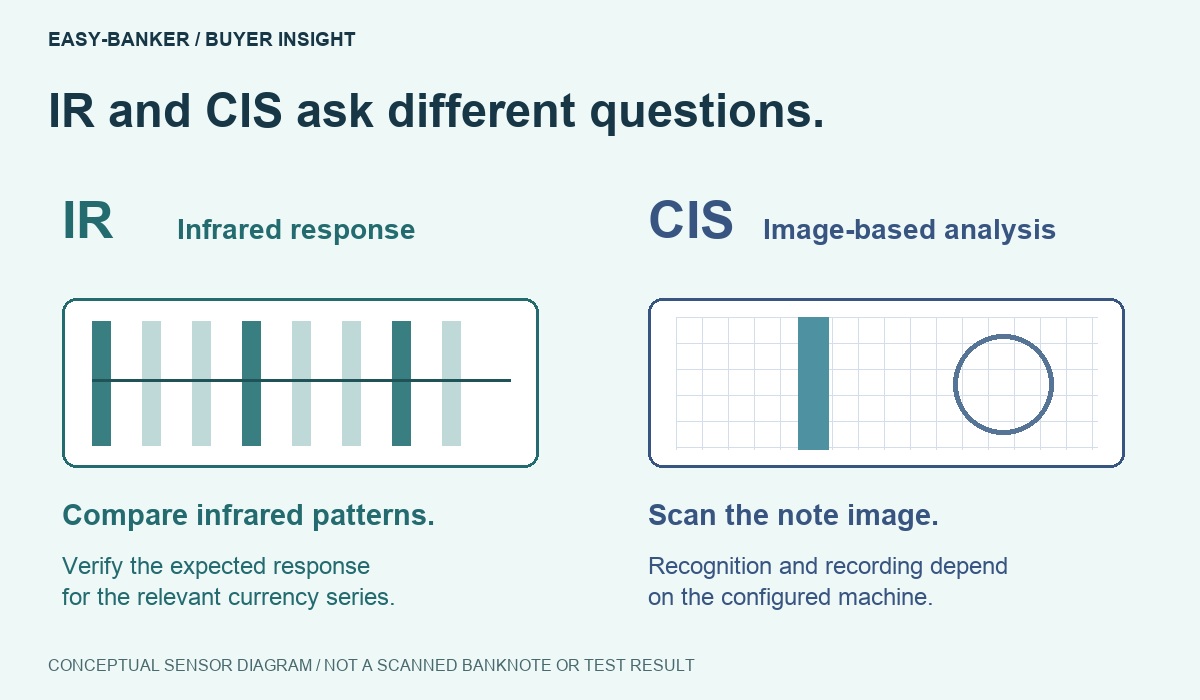
Infrared sensors exploit the fact that certain inks absorb or reflect IR light very differently from the surrounding paper, verifying hidden IR images and the IR pattern of the design. CIS takes it further: a contact image sensor scans the full front and back of the note like a flatbed scanner, enabling denomination recognition, serial-number capture, double-note and half-note detection, and condition scoring in one pass. CIS is what turns a "detector" into a "checker," and it is the same technology family behind modern fitness sorters — machines that can be demonstrated against central-bank test decks rather than a dealer's anecdote.
5. What Distributors Should Ask Their Supplier
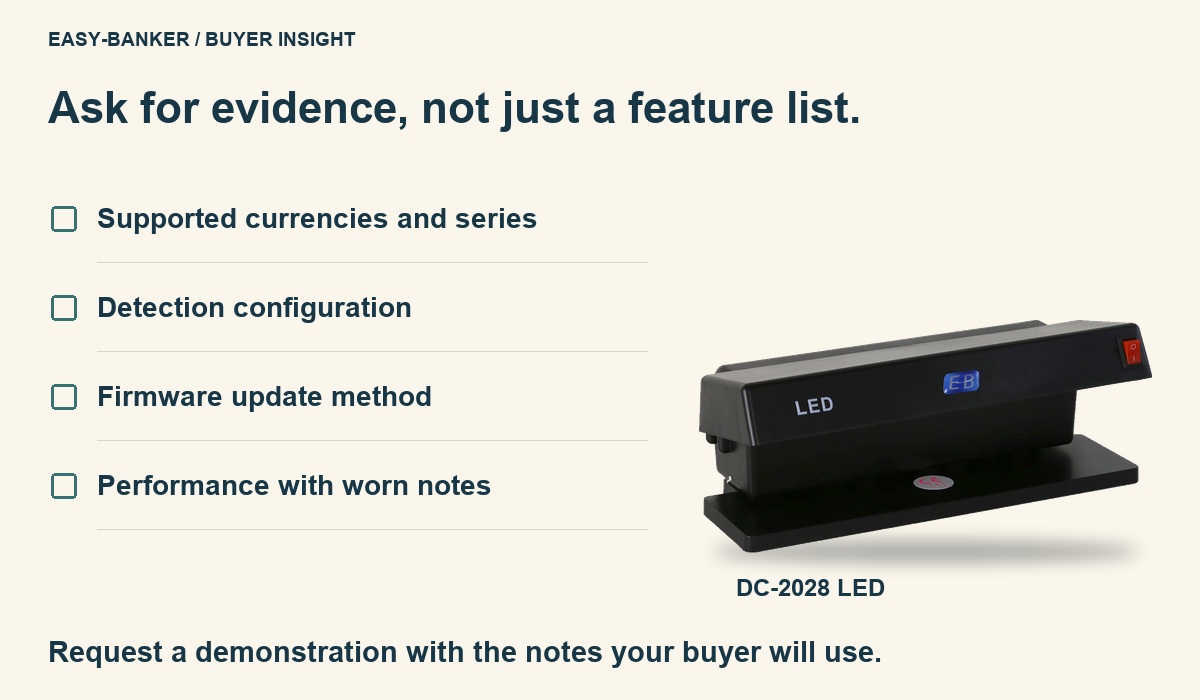
- Which sensors, on which denominations? Detection is calibrated per currency series; ask for the supported-currency list and the firmware update policy for new series.
- Is there an official framework behind the claim? For euro, check the ECB's cashProf tested-machines lists; for sterling, the Bank of England testing framework. Testability under these frameworks is a differentiator you can resell.
- False-reject rate on worn notes. Authenticity and fitness checks share sensors; poorly calibrated machines reject fit circulation notes and frustrate end users. Norges Bank's monitoring work documents how sorting results vary with machine calibration and maintenance status.
- Upgrade path. New series — polymer substrates included — change magnetic and IR signatures. Ask how detection firmware is updated and whether old machines can be field-upgraded.
6. Matching Machine Class to Customer Tier
A practical portfolio covers three tiers. Retail and small business: a single-window UV+MG detector or a UV/LED lamp desk unit (DC-5100 or DC-2028 LED class) at the counter. Cash-intensive businesses: a desktop counter with UV+MG flagging (LD-2110 class — 900 notes/min with TFT count and batch displays). Banks and cash centres: CIS-based sorters and checkers whose authenticity and fitness sorting can be demonstrated against a central-bank test deck. Easy-Banker manufactures all three tiers as a cash-handling equipment factory, with OEM options for alarm language, branding, voltage and detection packages. Distributor pricing, sample units and the full supported-currency matrix are available on request.
Facts and sources: ECB "Successfully tested types of banknote handling machines" (staff-operated list updated 2026-06-26; customer-operated list 2026-07-03), ecb.europa.eu cashProf; Bank of England "Framework for the Testing of Automatic Banknote Handling Machines," October 2022; Norges Bank staff memo on quality of banknotes in circulation; product specifications from easy-banker.com official product pages (DC-5100, DC-2028 LED, LD-2110).