Double Feeds, Chained Notes and Half Notes: How Banknote Counters Detect Feed Errors
Why Feed Errors Matter More Than Counting Speed
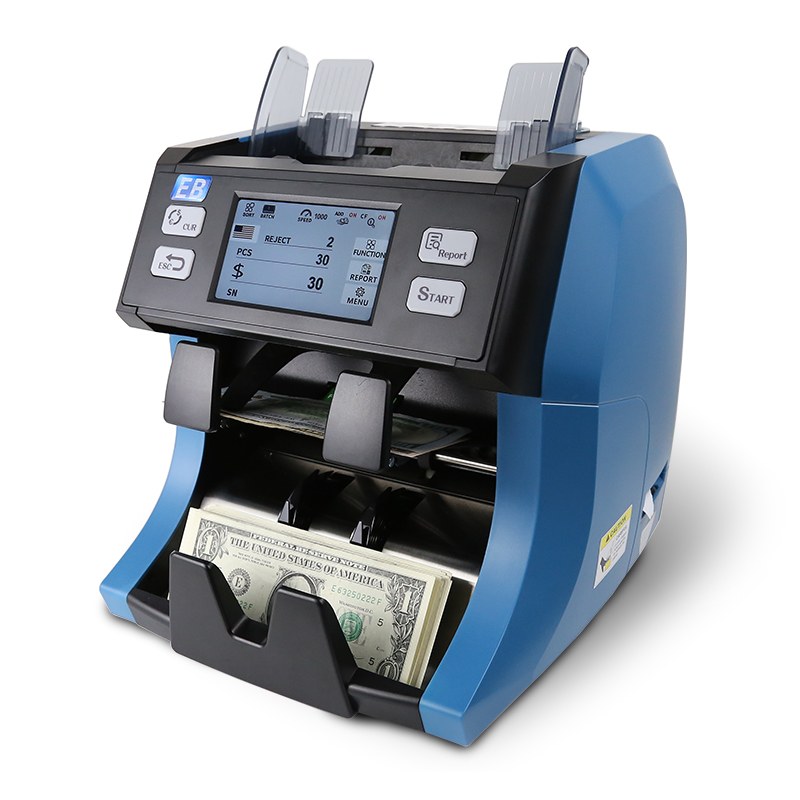
Ask a bank operations manager what causes most cash discrepancies at the counter, and the answer is rarely a sophisticated counterfeit. It is the humble mechanical fault: two notes passing through the transport as one (a double feed), notes clinging end-to-end (a chained note), or a torn half note counted as a full one. At 1,000 notes per minute, a single undetected double feed on a value-counting machine distorts the total by the full denomination of the doubled note — and the error is discovered hours later during end-of-day reconciliation, when nobody can tell where it happened.
This is why modern banknote counters treat feed-error detection as a core function rather than an accessory. Every Easy-Banker counter ships with batch and add functions (cumulative counting up to 999 bills), so an undetected feed error silently propagates into every downstream total. Detecting the fault at the moment it happens — stopping the machine and flagging the note — is the only way to keep the audit trail clean.
Three Physical Clues a Machine Can Read
A banknote in the transport path reveals three independent physical signatures that distinguish "one note" from "two notes stuck together":
1. Passage time and light interruption. Photoelectric sensors time how long an object blocks the beam. Two overlapping notes present a longer, thicker profile than the reference; the timing window flags the anomaly before the note even reaches the stacker.
2. Image evidence. A CIS (Contact Image Sensor) scans the note surface line by line. When two notes overlap, the scanned image shows mismatched edges, doubled patterns or a print region that does not belong to a single denomination — a signature image analysis can detect on both faces.
3. Thickness. Every machine publishes a countable-note thickness window in its specification table — the LD-2700G, for example, handles notes from 0.075 to 0.15 mm, a range that covers both cotton-paper and polymer substrates. Two stacked notes exceed the upper bound, and a mechanical thickness check catches them even when the images happen to align.
Half-Note, Chained-Note and Double-Note Detection in Practice
On current Easy-Banker value counters, this detection is standard, not optional. The specification sheets of the LD-2700G and the LD-1910 both list "automatic half-note, chained note, double-note detection" alongside UV and MG counterfeit detection.
The two machines differ in sensor depth. The LD-2700G uses 2 CIS sensors and a 4.3-inch TFT touch screen, with a 500-note hopper, 200-note stacker and three speed settings (800 / 1000 / 1200 notes per minute); it performs mixed-value counting with denomination and version sorting on a 100-240 V, 60 W supply. The LD-1910 uses 1 CIS with UV + MG detection, counts at 1000 notes per minute with a 200-note hopper and 200-note stacker, and adds USB and RS232 ports for cash data output — the interface banks use to log counted value into their own systems.
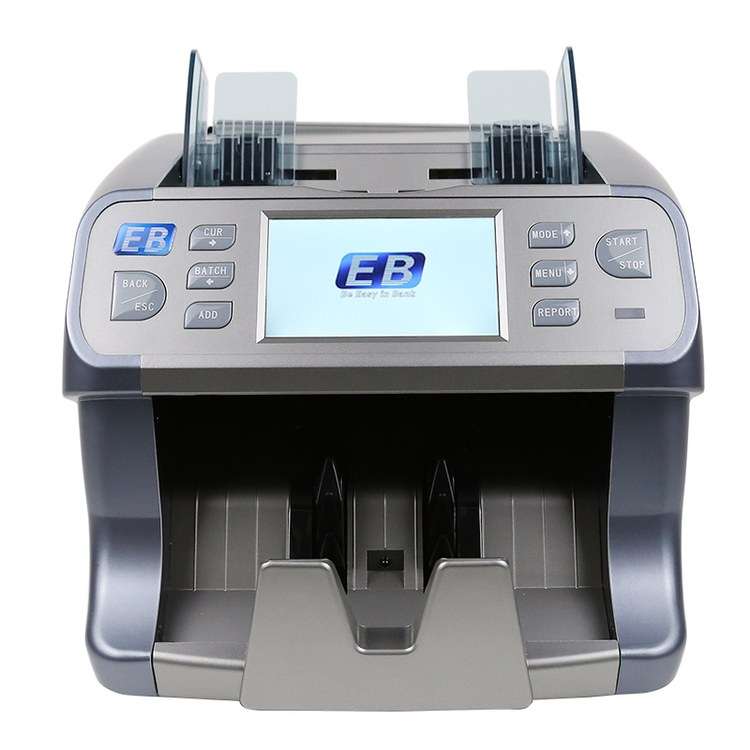
In both cases the practical effect for a cashier is the same: the transport stops, the display names the fault, and the suspect note is physically separated instead of buried inside a counted bundle.
DD Width Detection: The Reference-Note Method
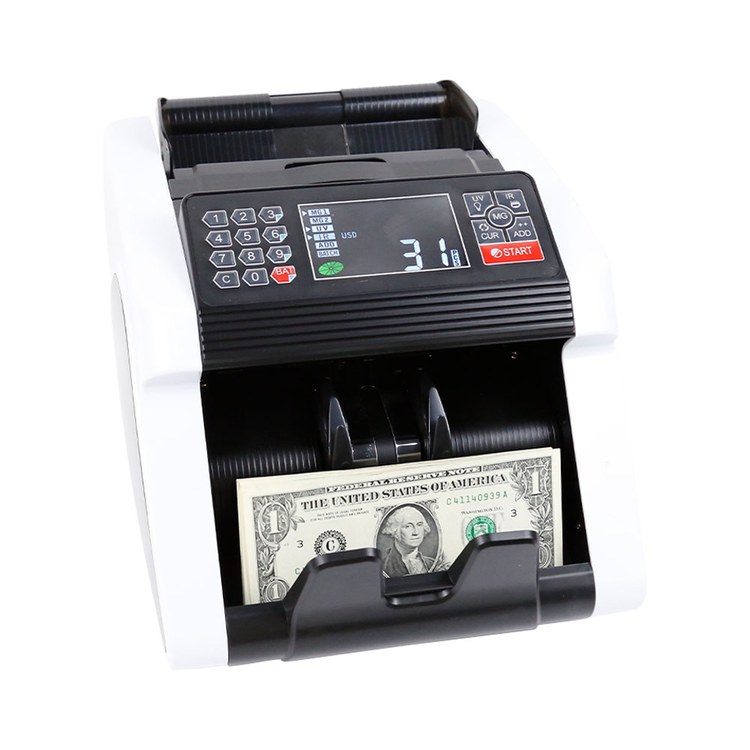
Portable counters take a lighter but still effective approach. The LD-2300 pairs UV and MG detection with what its feature table calls DD detection: banknotes are measured by width, the first note of a pile is defined as the reference width, and the message "Width Different" is shown when a note of another width is identified.
The logic is simple and robust. A chained pair measures longer than the reference; a half note measures shorter; a stray denomination dropped into the stack measures differently again. At 900 notes per minute with a 130-note hopper and a 5.5 kg body handling notes from 50×110 mm to 90×180 mm, the LD-2300 is built for tellers, shops and mobile cash teams that need fault detection without a full sorting platform.
Sorter-Grade Verification: Mechanical Thickness Checking Plus 200 dpi CIS
At the top of the chain, currency sorters combine every method above with fitness grading. The BS-2090 analyzes each note with optical, IR, UV and MG sensors plus 2 CIS at 200 dpi, reading the note by reflection on both sides and by transmission in visible and IR light. Its feature table lists FIT/UNFIT fitness sorting "through a very stable analysis of the banknote state using different sensors and mechanisms — CIS of 200 dpi, powerful UV, mechanical thickness checking."
For feed errors specifically, the BS-2090 adds quality analysis that catches what counting alone cannot: tears, adhesive and tape residue, double-note detection, and checking of washed banknotes. Strong and weak magnetic patterns and the metal thread are analyzed separately, and captured serial numbers can be printed or stored. It processes at 800 / 1000 / 1200 notes per minute on a 4.3-inch touch screen with LAN, RS232, USB and PC interfaces and an optional built-in printer.
A Distributor's Checklist for Feed-Error Detection
When evaluating any counter or sorter, the specification sheet answers these questions:
1. Does the feature list name half-note, chained-note and double-note detection explicitly? 2. What thickness range does it accept (0.075–0.15 mm covers paper and polymer)? 3. How many CIS sensors — one, or two for double-sided reading? 4. Are there selectable speed settings (e.g. 800/1000/1200) so detection accuracy can be traded against throughput per job? 5. Which interfaces (USB, RS232, LAN) export counted data for reconciliation? 6. Do hopper and stacker capacities match the workload — 500/200 for back-office value counting, 130 for a portable teller unit? 7. Is a continuous working time rated (Easy-Banker machines rate >30 minutes)?
Bottom Line
Feed errors are the quiet source of cash discrepancies, and the machines that prevent them are not magic — they read timing, images, thickness and width, then stop the transport and name the fault. Whether the duty is a portable teller counter or a full fitness sorter, the detection list on the spec sheet tells you exactly how much protection you are buying.
Easy-Banker manufactures banknote counters, currency sorters, money detectors and full cash-handling lines, with OEM/ODM customization for distributors worldwide. Contact our team for specifications, MOQ and lead times.