Global Banknote Watch, October 2026: Currency Withdrawals, Replenishments and the Euro Redesign Coun
October 2026: A Busy Month in the Life of Cash
Banknotes are never static. They are issued, worn, replaced, upgraded and withdrawn in a continuous cycle that every bank branch, cash-in-transit company and equipment distributor has to keep up with. October 2026 has been one of the busiest months this year: Sudan opened a deposit-only window for old 500-pound notes, the Maldives replenished its most worn denomination, Trans-Dniester put a QR code on a new 100-ruble note, Samoa released a polymer commemorative, and the European Central Bank moved closer to its year-end decision on the next euro series. Here is what was actually announced — and what each item means for cash handling operations.
Sudan: Old 500-Pound Notes Must Be Banked by 31 December
The Central Bank of Sudan began withdrawing 500-pound notes issued in 2023 and earlier on 1 October 2026. Holders in the Kordofan and Darfur regions — areas not covered by the first two phases of the currency-replacement programme because of security conditions — can deposit the affected notes at commercial bank branches at face value until 31 December 2026. Cash-for-cash exchange is not offered: deposits only. The notes remain legal tender until close of business on 31 December and lose that status on 1 January 2027 (Radio Tamazuj, 1 October 2026). The measure is the latest phase of the replacement programme launched in December 2024 for the 1,000- and 500-pound denominations; the second phase completed in mid-May 2026 in Khartoum, Al Jazirah and White Nile states. Economists quoted by Dabanga (8 October 2026) link the 500-pound withdrawal to counterfeiting pressure. It follows the earlier removal of the 1, 2, 5, 10, 20 and 50-pound notes, whose deposit window closed on 30 July 2026 after inflation stripped them of purchasing power (Sudan Tribune, 4 July 2026).
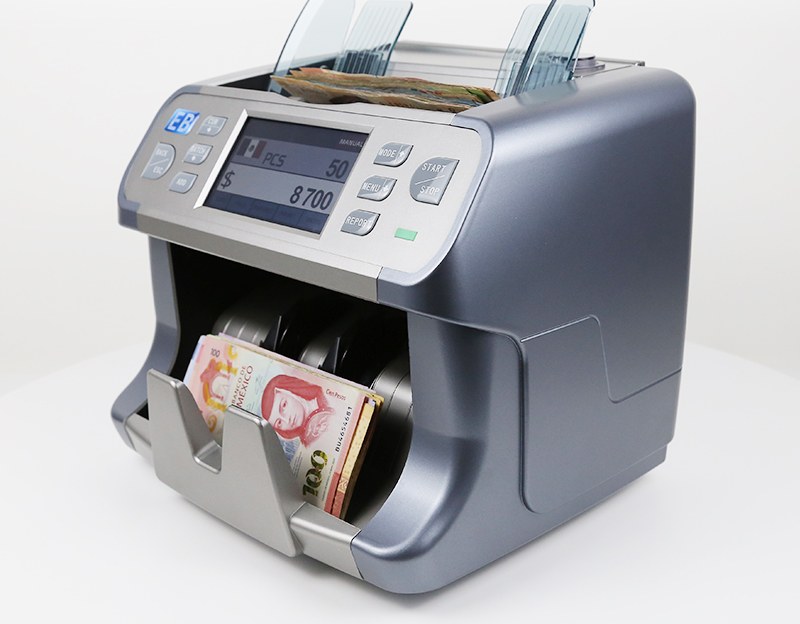
What it means for cash equipment: a deposit-only deadline concentrates enormous counting volumes into bank counters in a short window, with old and new series arriving mixed and counterfeit risk explicitly cited. Operations like this are where serial-number-recording counters earn their keep. The LD-2700G pairs 2 CIS sensors with SN code recording, counts at 800/1000/1200 notes per minute, sorts by denomination and version on its 4.3-inch TFT touchscreen, and stacks 200 notes per batch — the audit trail and version separation a currency swap demands.
Maldives: Why the Smallest Denomination Wears Out First
The Maldives Monetary Authority announced on 14 October 2026 that a new stock of MVR 5 banknotes would enter circulation the following day — the first replenishment of the denomination since it was introduced under the Ran Dhihafaheh series in 2017. The MMA's explanation is a textbook case of note fitness economics: the 5-rufiyaa note is used heavily in everyday transactions, fewer notes return to the authority through banks, and the notes already in circulation have deteriorated. The new stock carries the dates 31 July 2025 and 6 Safar 1447 with the signature of Governor Ahmed Munawar, and features the official rufiyaa symbol. Existing MVR 5 notes remain valid, and both versions circulate side by side (MMA announcement via Maldives Media, 14 October 2026).
What it means: two valid versions of one denomination in circulation at once is the normal state of cash, not an exception. Counters must accept both without rejects, and fitness-based sorting — separating worn notes for return to the central bank — is what extends the useful life of every series.
New Security Features: A QR Code on the 100-Ruble Note
BanknoteNews reported on 19 October 2026 a new Trans-Dniestrian 100-ruble note (catalogued as B242): violet, with Prince Dmitry Kantemir on the front, a QR code, and a windowed holographic security thread with demetalized Cyrillic lettering. It follows Russia's new 100-ruble note (B841a), confirmed introduced on 10 July 2026, whose back map was reduced from the whole country to the Central Federal District alongside improved security features.
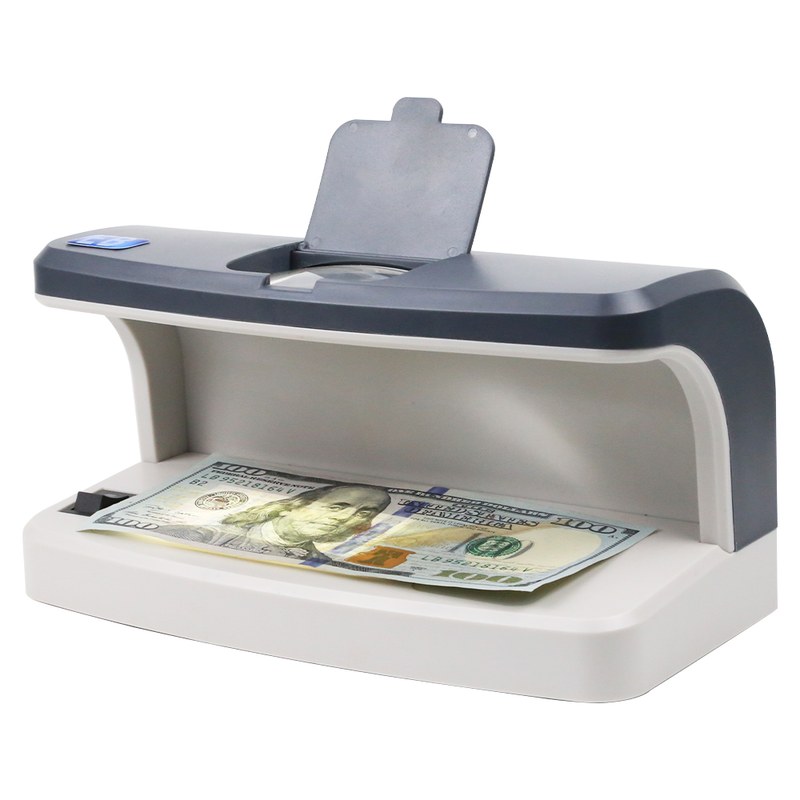
What it means: machine-readable elements like QR codes and upgraded holograms change the authentication checklist at every counter. Before machines are re-profiled, manual verification remains the first line of defence. The DC-5100 covers the classic checks in one rechargeable unit: 365nm UV light for fluorescent features, a magnetic sensor for magnetic ink, a 5X magnifier for micro-printing and a ruled measuring area for dimension checks — 200×105×105mm, 0.55kg, with a 1200mAh battery rated for 4 hours of operation. It verifies banknotes, cards, passports and IDs alike.
Samoa: Polymer Goes Commemorative
Samoa introduced a 100-tala polymer note on 10 September 2026 commemorating the 100th anniversary of the birth of Queen Elizabeth II. Although it is legal tender, only 20,000 notes were produced; the public could obtain two notes at face value with explicit instructions not to spend them in everyday commerce, while the bulk is sold to international collectors at a premium through PBN Currency Solutions. The 140×72mm note is printed by Royal Joh. Enschedé on PolySecure substrate made by Q&T Hi-Tech Polymer in Vietnam, carries the QEII prefix, and has no security thread (BanknoteNews, 21 September 2026).
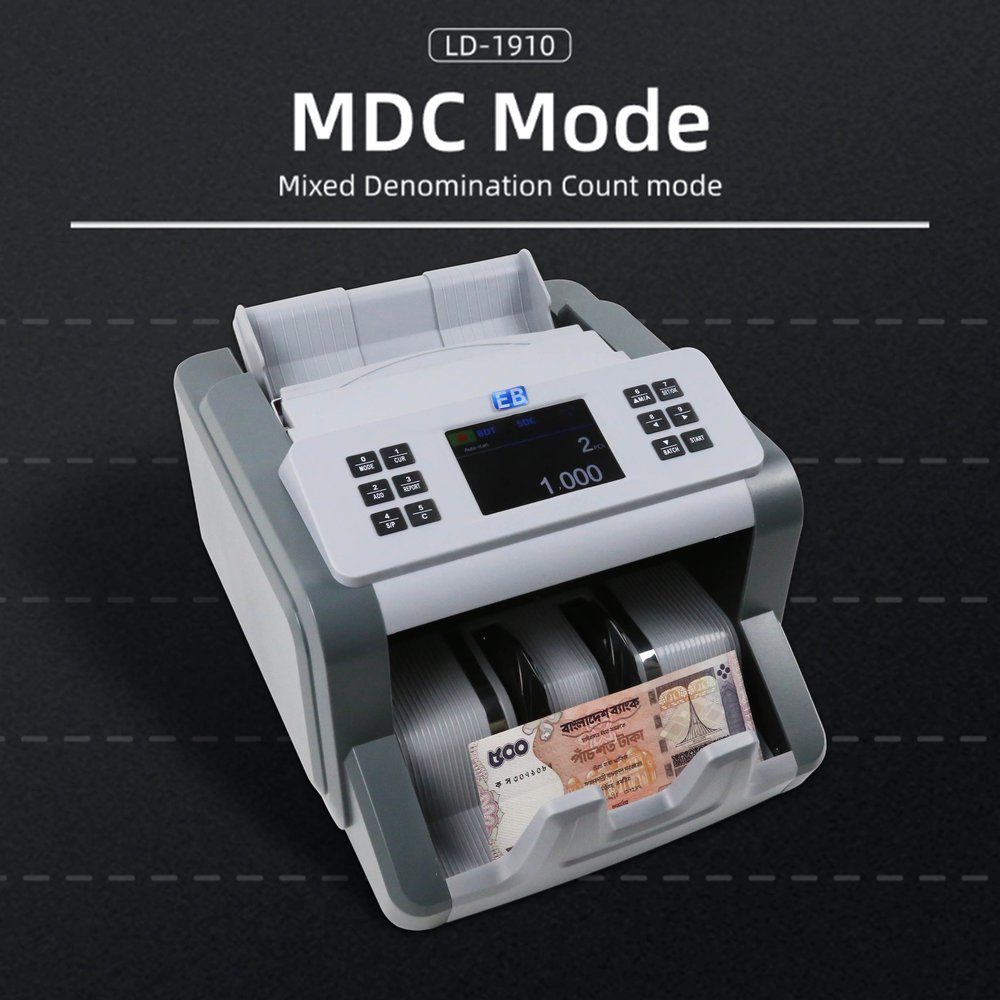
What it means: polymer keeps spreading through the world's currencies, in circulation series and commemoratives alike. Polymer notes behave differently in transport — they are slicker and stiffer — so counters need the right size and thickness envelope. The LD-1910 handles notes from 110–180mm long and 50–90mm wide at 0.075–0.15mm thickness — the Samoan tala sits comfortably inside that range — and its 1 CIS sensor drives mixed-value counting with denomination and version sorting at 1,000 notes per minute, over USB or RS232.
The Euro Redesign Countdown: Decision Expected by End-2026
The ECB's public survey on the ten shortlisted designs for the next euro series closed on 21 September 2026 after drawing more than 9 million participants, and the Governing Council is expected to choose the final design around the end of 2026. It is the first complete redesign since the euro launched in 2002, with two competing themes — "European culture" and "Rivers and birds" — and denominations unchanged from €5 to €200. Two details matter enormously for equipment buyers. First, the ECB has said sizes and dominant colours are likely to stay the same specifically "to facilitate the changeover and limit the costs of adapting banknote handling machines." Second, the new notes will not reach pockets for several years after the design is fixed (ecb.europa.eu; Banque de France press release). Counterfeit pressure, meanwhile, remains historically low: 444,000 fake euro notes were withdrawn in 2025, about 14 per million genuine notes.
What it means: continuity of size and colour means existing fleets stay largely compatible, but the new series will still bring upgraded security features that require sensor profile updates when they arrive. Distributors serving European markets should track the year-end announcement and their suppliers' firmware roadmaps.
What Distributors Should Take From October
Every item above points to the same operational reality: currency series overlap, security features evolve, and worn notes constantly cycle out. A cash handling toolkit for 2026 should include multi-currency mixed-value counting, denomination and version sorting for old/new separation, layered detection (UV, MG and CIS), serial-number recording for swap and audit operations, polymer compatibility across the size and thickness range, and fitness grading for recirculation. Easy-Banker builds all of these functions as an OEM factory — counters, sorters and detectors ship with the interfaces (USB, RS232) banks and distributors integrate with. Contact us for full specifications, MOQ and lead times for any model mentioned in this digest.
Sources
Radio Tamazuj (1 Oct 2026); Dabanga via AllAfrica (8 Oct 2026); Sudan Tribune (4 Jul 2026); Maldives Monetary Authority via Maldives Media (14 Oct 2026); BanknoteNews (19 Oct, 21 Sep, 11 Aug 2026); European Central Bank, Future Banknotes & FAQ pages; Banque de France press release. Product specifications from Easy-Banker live product pages, verified 21 October 2026.