Polymer Banknotes vs Paper: What Has to Change Inside Your Counter and Sorter
Polymer Banknotes vs Paper: What Has to Change Inside Your Counter and Sorter
For most of the history of cash handling, machines were calibrated for one substrate: cotton-fibre paper. In 2026 that assumption is expiring. India, the world's second-largest banknote market by volume, has approved a two-billion-piece field trial of polymer ₹10 and ₹20 notes, and at least four other central banks issued polymer denominations this year. For banks, cash-in-transit companies and the distributors who equip them, the question is no longer whether polymer arrives, but whether today's counters and sorters can read it without false rejects.
The 2026 Trial Wave, in Numbers
The Reserve Bank of India's programme is the largest machine-handling stress test anywhere. India's government informed Parliament in July 2026 that the RBI may issue one billion pieces each of polymer ₹10 and ₹20 notes for field trials (Times of India, 28 July 2026), a trial worth roughly ₹3,000 crore. The denominations were chosen deliberately: about 25% of note volume but only 1.4% of total value in circulation (Outlook Business, 5 August 2026). Governor Sanjay Malhotra has said issuance is planned from the beginning of the next fiscal year, with polymer circulating alongside paper rather than replacing it (The Hindu, August 2026). The printing arm BRBNMPL floated an Expression of Interest for 68,000 reams of biaxially oriented polypropylene substrate in July. Market analysis is blunt about the cost side: a New Indian Express explainer (22 September 2026) lists "new costs for machines, sorting, handling and disposal" as the central economic question of the trial.
India is not alone. During 2026 the Central Bank of Oman circulated a polymer one-rial note, the Central Bank of Solomon Islands issued a polymer $50 for its 50th anniversary, Samoa released a 100-tala polymer commemorative, and Sao Tome and Principe moved to a polymer 50-dobras note. Each of those denominations already passes through real counters and real sorters — often mixed in the same bundle as paper notes of the same currency.
Why Polymer Tricks Sensors Built for Paper
A detector does not "see" a note the way an operator does. It measures a few physical signatures and compares them against stored parameters per denomination and version. Polymer changes several signatures at once.
Ultraviolet. Paper is cotton fibre; polymer film has none of it, and fluorescent ink patches sit on a substrate that is transparent by design. A UV channel tuned only to paper responses can flag genuine polymer notes as suspicious.
Transmission infrared. The biggest difference is in the IR transmission image. With a lamp above and sensor lines below, the machine records where a note absorbs IR and where it lets the beam through. Paper reads as a mostly opaque sheet with characteristic zones; polymer carries deliberate transparent windows through which the beam passes unimpeded. Without a polymer parameter set, the machine literally reads a window as a missing feature. High-end sorters image every note in visible and IR transmission rather than trusting point sensors alone.
Magnetism. Magnetic-ink detection still works on polymer — the ink is in the printing, not the substrate — but window foils replace parts of the metal-thread pattern older machines were taught to expect, so the magnetic feature map must be versioned per substrate.
Thickness and size. A polymer note and a paper note of the same denomination do not present the same gauge and stiffness to the feed train or a mechanical thickness check. Counters are specified by countable-note ranges: the Easy-Banker LD-2300 accepts 50×110 mm to 90×180 mm notes at 0.075–0.15 mm thickness, carries polymer-and-paper compatibility in its product name, and adds width-difference ("DD") detection that flags any note deviating from the reference width of the batch.
Mixed Circulation Makes Version Sorting Mandatory
Trials do not run on clean separation. Tellers handling ₹10s will receive bundles in which paper and polymer versions of the same denomination sit side by side, alongside old and new designs. A counter that only counts pieces will still balance; a machine reporting value is untrustworthy unless it identifies each version, because the sensor model for the polymer note differs from the paper one. Denomination-and-version sorting therefore moves from premium feature to baseline requirement. The LD-1500 front-feeder, rated above 1,000 notes per minute with amount preset, combines UV, magnetic and infrared detection with denomination/version sorting and mixed-value counting in a desktop unit.
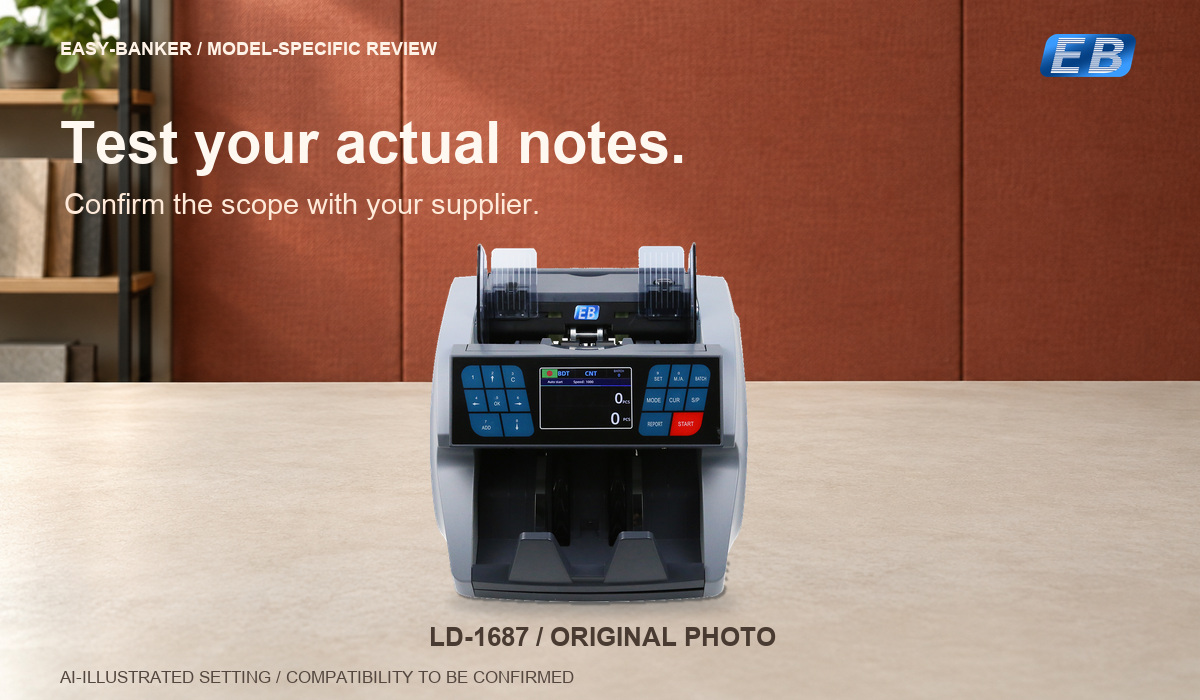
Serial-number capture sharpens the point. Trial notes are tracked by central banks, and cash centres that record serials can reconcile paper-versus-polymer streams per deposit. The LD-1687 pairs two CIS image sensors with serial-number scanning and version sorting, counting at selectable 800, 1,000, 1,200 or 1,500 notes per minute with a 300-note hopper, USB and RS232 interfaces, and a TFT touch screen.
Fitness Grading Gets a Second Curve
Polymer ages differently. Paper wears soft and torn; polymer surfaces soil and corner-curl while staying dimensionally intact. Fitness (FIT/UNFIT) logic built purely on paper wear will misgrade both populations. Sorters that analyse each note with 200 dpi contact-image sensors — reflection on both sides plus transmission in visible and infrared, strong and weak magnetic pattern and metal-thread checks, mechanical thickness measurement and washed-note detection, as specified for the Easy-Banker BS-2090 — give operators data to recalibrate per-substrate thresholds instead of guessing. The BS-2090 runs 800, 1,000 or 1,200 notes per minute on a 4.3-inch touch TFT with configurable menus, exporting counts over LAN, RS232 or USB with an optional built-in printer.
Five Questions Distributors Should Ask Before Quoting
- Is there a written polymer compatibility statement for the exact model, not the brand? Substrate support is a firmware-and-sensor package, not a marketing adjective.
- How are currency libraries updated when a new version enters circulation — the path, the cost, and the typical lag after an issuer announcement?
- Does detection include transmission imaging (visible and/or IR) or only point sensors? Transmission imaging is what separates "rejects polymer windows" from "reads polymer windows".
- Do thickness and size ranges cover both substrates, and does the machine sort versions within one denomination?
- Can it capture and export serial numbers for trial monitoring and dispute handling?
The Bottom Line
The substrate transition is slow at the issue window and fast at the machine: by the time a polymer denomination reaches real circulation, every counter in the market must read it on day one. Buyers who verify parameter sets, transmission imaging, version sorting and serial capture now avoid being caught later. Distributors who can demonstrate those four answers from stock will find polymer is not a forecast risk but a renewal cycle.
Easy-Banker manufactures banknote counters, detectors and sorting machines with multi-currency, multi-substrate firmware and OEM options. Contact our team to arrange testing with polymer samples of your target currencies, or explore the LD-2300 polymer-compatible counter and the BS-2090 transmission-imaging sorter.