Safeguarding Trust in Money: The 2026-2027 Policy Wave Reshaping Cash Equipment Procurement
Central banks rarely appear on a purchase order, but in 2026 the policy current is flowing directly into cash-handling budgets. A chain of decisions published over the past months - from Basel to Mumbai, Frankfurt and Washington - is quietly defining what banks, cash centers and their equipment suppliers must buy before mid-2027.
Trust in money: the BIS frame for the next-generation system
On 23 June 2026 the Bank for International Settlements released the conclusions of a special chapter of its Annual Economic Report 2026. The BIS stated that the path to the next-generation monetary and financial system "lies in leveraging innovation to improve today's two-tier financial infrastructure, while safeguarding trust in money." The chapter assessed programmable platforms and money-like instruments, and it was pointed in its verdict on stablecoins: current designs "fall short in terms of the key properties that ensure trust in money - in particular singleness, or the ability to redeem different forms of money exactly at par in exchange for central bank money."
The report also warned that wider stablecoin adoption could shift bank funding and credit provision, and that heavy demand for dollar-denominated stablecoins could make capital flows more volatile and challenge monetary sovereignty in weaker economies. For cash operations, the subtext matters as much as the headline: central bank money - notes and coins - remains the reference asset every other form of money must redeem against at par. Cash is being treated not as legacy but as the trust layer of payments, and the institutions that handle it are expected to prove they do so correctly.
Operational resilience now has a written yardstick
On 14 October 2026 the BIS Committee on Payments and Market Infrastructures (CPMI) and the International Organization of Securities Commissions (IOSCO) published a final report setting out guidance for financial market infrastructures on managing general business risks and losses. The report covers identifying, monitoring and managing general business risks; determining the minimum amount of liquid net assets funded by equity held against potential losses; and governance and transparency, including in the context of recovery and orderly wind-down.
Cash processing sits upstream of these requirements: vaults, cash centers and cash-in-transit partners underwrite branches and ATMs. As supervisors formalize resilience expectations, banks translate them into procurement language - documented processing standards, exception handling and auditable reports from the equipment on the counter and in the cash room.
National cash rules: the deadlines to calendar now
Layered on top of the international framework are hard dates set by national authorities, several of which we have previously verified against primary sources:
- India - 30 June 2027. Under the Reserve Bank of India's master direction on banknote sorting machines, banks must replace machines that do not meet prescribed fitness and detection standards, with Indian BIS certification referenced, by 30 June 2027 (source: rbi.org.in, reviewed by Easy-Banker editorial on 15 and 22 October 2026). For Indian cash hubs and their vendors, this is a replacement cycle, not an upgrade cycle.
- Euro area - design decision due by end-2026. The European Central Bank closed its banknote design survey on 21 September 2026 with more than 9 million participants and said its Governing Council would settle the design direction of the future euro series by year-end; the €5-€200 denominations stay, and sizes and main colours are expected to change as little as possible precisely to limit recertification costs for cash-handling machines (source: ecb.europa.eu, reviewed 21 October 2026).
- United States - non-sequential strapped notes. The Federal Reserve's currency design refresh has moved $1 (May 2023), $20 (June 2025), $2 (October 2025) and $5 (September 2026) notes to non-sequential numbering in straps, with deposit rules referencing full-strap integrity for $1-$20 (sources: frbservices.org and federalreserve.gov, reviewed 13 and 25 October 2026). Branch and vault teams need counters and sorters that read, record and reconcile straps cleanly.
- Thailand - 15 October 2026. Bank of Thailand requirements for machine verification of cash returned by businesses and financial institutions entered into effect this month (sources: Thairath and Bangkok business press, reviewed 6 October 2026).
What "provable" cash equipment looks like
Read through the compliance lens, the equipment conversation changes from speed alone to evidence: what the machine saw, what it rejected, and what record it left behind. Three Easy-Banker platforms illustrate the pattern, with parameters as listed on their product pages:
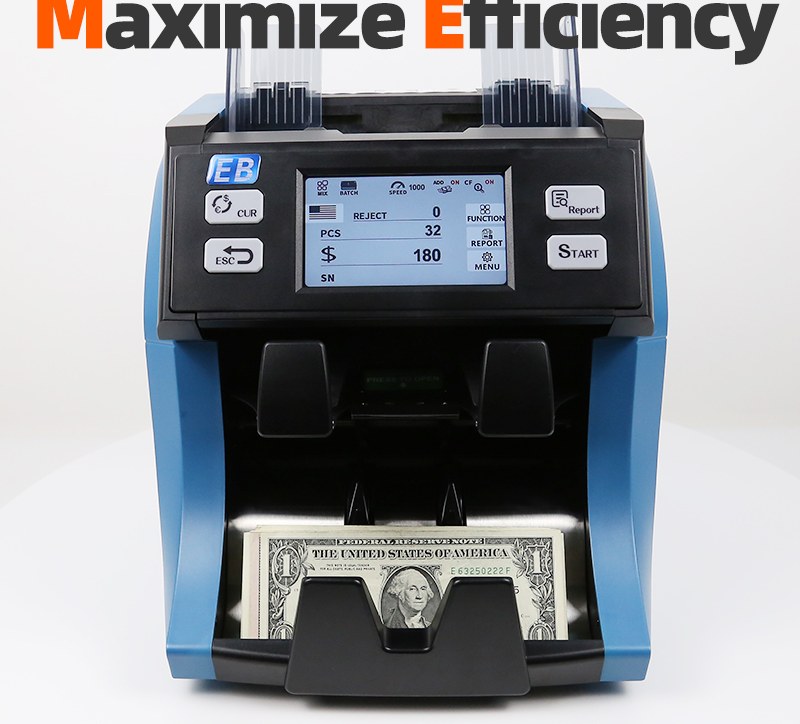
The BS-2090 currency sorter analyses each note through dual CIS at 200 dpi in reflection on both sides and in transmission, in visible and infrared, plus strong and weak magnetic and magnetic-thread checks. It sorts fitness (FIT/UNFIT), flags tears, adhesive tape and doubles, checks washed notes, and can capture banknote serial numbers to memory card - with an optional built-in printer for shift-level records. Process speed runs at 800/1000/1200 notes per minute on a tactile screen, with LAN, RS232, USB and PC connectivity, handling USD, EUR, GBP, CNY, JPY, KRW, RUB, INR and other listed currencies.
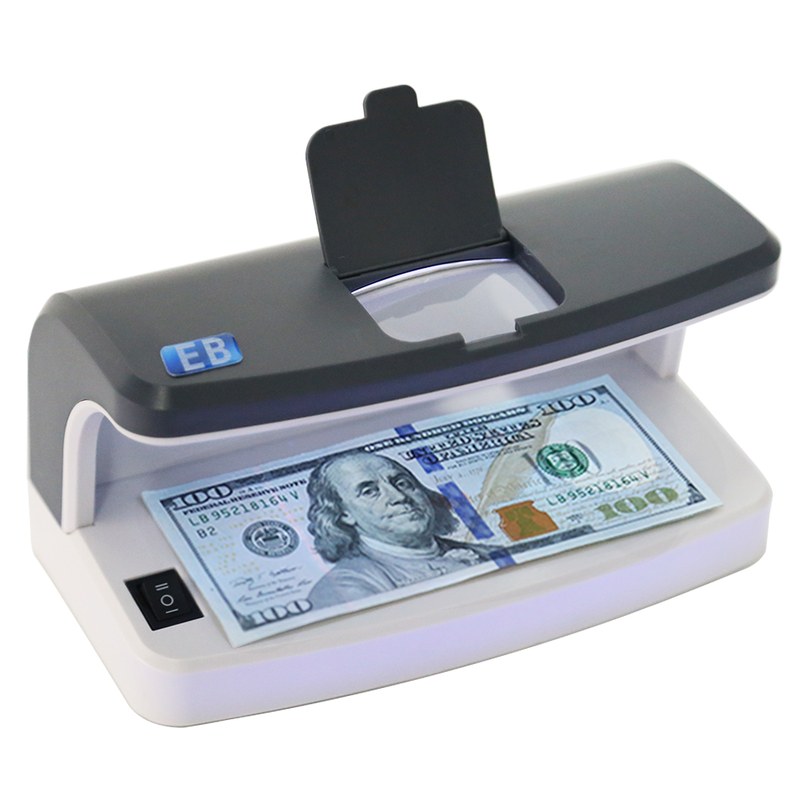
Trust starts at the counter, where the DC-5100 detector combines 365 nm ultraviolet, a magnetic-ink sensor, a 5X magnifier for micro-printing and a ruler zone for size checks, in a 200 x 105 x 105 mm body weighing 0.55 kg, USB-rechargeable with a 1,200 mAh battery for roughly four hours of operation.
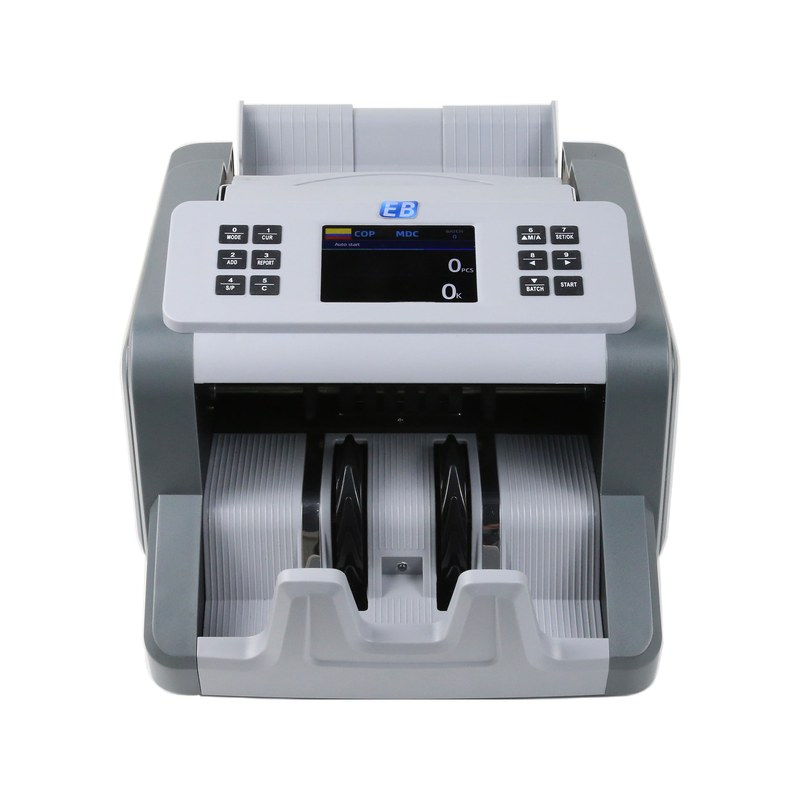
Between the two sits the LD-1910 mixed-value counter: one CIS plus UV and MG detection, mixed-value counting with denomination and version sorting, automatic half-note, chained-note and double-note detection at 1,000 notes per minute, a 200-sheet stacker, notes from 110-180 mm long and 50-90 mm wide between 0.075-0.15 mm thick, TFT display, and USB and RS232 ports for integration - 5.5 kg on the counter.
A procurement note for distributors and cash centers
Three planning points fall out of this calendar. First, the RBI deadline of 30 June 2027 compresses into a 12-month window - orders, shipping and commissioning rarely fit one quarter, so Indian demand should be assumed to move from early 2027. Second, the ECB's intent to keep sizes and colours broadly stable means existing CIS-based platforms can be recertified rather than replaced, favouring suppliers with machine-grade detection documentation. Third, the Fed's non-sequential straps and the CPMI-IOSCO guidance push in the same direction: records. Counters and sorters that capture serials, exception counts and session reports turn an operational task into auditable evidence.
Easy-Banker manufactures banknote counters, currency sorters, detectors, bundlers and coin equipment for banks, cash centers, CIT companies and distributors, with OEM configuration and market-specific currency libraries. Talk to our team about your 2027 compliance cycle via the contact page - and trial units can be calibrated on your target currencies first.
Sources: BIS media releases of 23 June and 14 October 2026 (bis.org); RBI master direction documentation; ECB future-euro-series pages; Federal Reserve/Fed360 currency-design notices; Thai press on Bank of Thailand cash-checking requirements, as noted. Product parameters quoted from Easy-Banker live product pages.