The Banknote Refresh Wave: What New ECB and Bank of England Series Mean for Machine Readability
Cash is getting a makeover. Within the same twelve months, two of the world's most influential central banks have put new banknote series front and center — and for anyone who counts, sorts or verifies physical money for a living, a redesign is far more than a change of portrait. Every new series quietly rewrites the checklist your machines, your firmware and your procurement calendar need to follow.
Two central banks, one unmistakable signal
On its official banknotes page, the European Central Bank states that more than 30 billion euro banknotes are in circulation with a combined value above €1.5 trillion, and that its work on "future banknotes" aims to make them "even more safe, secure and sustainable" — while stressing that if a digital euro is ever issued, it would exist alongside cash, not instead of it. The message for cash handlers: the euro in your hopper will keep changing.
Across the Channel, the Bank of England reports that over 4.98 billion of its notes are in circulation, worth roughly £91.5 billion. It has confirmed that its next series of banknotes will feature UK wildlife as central images — the Atlantic puffin, the barn owl, the buff-tailed bumblebee and the European hedgehog — and points to De La Rue as the company currently printing its notes. The BoE also runs a Banknote Checking Scheme that pushes banknote news to businesses that handle cash, since design changes affect how notes must be checked.
Why "new notes" is a machine problem, not a marketing problem
Counting and sorting machines do not recognise banknotes the way people do. They rely on a bundle of measurable features per note type: dimensions and thickness ranges, paper or substrate response, magnetic ink patterns, magnetic security threads, ultraviolet fluorescence under 365 nm or broad-band UV lamps, infrared absorption and, on image-analysis machines, CIS camera signatures at visible and IR wavelengths. A counter or sorter works because its currency profile — the stored reference data for each denomination — matches the note physically passing through it.
When a central bank migrates to a new series, several of those signatures move at once. Security threads shift position, UV fibres change pattern, ink magnetic levels are retuned, and image templates are rebuilt. A machine whose profile library has not been updated will react in one of three annoying ways: it rejects genuine new notes as suspect, it accepts worn or counterfeit copies that the new features would have caught, or it silently mis-counts doubles and half-notes because the dimensional tolerances shifted. Each failure mode costs real money — and each is a firmware-and-profile question, not a hardware question.
The coexistence window: two generations in one cash drawer

Central banks withdraw old series slowly. During a migration you process old and new notes of the same denomination side by side, sometimes for years. That coexistence window is where most machine complaints cluster, because a single denomination now has two legitimate identities with different feature sets. This is why the serious specification questions to ask a supplier are: how many currency profiles does the machine hold, how often are profile updates published, is updating free or chargeable, and can the machine be updated in the field without sending units back to a lab?
The ECB's own design work — including keeping key sizing and denomination structure broadly stable to limit re-tooling costs for the cash-processing industry — reduces the pain but does not remove it. Machine readability maintenance is a standing obligation for the whole life of the equipment.
A distributor's checklist before quoting a cash project
- Ask which banknote series the quoted profile set covers, and what the update policy is for the next 24 months.
- Confirm the machine reads both old and new designs of your key currencies simultaneously, not "after a swap".
- Verify the detection stack matches your risk profile: UV + magnetic + security-thread checks as a floor, image analysis (CIS) for value-accuracy and serial capture.
- Check note-size acceptance ranges against the smallest and most damaged notes in circulation, not catalogue-perfect new ones.
- Agree how profile updates are delivered — USB stick, PC tool or network — and whether your local team can apply them.
How Easy-Banker machines handle a moving currency landscape
The Easy-Banker lineup is built around exactly this problem of keeping multi-currency fleets current. The LD-1500 front-feeding counter combines UV, magnetic and infrared detection with amount presets and speeds above 1,000 notes per minute for daily bank-counter and retail use. The LD-2700G steps up to dual CIS image analysis at 800/1,000/1,200 notes per minute with mixed-value counting and serial-number recording — the feature cash centres need when they must trace which notes a branch actually received.
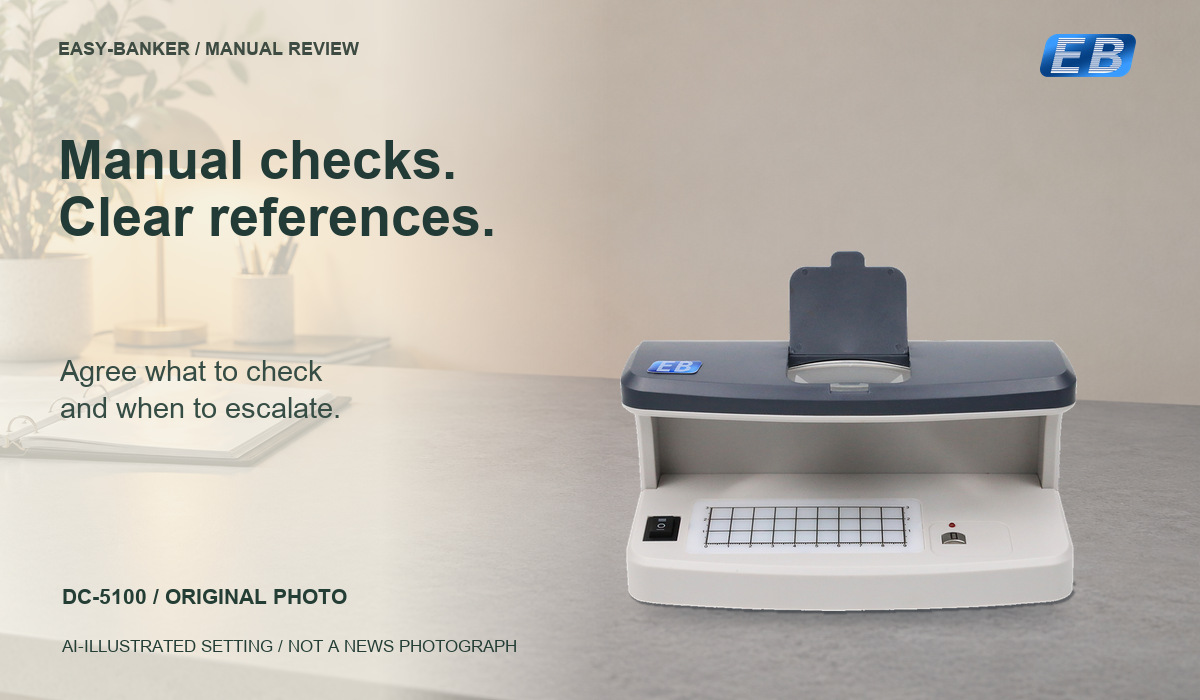
For full sorting duties, the BS-2090 currency sorter runs dual 200 dpi CIS cameras in reflected and transmitted visible plus IR light, checks magnetic ink and security threads, separates FIT/UNFIT notes, flags tears, tape and doubles, detects washed notes and can capture serial numbers to a memory card or optional printer. At the till itself, the DC-5100 UV/magnifier detector gives cashiers a fast manual second opinion on any note design they do not recognise. All models are factory-direct with OEM/ODM support, and profile and firmware support is handled through the same engineering team that builds the machines.
FAQ
Q: Do new banknote series make old counting machines obsolete?
A: Usually not. Most machines keep working after a profile/firmware update that teaches the existing sensors the new signatures. Hardware replacement is only needed when the detection stack itself (e.g. adding image analysis) is insufficient for the risk level required.
Q: How long do old and new series coexist?
A: It varies by central bank, but withdrawals are deliberately gradual — often several years from first issue to full demonetisation — so equipment must support both designs simultaneously for the whole transition.
Q: Can a counterfeit detector from last year read this year's notes?
A: A basic UV/magnetic detector still shows the physical security features, but its reference expectations may need updating, and image-analysis devices need new templates to judge value-side authenticity reliably.
Q: What should a distributor ask its supplier before tender season?
A: The currency profile list, the update cadence and pricing, the field-update method, and whether the machine supports old-plus-new series of each currency at the same time.
Sources
European Central Bank, "Banknotes" overview page (circulation figures, future banknote programme, digital euro alongside cash), ecb.europa.eu/euro/banknotes, accessed 26 October 2026. Bank of England, "Banknotes" hub (4.98 billion notes / ≈£91.5 billion in circulation, wildlife-themed next series, De La Rue printing, Banknote Checking Scheme), bankofengland.co.uk/banknotes, accessed 26 October 2026. Machine specifications quoted from the respective Easy-Banker product pages.
If you supply or operate cash-handling equipment and want the profile roadmap, demo units and OEM terms for the LD-1500, LD-2700G, BS-2090 or DC-5100, contact Easy-Banker — we will match the configuration to the currencies and series your customers actually process.