The Self-Service Branch Reset: What the 2026 Cash Recycling Wave Means for Bank Equipment Buyers
The Self-Service Branch Reset: What the 2026 Cash Recycling Wave Means for Bank Equipment Buyers
Cash is not disappearing — it is relocating. As branch footprints shrink, the cash work that used to sit behind the counter is moving into machines: recyclers at the lobby, deposit units at the night safe, and a busier back office that has to verify, sort and re-issue every note those machines touch. For banks, credit unions and the distributors who supply them, 2026 has been the year that shift turned from strategy slide into purchase order.
Three Signals from Three Continents
The pattern is visible in the trade press on every market. In the United States, ABA Banking Journal reported in January 2026 ("Recycling the narrative on cash") that branch numbers have declined by roughly 16% over the past decade, pushing more cash transactions onto ATMs and self-service devices — while cash recycling itself is framed as an opportunity for banks rethinking branch operations. The same article notes that Japan had widely deployed cash-recycling ATMs and teller units by the early 2000s, and that in Brazil, where nearly 70% of consumers still use cash for everyday transactions according to the reporting, recyclers keep branches solvent in cash without overstaffing them.
South Asia shows the replacement cycle in raw numbers. India's Business Standard reported on June 5, 2026 that with rising costs, the country's ATM industry is calling for cash-recycler interoperability — and that nearly 95% of replacement orders for ATMs are now for new-age cash recycling machines (CRMs), with recyclers positioned as a "virtual branch network" that lets small businesses deposit surplus cash directly to their accounts after the withdrawal of the Rs 2,000 note.
And in the Caribbean, Diebold Nixdorf announced on March 10, 2026 (PR Newswire) that JN Bank had expanded self-service banking across Jamaica using its cash recyclers, with a stated plan to grow its self-service network to more than 200 ATMs by 2027 while replacing legacy units. Different regions, one common thread: the deposit/withdrawal transaction is being handed to a machine that recycles notes back into circulation.
Why a Recycler Is Really a Verification Problem
A cash recycler dispenses deposited notes to the next customer. That single design decision changes the quality burden downstream:
- Every returned note re-enters circulation. If the machine's accept/reject decision is loose, taped, washed or heavily soiled notes come back out at the customer. Central banks increasingly notice; fitness standards and complaint thresholds apply to the recycler operator just as they do to the cash centre.
- Denomination and counterfit checks happen at lobby speed. There is no teller double-count. The machine's own sensor suite — magnetic, optical, imaging — has to do the job, and its reject pocket fills faster than staff expect.
- The back office inherits the exceptions. Rejects, suspect notes and serial-number follow-up all land on the cash office bench. Banks that scale self-service without scaling verification simply move the bottleneck behind the wall.
The practical consequence for procurement: a recycler programme should be planned together with note-verification and coin-handling capacity, not as a stand-alone ATM line item. That is exactly what the interoperability debate in India implies — machines that speak common protocols are useful only if the note data they capture (serials, fitness results, denomination records) can flow to your cash management system.
The Verification Layer: What a Branch Cash Office Needs
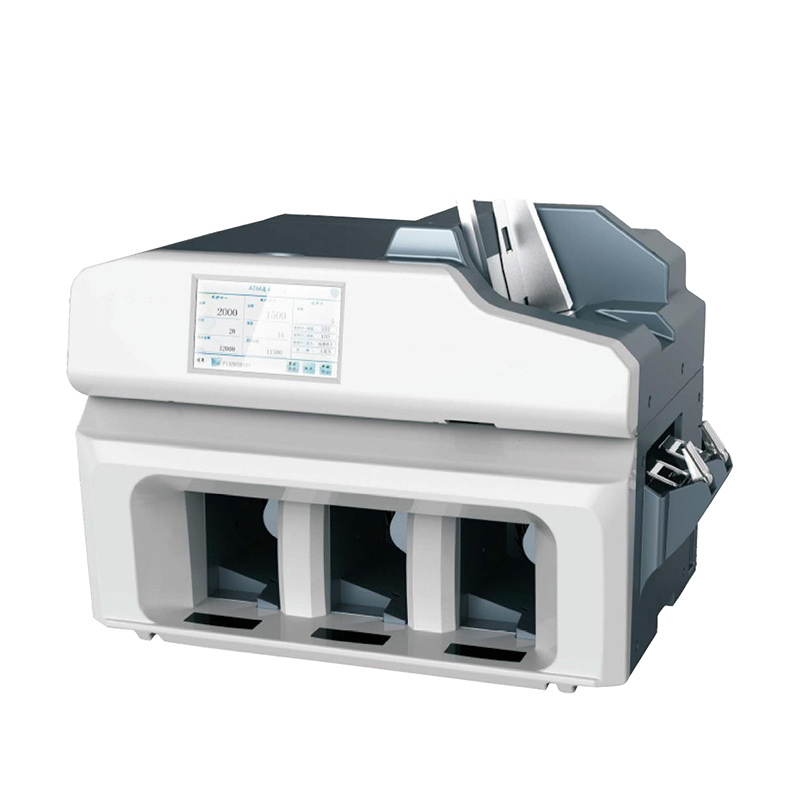
For branch and regional cash centres handling recycler rejects, straps and mixed deposits, a compact multi-pocket sorter covers most of the workload. Easy-Banker's BS-631 banknote sorter is built for precisely this bench: 3 output stackers plus 1 reject pocket (3×100-note capacity, extendable to 200 notes per stacker by software), a feeder holding up to 1,000 banknotes, and magnetic sensing that analyses both strong and weak magnetic patterns plus the metal security thread. It captures note serial numbers to the memory card with optional printing — useful when a central bank or CIT partner asks for traceability — and reports through RS232, USB 2.0 and Ethernet, the same interface set that cash-management software expects. The 640×240 colour touchscreen keeps setup simple for shift staff. At 650×420×450 mm and 42 kg it sits on a normal reinforced counter; it processes USD, EUR, GBP, CNY, JPY, KRW, RUB, INR, IDR, TWD, HKD and other currency profiles for multi-currency markets.
Where volumes are larger or fitness grading stricter, our 11-pocket BS-2090 currency sorter adds dual-CIS imaging for the fit/unfit decision — the same question your recycler is making at the lobby, answered with evidence.
Don't Forget the Coin Channel
Self-service branches that recycle notes usually still receive coin in mixed tubs, and coin is where back-office time quietly disappears. Two bench units cover most branch and CIT deposit needs:
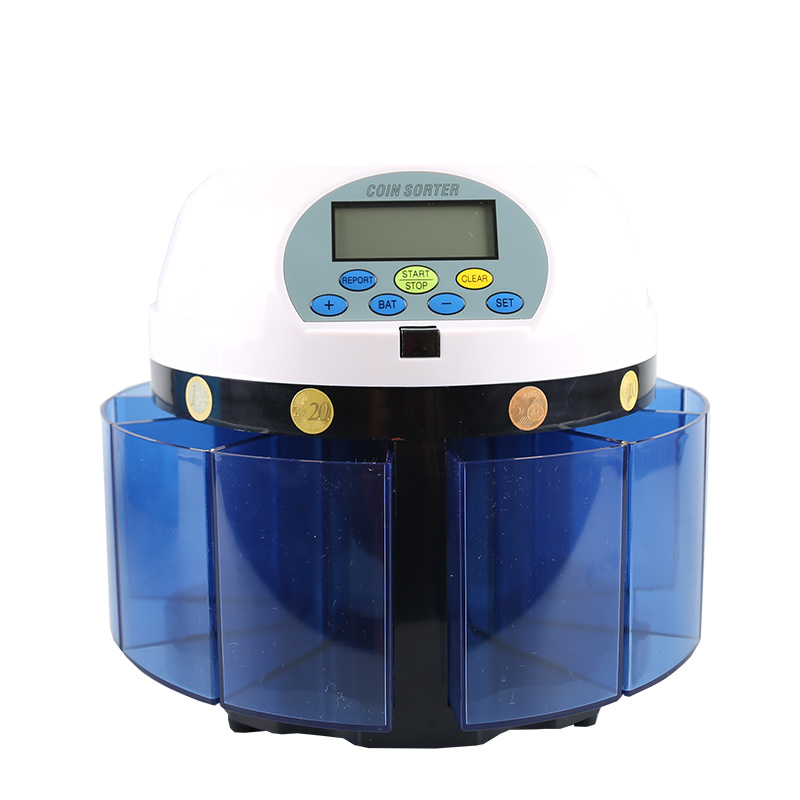
- CS-6500 coin sorter counts and sorts mixed coins into separate tubes by denomination, shows value and quantity on an LCD, takes a 350–1,000-coin hopper load, and runs on AC220V/50Hz or AC110V/60Hz at 45 W in a 302×278×258 mm desktop footprint (net weight 5 kg).
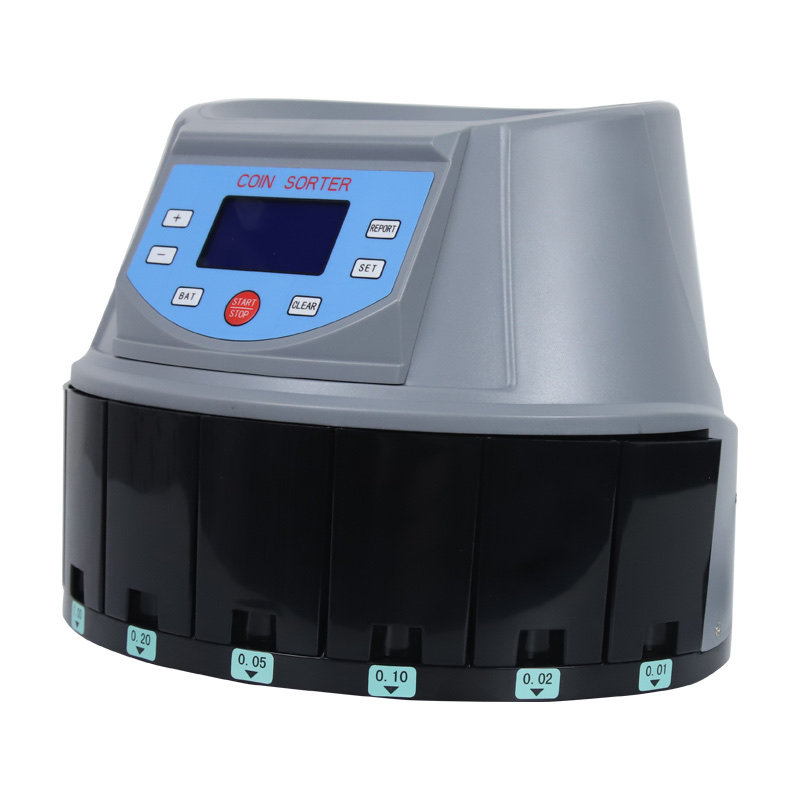
- CS-5505 coin counting machine serves smaller-count markets with a 500–700 coin hopper, LCD reporting, 317×347×273 mm bench size and 4.3 kg weight — the same 45 W dual-voltage power design.
A 2026 Procurement Checklist for Self-Service Rollouts
If you are specifying equipment alongside a recycler or virtual-teller deployment, we suggest the following questions on every tender:
- Interoperability and interfaces. RS232/USB/Ethernet on the verification devices, and an answer to where serial-number and fitness records go after capture.
- Currency profiles. Confirm every note you handle is on the machine's profile list — including new series and polymer issues being phased in this year.
- Reject-pocket economics. Size stacker capacity (100 vs extendable 200 notes) against real recycler reject rates, not catalogue averages.
- Traceability. Serial capture to memory card or printer matters for central-bank queries, counterfeit disputes and CIT chain-of-custody.
- Fitness grading. If your regulator grades fit/unfit, image-based sorting beats manual inspection at cash-centre volume.
- Coin, explicitly. Mixed-coin deposit is the step most recycler rollouts forget to resource on the back-office bench.
- Service and spares. A branch line only works if feeders, belts and sensors are replaceable locally — ask your supplier about spare-parts stocking before the first failure.
Outlook
The 2026 signal is consistent: recyclers are becoming the default cash machine, self-service networks are absorbing branch volume, and the verification layer — note sorters, detectors, coin benches — is what makes those networks safe to operate. Buyers who treat the lobby machine and the back-office bench as one system will keep complaint rates, buy/sell positions and staff hours under control. Distributors who sell them together will find the tender conversations far easier.
Easy-Banker manufactures banknote sorters, counters, detectors and coin handling equipment for banks, CIT companies and cash centres. Contact our engineering team for multi-currency test samples, OEM options and distributor pricing.