
The 140th China Import and Export Fair — the Canton Fair — opened in Guangzhou on 15 October 2026 and runs in three phases through 4 November. This is the fair's 70th anniversary session, and it is a big one: a total exhibition area of 1.55 million square metres, more than 32,000 participating companies, and roughly 340,000 overseas buyers expected on site. If you distribute cash handling equipment — banknote counters, currency detectors, note sorters, coin equipment, banding machines — the only phase that matters to you is Phase 1.
The organisers split the fair by product category, and the split is strict. Phase 1 runs 15–19 October and is built around "advanced manufacturing": machinery, hardware, tools, light and electrical products, electronics and appliances, industrial automation and intelligent manufacturing. More than 12,000 companies exhibit across 520,000 square metres in this phase alone.
Phase 2 (23–27 October) is housewares, gifts, ceramics, furniture and building materials. Phase 3 (31 October – 4 November) is textiles, apparel, toys, office supplies and medical products. Neither carries cash handling machinery. A distributor who lands in Guangzhou during Phase 2 hoping to compare money counters will find nothing but homeware. Book the Phase 1 window, and book the hotel for it — the two-to-three-day changeover gaps between phases are when the halls are stripped and rebuilt.
Venue is the Canton Fair Complex in Pazhou, Guangzhou, with daily opening hours from 09:30 to 18:00. The Ministry of Commerce confirmed more than 210,000 overseas buyers had pre-registered before opening, so the aisles will be dense — plan your booth route the night before, not in the taxi.
Cash handling equipment is not a single pavilion; it is scattered across the machinery, electronics and office-supply sections, which is exactly why unprepared buyers waste a day walking. Expect to find four families of product:
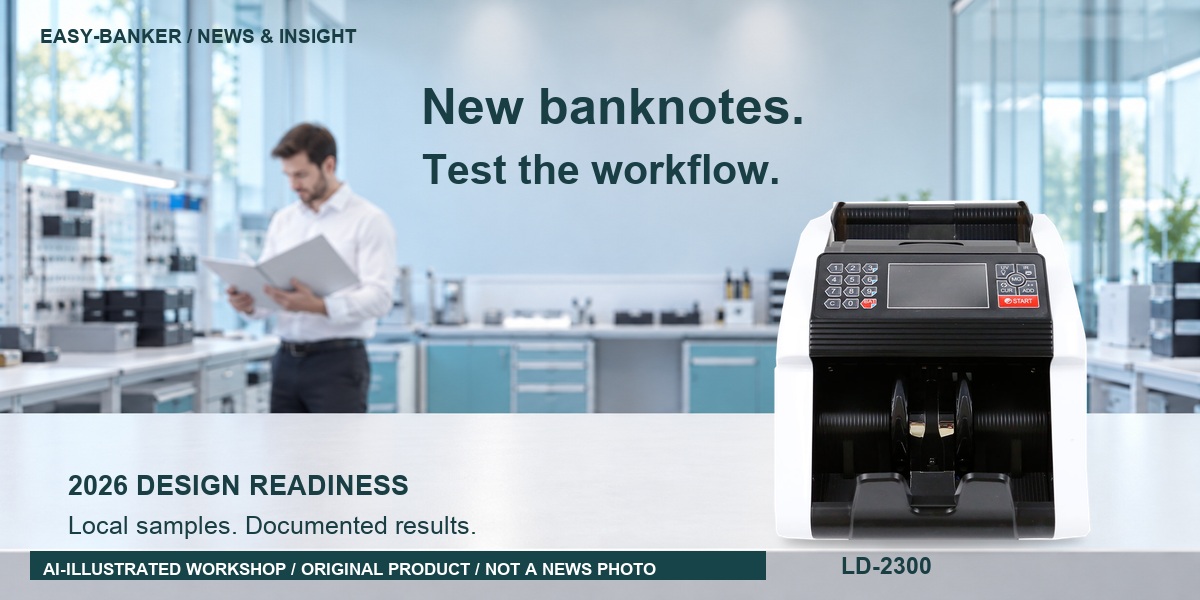
Counting and detection. Front-feeding and back-feeding banknote counters, value counters that add up mixed denominations, and UV/MG/IR counterfeit detectors. This is the deepest and most competitive category at the fair, and where price pressure is heaviest.
Sorting. Small sorters that separate fit from unfit notes, and larger two-pocket machines for bank branches and cash-in-transit operations.
Banding and strapping. Note banding machines that wrap counted bundles with paper tape or OPP tape, and heavier strapping units.
Coin and POS. Coin counters and sorters, cash drawers, and barcode scanners that sit on the same retail counter as the note counter.
At a fair this size, a large share of booths belong to trading companies that will resell your order to an unknown factory. Ten questions, asked in order, sort them quickly:
Write the answers down at the booth. Two days later, three similar quotes blur into one, and the cheapest-looking one is usually the trader.
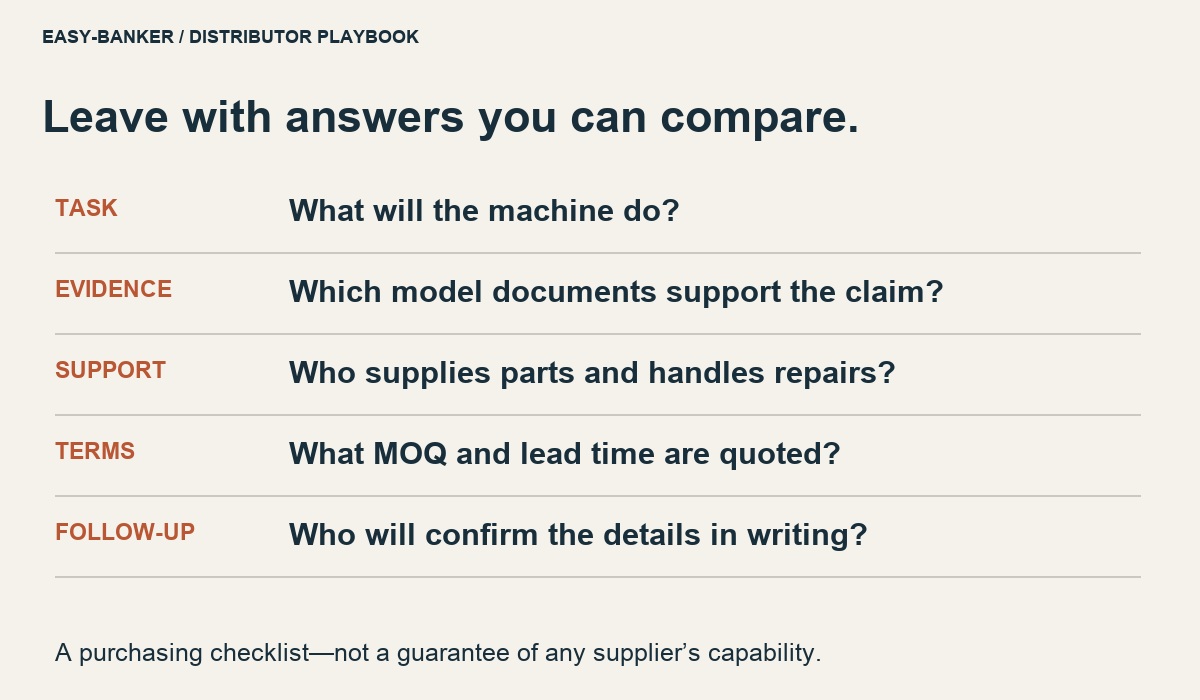
The fastest way to judge a supplier is to compare a printed spec sheet against the machine on the table. Three representative models, with the numbers that should appear on the sheet:
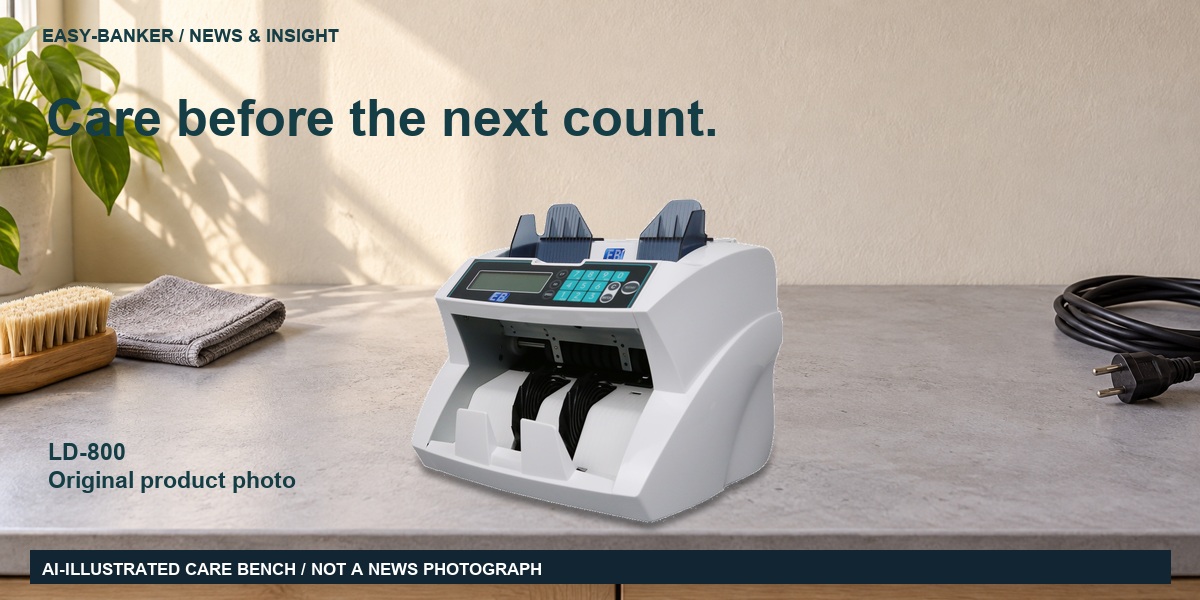
Back-feeding money counter (LD-1000 class). Hopper 130 notes, stacker 130 notes, counting speed 900 notes per minute, power AC 110–220V, consumption ≤80W, countable note size 50×110 to 90×180mm, thickness 0.075–0.15mm, 4-digit TFT count display plus 3-digit batch display, 280×225×160mm, 5kg net. If the booth machine quotes "1,200 notes per minute" on the same 130-note hopper, ask them to run it for two minutes without a jam.
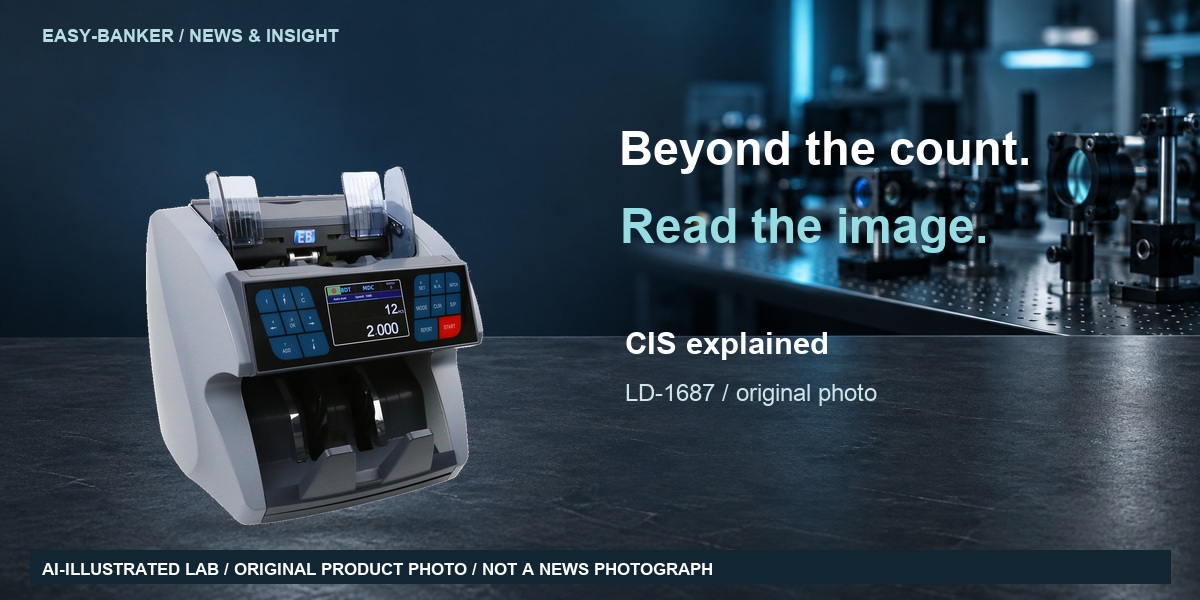
Value counter with MG detection (LD-1100 class). Hopper 100 old bills (100–150 new), speed above 1,000 notes per minute, AC 110–220V, ≤80W, LED count and batch displays, note size 50×110 to 90×180mm, thickness 0.075–0.15mm, 280×222×155mm, 4kg net. Value counting is where counterfeit detection and mixed-denomination addition meet — make them demonstrate a mixed stack, not a single-denomination one.
Automatic banding machine (JB-209 class). Tape 20/30/40mm width or OPP tape with a 50mm scroll inner hole, binding speed 23–26 strokes per minute, 220V/50Hz or 110V/60Hz, 37×31.5×38cm, 19kg net. Ask for the tape-length and sticking-time adjustment range — that is where cheap banders fail on local tape supplies.
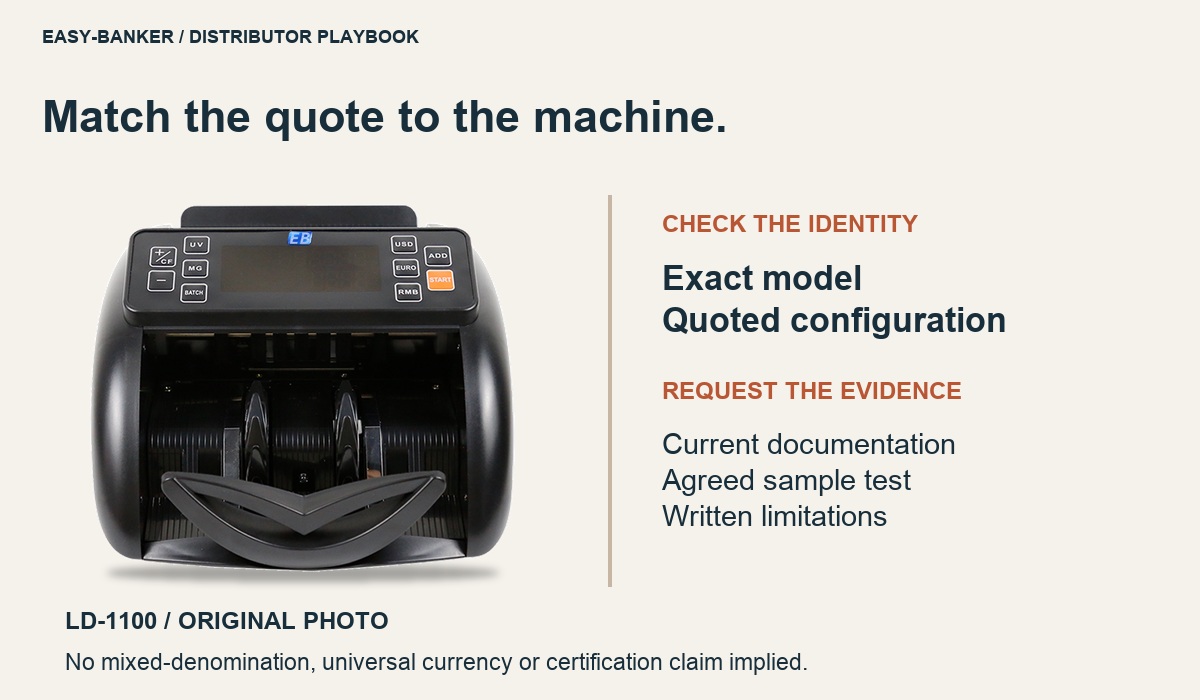
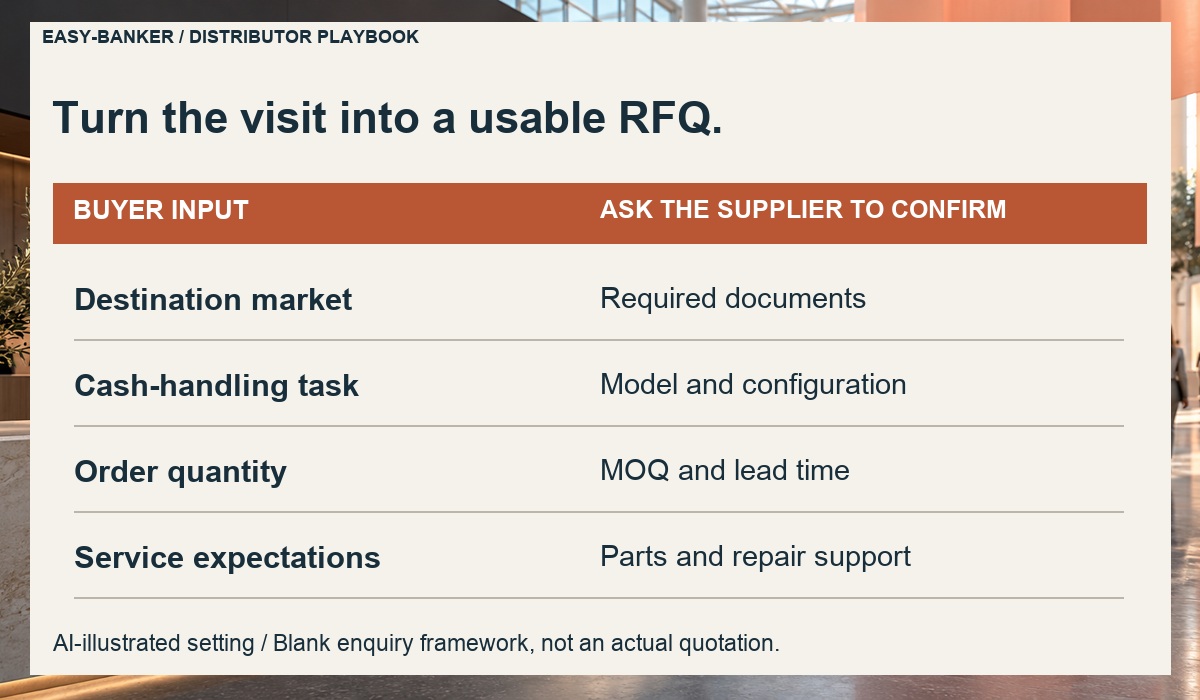
Three numbers decide whether a fair contact becomes a supplier: MOQ, OEM terms, and lead time. Ask for all three in writing on the quotation, not in conversation. A distributor's first order is usually a mixed container — two or three counter models, one banding machine, a batch of detectors. Confirm that the factory will mix models in one container, what the per-model minimum is, and whether the carton dimensions and quantities are quoted so you can calculate container loading yourself.
Also ask what happens after the sale. Machines that are cheap to buy and impossible to repair destroy a distributor's margin and reputation in one season. The supplier who can name their consumable parts and ship them within a week is worth a higher unit price.
Phase 1 closes on 19 October, but the sourcing calendar does not. Money20/20 USA runs 18–21 October at The Venetian in Las Vegas, where cash automation sits alongside payments and banking technology. HSP Asia follows in Hong Kong from 30 November to 2 December. For distributors who cannot travel, the practical substitute is a factory-direct conversation with a documented spec sheet and a video of the line — the same ten questions, asked by email, with the same insistence on written answers.
If you are building a cash handling range for your market, start with the models you will sell most: a back-feeding counter for volume counting (see the LD-1000 money counter), a value counter with MG detection for mixed-denomination and detection work, and a JB-209 automatic banding machine to finish the bundle. Easy-Banker manufactures all three and supplies them factory-direct with OEM/ODM support. Send us your target market and required certifications, and we will return a quotation with real specifications, MOQ, and lead time — the same numbers you would demand at the booth.
Contact the Easy-Banker export team for a factory-direct quotation on banknote counters, currency detectors, sorters, banding machines and coin equipment.