How CIS Sensors Turn a Money Counter into a Reading Machine
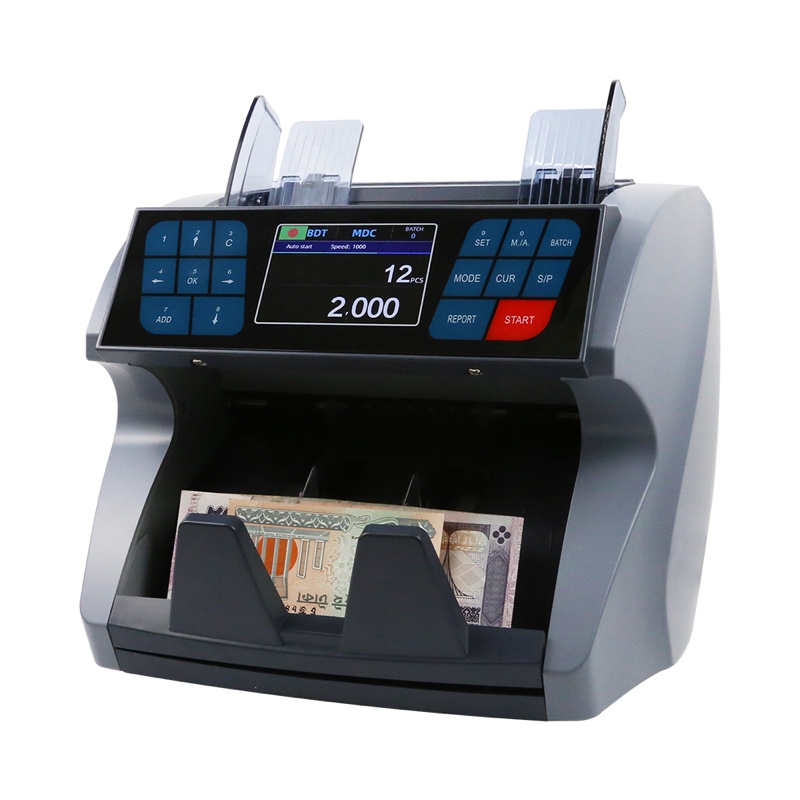
Money counters used to answer one question: how many. The machines selling best in 2026 answer a harder one - what is written on every single note, which side it came from, and whether the note is fit to re-enter circulation. The component that turned a counting machine into a reading machine is the CIS sensor. This guide explains how contact image sensors work inside banknote counters and sorters, what "1 CIS vs 2 CIS" actually changes at the teller line and in the cash room, and how distributors should stock for the serial-capture rules now spreading across Asia and Europe.
What a Contact Image Sensor Actually Is
Inside every modern money counter that claims to "read" a banknote rather than merely tick it, there is a strip of glass no wider than the note itself. That is the CIS - a contact image sensor: a row of colour LEDs, a lens array and a line of photodiodes packed into one slim bar. When a banknote passes over it at speed, the sensor captures one horizontal slice of the note per microsecond, and the slices are stitched into a full digital image before the note reaches the stacker. No camera, no moving optics - just a light line and a note flying across it.
Once the note exists as an image, software can do what physics alone cannot: recognise the denomination from the printed layout, distinguish series and versions, read the serial number characters through OCR, judge the note's fitness (creases, stains, holes, writing) and cross-check security features that UV or magnetic sensors miss. UV, MG and IR sensors answer "does this note have the right ink?" A CIS answers "what is written on this note, and what shape is it in?"
One CIS or Two: Why the Side-B Image Matters
Manufacturers fit either a single CIS (front side only) or dual CIS modules scanning both sides simultaneously, and the difference is not marketing - it decides what you can legally and operationally record. Serial numbers migrate: on many currencies the pair appears front-and-back, in different positions per series, and polymer issues move features into transparent windows that only a back-side pass sees reliably.
On our line, the entry point is the LD-1910, which uses a single CIS plus UV and MG detection to count and value-sort mixed denominations at 1,000 notes per minute with a 200-note hopper, TFT displays and USB/RS232 output. Step up to the LD-1687 and the image path doubles: two CIS sensors scan both faces, four selectable speeds from 800 up to 1,500 notes per minute, a 300-note hopper and a TFT touch screen. The LD-2700G keeps the 2-CIS engine but widens the workflow for cash rooms - a 500-note hopper, speeds of 800/1,000/1,200 per minute, a 4.3-inch touch screen and note-size coverage up to 185 mm, all on 60 W.
https://www.easy-banker.com/u_file/2610/photo/485cc0e45b.jpg
From Counting to Compliance: Serial Numbers Are Becoming a Legal Record
Two-sensor reading stopped being a luxury when regulators started asking for the note's identity, not just its value. China's People's Bank of China requires commercial banks to record the serial numbers of banknotes processed through branches and cash centres, with each record tied to transaction details - time, operator, terminal and device - long before polymer and fitness rules spread elsewhere. Vendors built entire software stacks around that mandate; the industry case study by Glory describes the challenge of reading serial numbers on up to ten characters without slowing a machine running twelve notes per second.
India moved the same goalpost in October 2026: the RBI's Master Direction on Note Sorting Machines allows only BIS-certified machines from 15 October 2026 and retires obsolete models by 30 June 2027 (we covered the direction and the deadline in our article on the RBI note sorting machine rules). Europe's framework pushes the same data from the other side - the ECB's fitness standards make machine-readable soiling and structural-damage criteria part of deposit eligibility, which is exactly what a dual-CIS sorter grades on.
At the top of the market the pattern is visible in G+D's BPS C6 brochure: full-face scanning of both sides, a high-resolution CIS for denomination, orientation and fitness, and OCR serial-number reading at 1,200 notes per minute. The desktop and mid-range machines now sold by distributors inherit the same architecture in miniature.
What the Image Buys a Cash Room: Fitness, Fraud and the Grey Note
Our BS-2090 sorter shows what the stitched image is used for once it exists: side-B analysis through 2 CIS sensors, fitness sorting into FIT/UNFIT classes, serial-number capture, and a dedicated check for washed banknotes - fraudulently "cleaned" real notes that defeat ink-based detectors because their ink is genuine. It processes at 800/1,000/1,200 notes per minute behind a 4.3-inch touch screen, exports through LAN/RS232/USB, and carries an optional built-in printer for shift reports.
https://www.easy-banker.com/u_file/2610/photo/87ab202052.jpg
Accuracy Is a Budget Question, Not a Spec Sheet Question
A useful frame from the cash-infrastructure trade press: at a cash centre running one million notes per shift, a serial-reading accuracy of 99.99% still leaves about 100 notes unrecorded - so the question for a buyer is never "can it read serials" but "what does the machine do with the note it could not read". Good answers: route it to a reject stacker, flag it in the log, keep the raw image for a human review. Weak answers: silently skip the field. That is why export interfaces matter on small counters - a LD-1687 or LD-1910 with USB/RS232 output hands its records to a terminal, where missing scans become visible rows instead of invisible gaps.
Speed and image quality trade off against each other on every machine: note condition, chain feeds and single-sensor designs all erode OCR confidence. Set the slowest speed your volume allows during onboarding, audit capture rates for a week, then push the throughput up.
How Distributors Should Stock This Wave
- Teller-line: single-CIS value counters (LD-1910 class) for branch counting where denomination and basic authentication cover the task.
- Cash-room: dual-CIS machines with serial capture (LD-1687 / LD-2700G) wherever customers face central-bank recording rules or ECB-destination deposits.
- Sorting-grade: multi-pocket sorters with fitness classification and washed-note logic (BS-2090 class) for cash centres replacing machines retired by the 2027 deadlines.
- Every tier: data export as standard - a machine that cannot hand its log to a system is a compliance liability regardless of sensor count.
Easy-Banker builds the full ladder in-house, from 1-CIS desktop counters to 11-pocket sorters, with OEM/ODM firmware, currency updates and serial-log formats tailored to each market's rules. If your customers are being pushed by a regulation - RBI 2027, PBOC-style recording, ECB fitness - we will match the sensor tier to the obligation, not to the price list.