How to Use a Money Counter: Setup, Counting Modes and Daily Operation
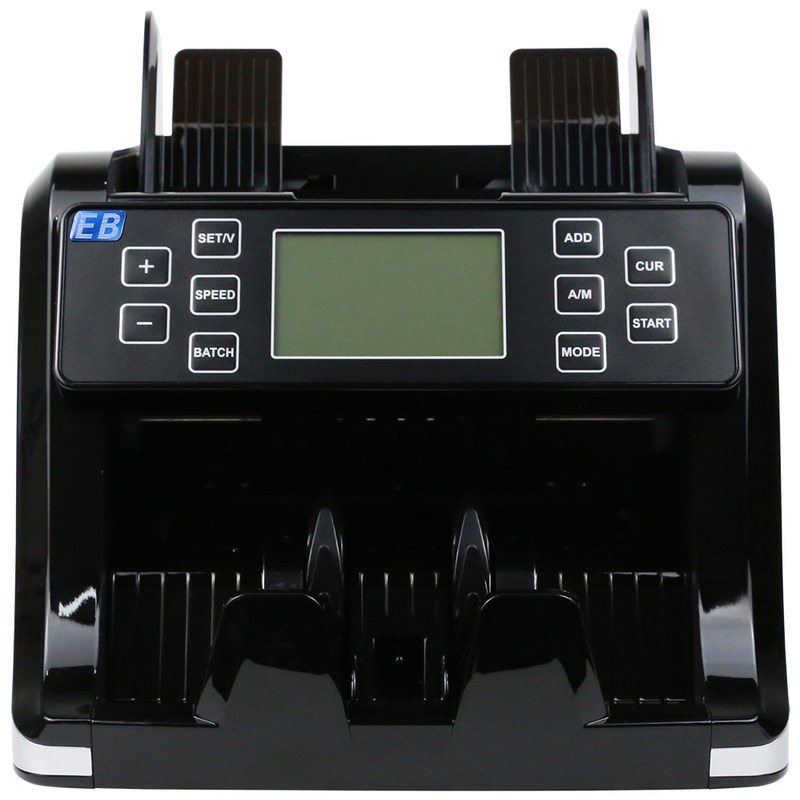
A money counter only protects your cash figures if it is set up and operated correctly. Most counting errors, jams and suspicious-note alarms trace back to a few avoidable habits: poor placement, unprepared banknotes, the wrong counting mode, or a speed setting that does not match the note condition. This guide walks through first-time setup, the counting modes you will actually use, single-denomination versus mixed-value operation, and the daily routine that keeps the machine accurate — with real specifications from four Easy-Banker machines: the LD-800, LD-1500, LD-1910 and LD-2700G.
1. First-Time Setup: Placement and Power
Place the counter on a flat, stable surface with room behind it for the stacker tray. All four machines specify an operating temperature of 0°C–40°C, so keep them away from direct sunlight, heaters and damp storage rooms. Noise stays below 60 dB on these models, which is quiet enough for teller lines and retail back offices.
Check the power range before plugging in. The LD-800 accepts AC 100V–240V, 50–60 Hz, and the LD-1910 accepts 90V–240V, 50–60 Hz, so both run unchanged in North America, Europe, Southeast Asia and most of Africa. The LD-1500 is specified at AC 220V 50/60Hz, and the LD-2700G at 100V–240V. For export buyers, wide-voltage models remove the need for transformers — a practical point when you standardize a fleet across several countries.
On first power-up the machine runs an automatic self-check: the display lights, the transport motor cycles once, and the counter resets to zero. If the display shows an error instead of zero, reseat the power cable and check that no packing material is left inside the hopper.
2. Prepare the Banknotes Before They Enter the Hopper
Feed quality decides count quality. Before loading:
- Remove every rubber band, paper strap, staple and clip.
- Fan the stack lightly to separate notes that stick together — new, tightly bundled notes are the most common cause of double-feed alarms.
- Straighten folded corners and set heavily taped or torn notes aside; run them last or count them manually.
- Load notes against the hopper guide with the stack squared, not dropped in loosely.
Hopper capacity sets your batch size: the LD-800 hopper holds 300 pieces with a 200-piece stacker, the LD-1910 holds 200/200, the LD-1500 holds 100 old bills or 200 new bills, and the LD-2700G takes a 500-piece hopper with a 200-piece stacker — the largest first-load capacity of the four, which matters in cash centres and exchange counters.
3. Counting Modes: Free, Batch and Add
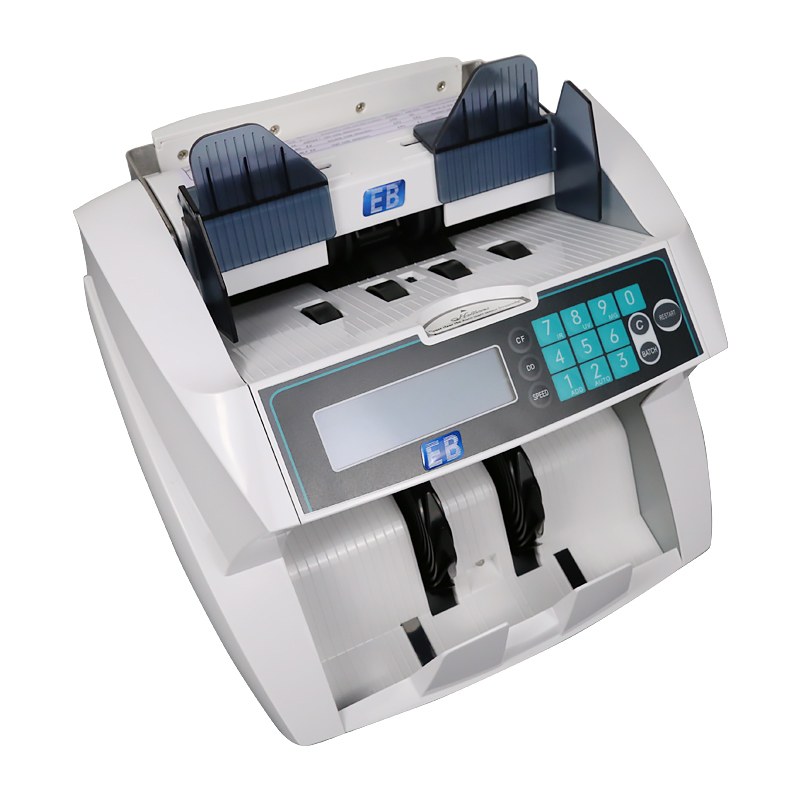
All four machines start, stop and clear automatically — notes trigger the feed sensor, and the display clears when you lift the stack. On top of that, three modes cover nearly every cash task:
- Free counting — the default. Drop in a stack and read the piece count. Use it for till checks and quick verifications.
- Batch (preset) mode — you preset a target quantity, typically 100 for a bundle; the machine counts to that number, then stops and alerts. This is how tellers build uniform bundles for banding. The LD-1500 adds an amount-preset function for target-value counting in cashier operation.
- Add mode — cumulative counting across multiple stacks, up to 999 pieces per session on these models. Use it when a drawer total exceeds one hopper load.
A typical retail close-out: add mode for the whole drawer, then batch mode at 100 to strap the notes, and a final free count of the remainder.
4. Piece Counting vs Mixed-Value Counting
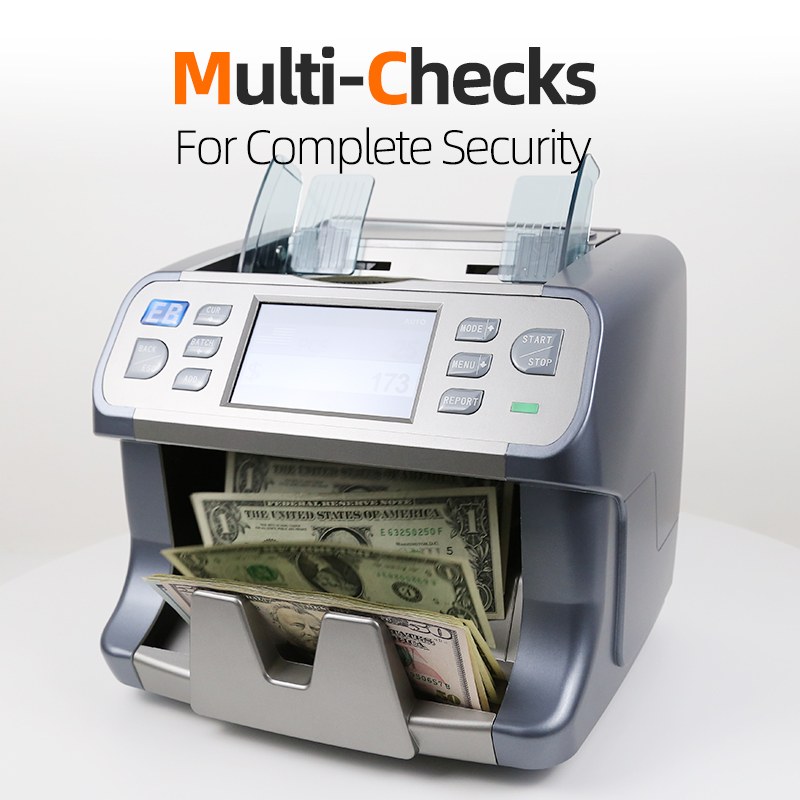
A standard counter reports how many notes passed through, not how much money. The LD-800 and LD-1500 are piece counters: their feature tables mark mix-value counting and denomination/version sorting as not included. If a mixed stack runs through, the LD-1500’s DD detection measures note width against the first note and shows “Width Different” when sizes change — a warning that the stack is mixed, not a value calculation.
The LD-1910 (1 CIS sensor) and LD-2700G (2 CIS sensors) read each note’s image, identify the denomination, and support mix-value counting plus denomination/version sorting — so one unsorted stack produces a total value and a per-denomination breakdown. The LD-2700G also records serial number (SN) codes, with a 4.3-inch TFT touch screen for setup, and counts at 800/1000/1200 pcs/min. If your customers are banks, cash-in-transit firms or currency exchange counters, mixed-value models are the segment to stock; for supermarkets and offices counting a single denomination, a piece counter such as the LD-800 — four speeds, 800/1200/1600/1900 pcs/min — is the cost-effective choice.
5. Speed Selection and Handling Suspicious Notes
Run new, crisp notes at high speed; slow down for worn, soft or dirty notes. On the LD-800, drop from 1900 to 800 pcs/min when counting circulated bills — most feed errors disappear at the lower setting. All four machines check notes for UV and MG properties as they pass, and the LD-1500 adds infrared (IR) detection; half-note, chained-note and double-note detection is automatic on every model.
When a suspicious-note alarm sounds, do not simply re-run the note. Set it aside and verify it on a dedicated detector — a UV/MG lamp unit such as the DC-5100 — because counters flag suspects by machine reading, and final verification needs a second, human-checked pass. Our article on why money counters reject banknotes explains the difference between feed faults and genuine suspect notes.
6. Daily Operation Limits and Basic Care
These machines are rated for more than 30 minutes of continuous working time; in busy locations, give the motor a short break between long sessions and keep the hopper within rated capacity — overfilling causes misfeeds far more often than a slow feed does. At the end of each day, brush dust off the hopper sensors and wipe the transport path with a dry, lint-free cloth; the full routine is in our money counter maintenance guide. For deeper model differences, see mixed-denomination counters explained and the money counter buying guide.
For Distributors: Support and Customization
Easy-Banker is a factory-direct manufacturer of banknote counters, currency detectors and cash handling equipment, supplying distributors, banks and cash-in-transit companies in the USA, Europe, Southeast Asia, South America, Africa and the Middle East. Interfaces include USB and RS232 on the LD-1910 for PC connection, and OEM/ODM customization is available across the range. Contact our sales team for quotations, sample machines and distributor terms.