New Banknote Designs in 2026: What the Redesign Wave Means for Cash Equipment
Why 2026 Is a Busy Year for Banknote Designers
Central banks around the world are rethinking their paper money at an unusual pace in 2026. Bangladesh is replacing an entire banknote series after a national redesign decision, Oman printed its first polymer note, and two island nations issued commemorative polymer notes this year. For distributors of cash handling equipment, each new design is a commercial event: every note that changes in size, colour, substrate or security features creates immediate demand for counting, sorting and detection machines that recognise the new variety.
This article reviews the verified 2026 issues, what changes inside the notes, and what cash centres, banks and retailers in each affected market will need from their equipment.
Bangladesh: A Full Series Under Redesign
After the political change of 2024, Bangladesh Bank began one of the most ambitious banknote programmes in Asia: an entire series titled “Historical and Archaeological Architecture of Bangladesh”, replacing designs that had carried a single portrait since the 2010s.
The rollout has been stepwise. According to bdnews24.com and the Bangladesh Bank press statement, the redesigned 10 taka note entered circulation on 3 February 2026, showing the Baitul Mukarram National Mosque on the front and July 2024 uprising graffiti on the reverse, in a pink scheme with a Royal Bengal Tiger watermark, a windowed security thread that shifts from red to green when tilted, and microtext on both sides. A redesigned 5 taka note (Star Mosque of Dhaka) followed on 19 May 2026, while 20, 50, 100, 500 and 1,000 taka notes with heritage monuments such as the Sixty Dome Mosque and the Shaheed Minar were released through late 2025 and 2026 (release confirmations tracked by The Banknote Book / BanknoteNews).
Two facts matter to cash businesses. First, the central bank confirmed that all old designs remain legal tender and will be replaced gradually — so for several years, Bangladeshi cash will arrive at counters as a genuine mix of two complete series. Second, several 2026 notes carry a new governor's signature variety (confirmed by BanknoteNews in May and June 2026), which is exactly the kind of detail that only machine-readable denomination libraries track reliably.
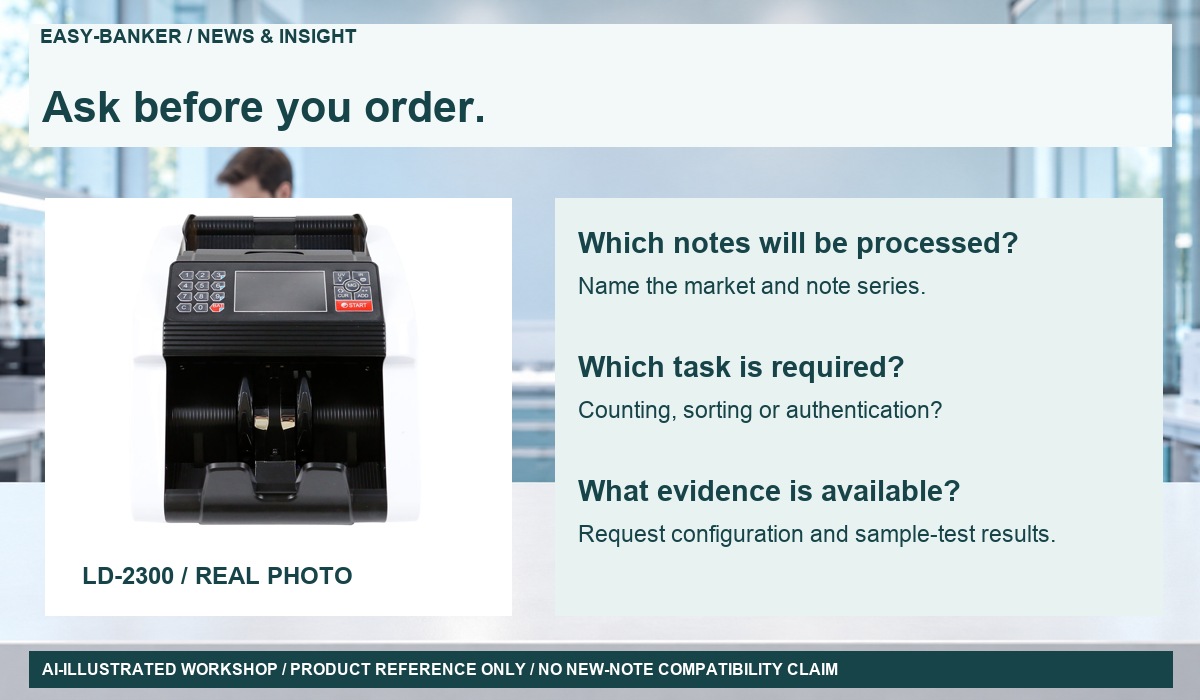
A mixed-vintage circulation is the natural habitat of a mixed-value counter. The Easy-Banker LD-2300 counts at 900 notes/min, accepts note sizes from 50×110 mm to 90×180 mm (the 10 taka's 123×60 mm falls comfortably inside), and its width-different (DD) sensor flags a note that does not match the reference width of the batch — useful when old and new series circulate side by side.
The Polymer Wave Keeps Rolling: Oman, Solomon Islands, São Tomé
Polymer substrate is no longer limited to Australia, Canada and the UK. Three verified 2026 issues show the technology spreading into new regions:
- Oman — first polymer 1 rial (11 January 2026). The Central Bank of Oman issued its first-ever polymer note, a 1 rial (145×76 mm) with a large transparent window inspired by the arches of the Oman Botanic Garden, a colour-shifting frankincense-tree foil and an iridescent logo, circulating alongside the cotton-paper 1 rial (Times of India, Central Bank of Oman statement).
- Solomon Islands — commemorative $50 on polymer (June 2026). The Central Bank of Solomon Islands launched a limited Golden Jubilee $50 note that keeps the size and green palette of the circulating paper $50 but moves to polymer with a transparent window carrying an eagle motif (CBSI Press Release No.16/2026).
- São Tomé and Príncipe — 50 Dobras commemorative polymer (August 2026). Issued for the 50th anniversary of independence and printed by Royal Joh. Ensché (Authentix), the note uses the new PolySecure® substrate from Q&T (Vietnam) with a transparent window containing an iridescent cocoa pod, plus optically variable ink (Authentix, Lanklu Designs numismatic report).
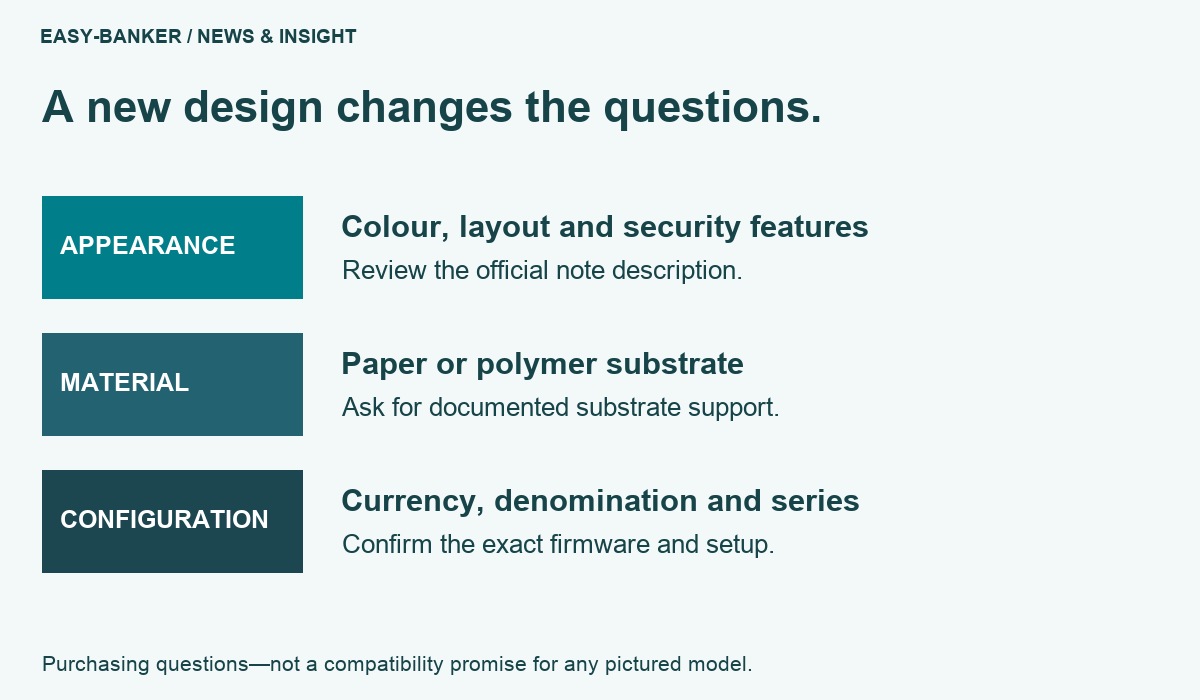
Polymer notes behave differently from cotton-paper notes in three ways that every cash-handling operator should understand: they are thinner and stiffer (which affects double-feed and thickness sensing), they reflect and fluoresce differently under UV lamps (optical brighteners in plastic films are managed differently from paper), and their transparency windows can fool simple light-path sensors designed for opaque paper.
What New Designs Demand From Your Equipment
1. Updated detection libraries. A machine calibrated only to the previous series may reject or mis-sort the new design, or worse, pass a counterfeit that copies the old design while the public has moved on. Distributors should plan firmware and pattern-library updates around each official launch date.
2. Fitness and denomination sorting at scale. During a multi-year coexistence of old and new series — the normal pattern, as in Bangladesh — banks and cash centres must sort by denomination, orientation and series. The Easy-Banker BS-2090 high-speed sorter counts at 800, 1,000 or 1,200 notes/min with dual 200 dpi CIS front and back imaging, UV and MG sensors and thickness-based double detection, and can be configured to separate note series as an image-defined category.
3. Simple counter-level authentication. Not every cash office needs a sorter. Front-line counters still need reliable UV/MG verification of the newer notes, whose colour-shift foils and window devices respond well under 365 nm lamps. The DC-5100 desk detector combines a 365 nm UV field, magnetic-ink sensor and a 5X magnifier for microprint, runs 4 hours on its 1,200 mAh battery or on USB power, and verifies banknotes, passports and ID documents — a practical tool for retailers in markets with freshly issued series.
4. Polymer compatibility as a purchasing checklist item. When sourcing equipment for a market that is migrating to plastic notes, confirm in writing that the counter's feeder, thickness sensor and UV channel are declared for polymer substrates. Easy-Banker's LD-2300 and value counters are specified for polymer and paper notes; the countable-thickness window (0.075–0.15 mm on the LD-2300 spec table) should be matched against your local notes' measured thickness before ordering.
Frequently Asked Questions
Q: Do old banknotes stay valid when a central bank releases a redesign?
A: Usually yes. Bangladesh Bank explicitly confirmed that existing notes remain legal tender while the new “Historical and Archaeological Architecture” series circulates, so expect a mixed-vintage cash pool for years.
Q: Will my paper-only money counter damage polymer notes?
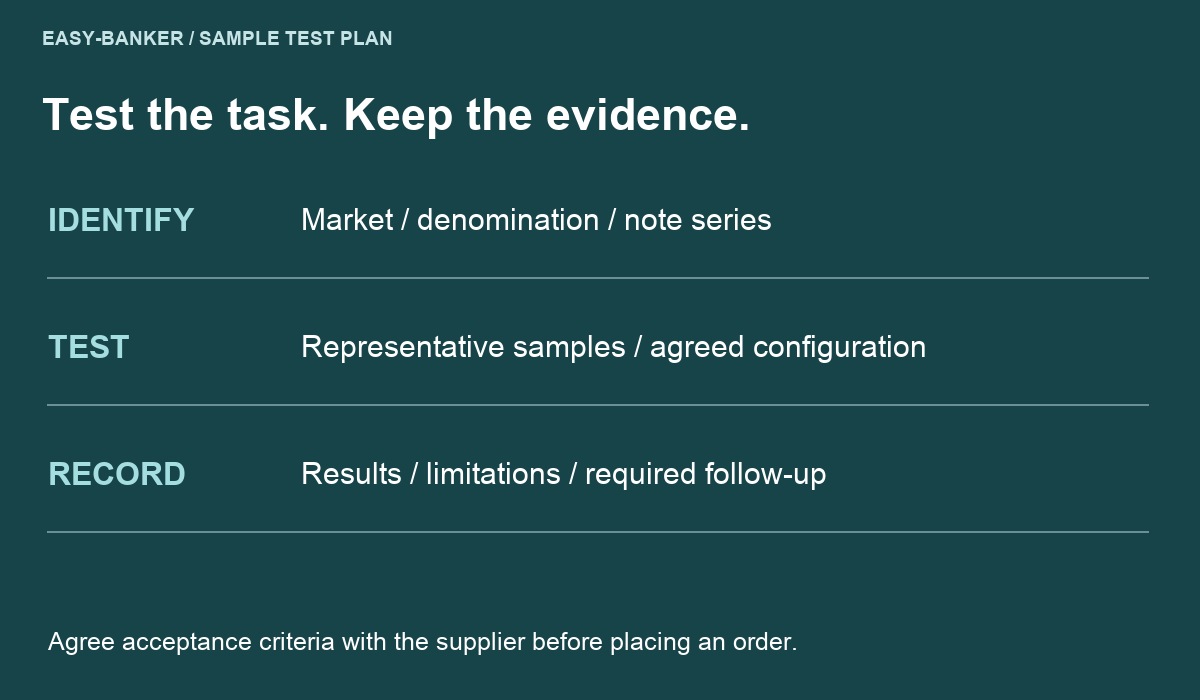
A: Modern friction-feed counters designed for both substrates do not. Older machines tuned only for thick cotton paper may mis-feed or double-detect thin polymer notes; check the manufacturer's declared thickness range (for example, 0.075–0.15 mm on the LD-2300) and request a test with samples of the local new notes.
Q: Which 2026 notes are polymer?
A: Verified examples include Oman's 1 rial (11 Jan 2026), the Solomon Islands commemorative $50 (Jun 2026), São Tomé's 50 Dobras commemorative (Aug 2026), plus India's approved field trial of 1 billion each of the ₹10 and ₹20 polymer notes.
Q: Can machines be updated for a new series?
A: Yes — sorting logic and detection thresholds are configurable on our counters and sorters. Tell us the market and the note denominations involved and our engineering team will confirm library support before shipment (OEM/ODM available).
Bottom Line
Every banknote redesign is a refresh cycle for cash equipment demand. Distributors who track issue dates — and who stock polymer-ready counters, series-aware sorters and simple UV/MG verifiers — convert central-bank news into purchase orders. Ready to equip your market for the 2026 note wave? Contact Easy-Banker for model recommendations, sample testing and factory-direct quotations.