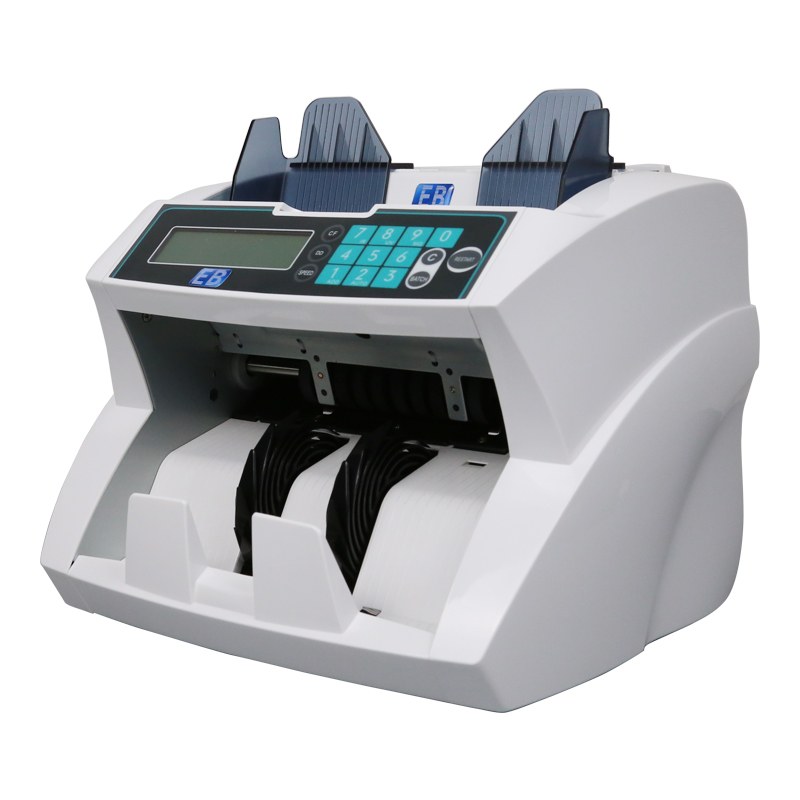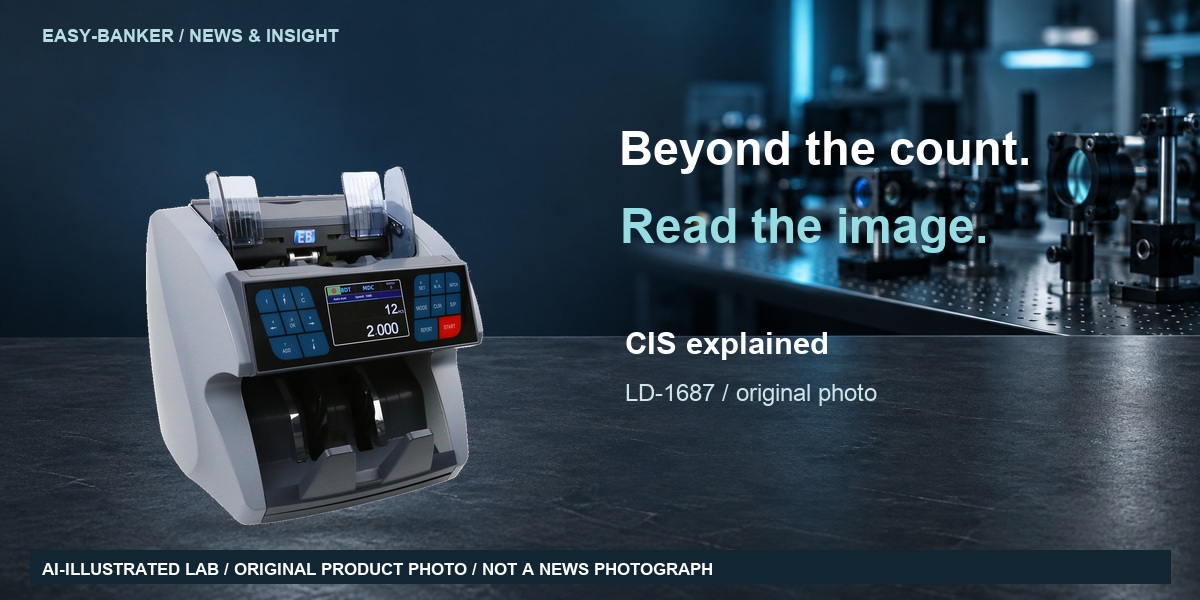

Digital payments keep grabbing headlines, but the world's central banks are quietly printing more banknotes, not fewer. For distributors of cash handling equipment, that is the single most important market signal of the 2026-27 season: every additional note produced has to be counted, authenticated, sorted for fitness and recirculated — by machine. This roundup covers four policy developments from the second half of 2026 and what each one means for banks, cash-in-transit companies and the suppliers who equip them.
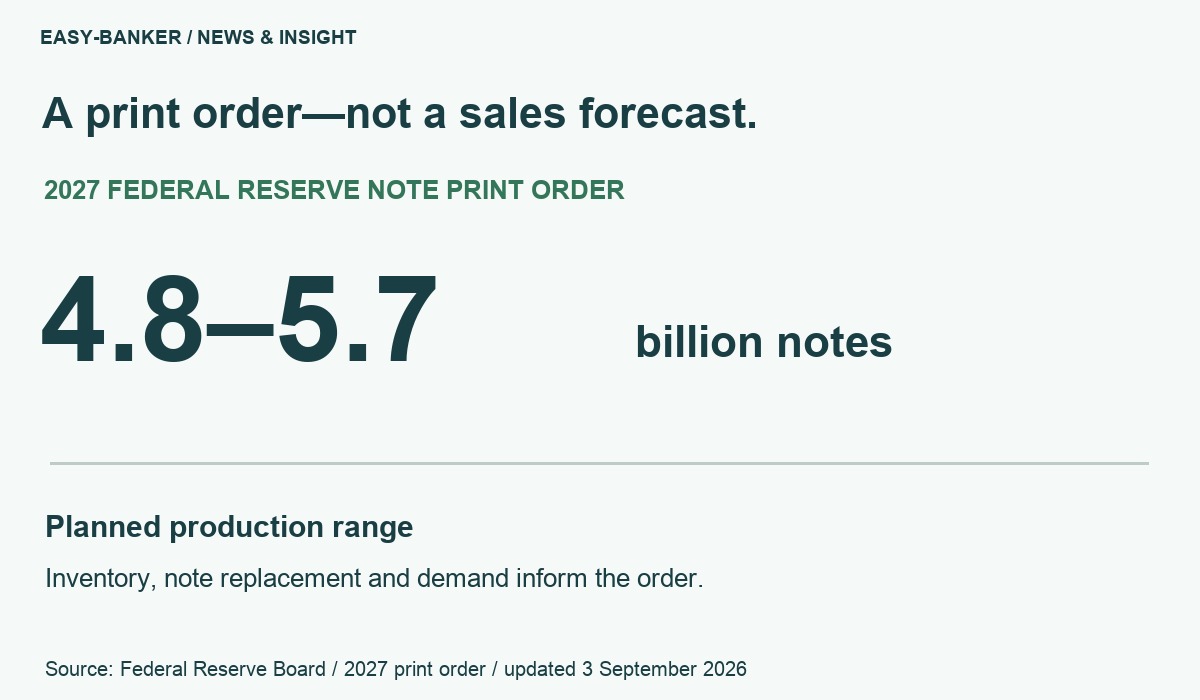
On July 13, 2026, the Federal Reserve Board approved and submitted its calendar-year 2027 print order to the Bureau of Engraving and Printing: 4.8 to 5.7 billion banknotes, valued at $132.1 billion to $166.4 billion. The lower range alone is about 27% higher than the lower range of the 2026 order (3.8-5.1 billion notes). The Board's stated drivers are forecasted currency inventories, the destruction rate of "unfit" notes and demand from both domestic and international customers.
The supporting data point matters even more: currency in circulation rose by 1.1 billion notes (about $73.6 billion in face value) between May 2025 and May 2026 — faster than the previous year's increase of 0.8 billion notes. Cash consumption in the world's largest economy is still accelerating.
Source: Federal Reserve Board, "2027 Federal Reserve Note Print Order," published September 3, 2026 (federalreserve.gov).
The less-discussed change is procedural but operationally significant. The US Currency Program's multiyear modernization of banknote production equipment — started in 2023 — has now rolled out on $1, $2, $5 and $20 denominations: the $5 joined the new equipment in September 2026, following the $20 (June 2025) and the $2 (October 2025).
Notes printed on the new equipment come in non-sequential straps: serial numbers contain gaps, the first note in a strap no longer ends in "01," the last no longer ends in "00," and the new lines no longer produce star notes at all. Until the transition completes, banks and CIT vaults will see both sequential and non-sequential straps mixed in the same cash cycle.
Two practical implications for cash rooms:
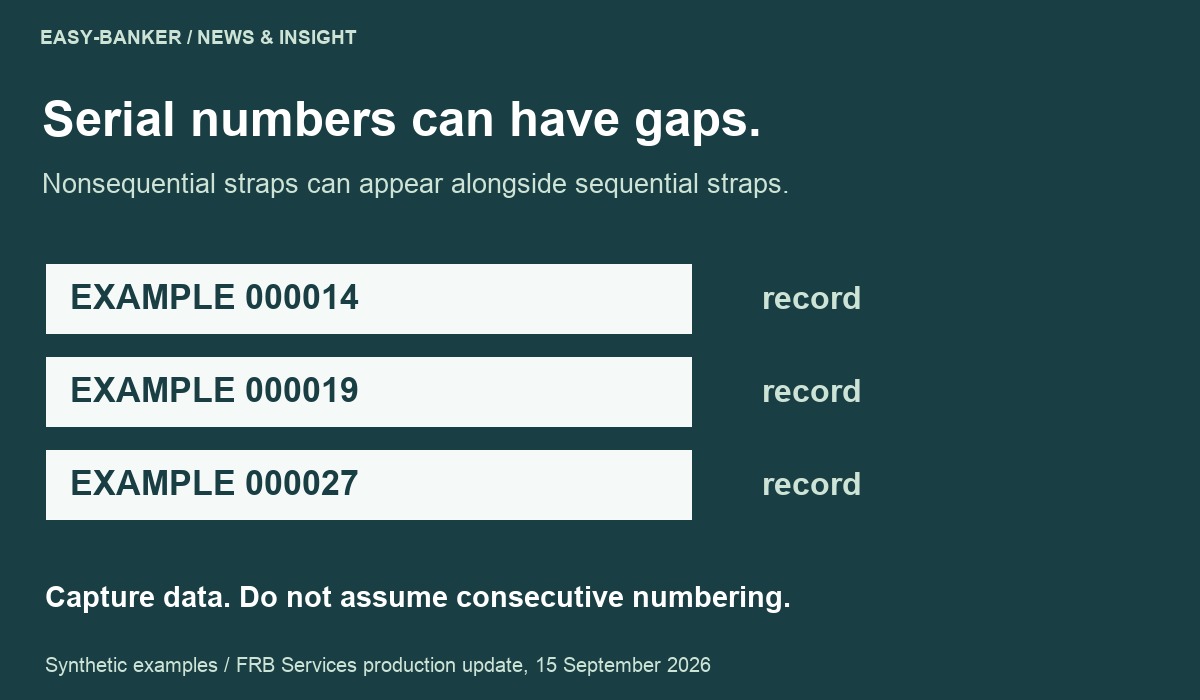
Source: Federal Reserve Financial Services, Fed360, September 15, 2026, and the FedCash Currency Depositing and Ordering production updates (frbservices.org).
The US Federal Reserve's Currency Recirculation Policy charges a cross-shipping fee when an institution deposits fit $10 or $20 notes and then orders the same denomination back within the same week and zone. "Unfit" notes — those that fail the Fed's quality criteria — are destroyed instead of recirculated. In short: fit/quality classification now has a direct price tag, and machines that separate fit from unfit notes protect margin.
Europe is wrestling with the same issue at a specific denomination. In a research note published September 3, 2026 (Passé n°459), the Banque de France reported that despite rapid growth of digital payments, demand for banknotes in France remains strong — but €5 notes are circulating in poor condition even under their protective varnish. The note documents three remedies under consideration: centralising recycling at the Banque de France (a 2025 experiment on stopping external recycling by cash-in-transit firms and banks yielded positive results), an experiment scheduled for 2026 to speed up merchant returns of €5 notes, and increasing €5 availability at ATMs. The study also observed a structural shift from €20 to €50 notes in withdrawals and ATM stocks.
For equipment buyers the lesson is identical on both sides of the Atlantic: currency sorters with fitness (FIT/UNFIT) grading are moving from a bank-core luxury to a branch and retail requirement, because worn-note detection is exactly what central banks will demand proof of.
On July 31, 2026 the Reserve Bank of India directed banks to strengthen how they identify, impound and report Fake Indian Currency Notes (FICNs), after finding some lenders' implementation of existing guidelines "not adequate." The circular restates the core rule — every banknote received by a bank must be machine-examined for authenticity — and adds dated obligations that are now in their final stretch:
Source: ETBFSI, "RBI Mandates Banks to Train Cash Handlers on Fake Currency Detection by October 2026," July 31, 2026, reporting the RBI circular.
This is the clearest demand signal of the four: hundreds of branches must acquire UV/MG/IR detection capability and training-grade counterfeiting kits before the October 31 deadline — and, per our sensor explainer on UV, MG, IR and CIS detection, machine authentication is the only feature set that satisfies an audit trail.
Four regions, four policies, one conclusion: the world is printing, circulating and policing more banknotes than last year. The equipment demand follows predictably —
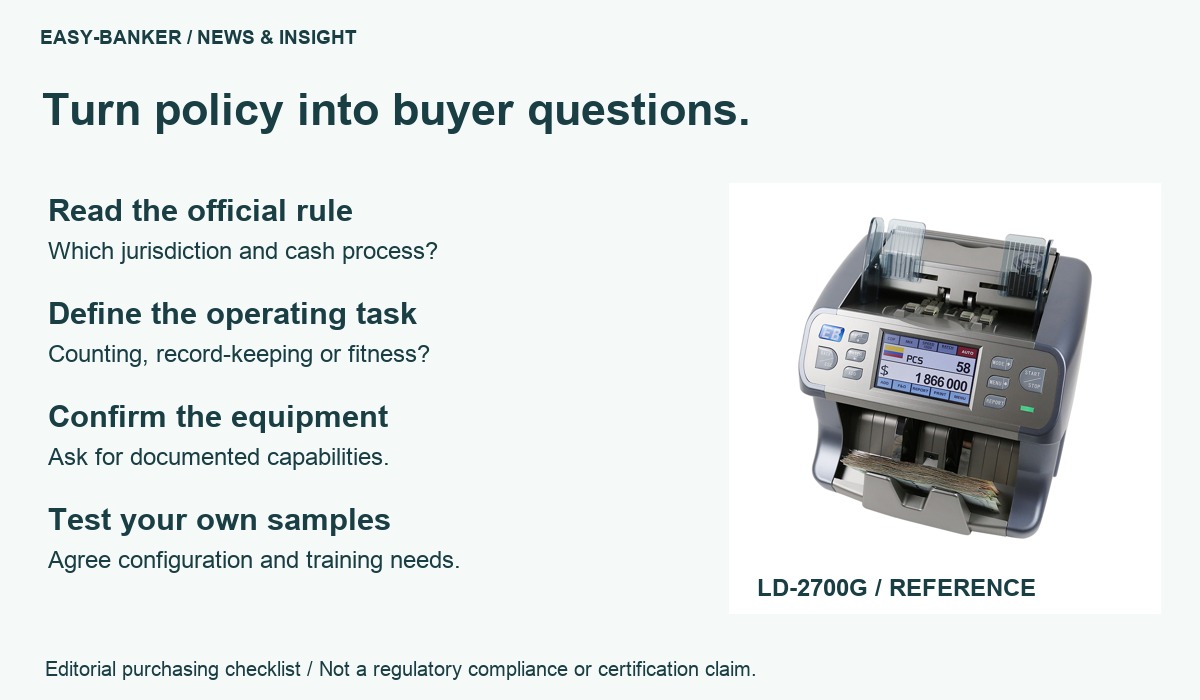
Easy-Banker manufactures banknote counters, multi-currency value sorters, currency detectors and coin handling machines with OEM/ODM customization for distributors and tender channels. Ask for our 2026-27 compliance-oriented product list and lead times — the machines that pass an audit are the machines that sell.