
What does the Diebold Nixdorf–Euronet ATM deal mean for banks? On 26 October 2026, Diebold Nixdorf and Euronet Worldwide announced their intent to form a global strategic collaboration that pairs Diebold Nixdorf's cash recycling ATMs and field services with Euronet's Ren processing platform and ATM operations, offered to financial institutions as integrated ATM outsourcing. The short answer for bank cash managers: more of the ATM estate may be run as a managed service, but the notes that feed those recyclers still have to be counted, authenticated, fitness-checked and bundled somewhere — so back-office cash equipment becomes more important, not less.
Source: Diebold Nixdorf and Euronet Announce Intent to Form Global Strategic Collaboration to Transform ATM Networks, PR Newswire (Diebold Nixdorf, 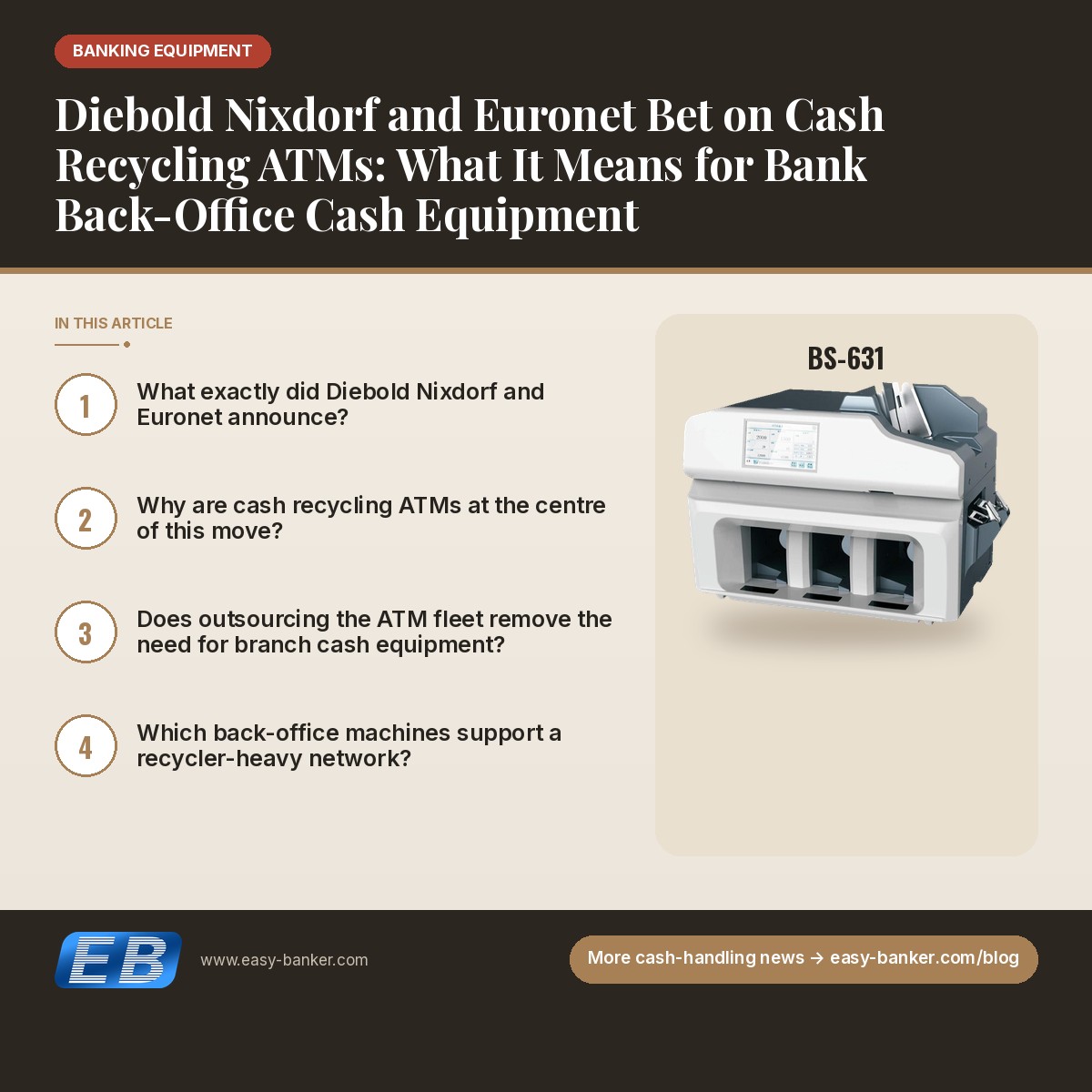 Incorporated), 26 October 2026.
According to the press release, the two companies intend to develop and deliver integrated ATM outsourcing solutions. Diebold Nixdorf contributes cash recycling ATMs, banking software and a global field service organization; Euronet contributes its Ren payments processing platform, the Euronet Back Office (EBO) infrastructure and more than three decades of ATM operations experience. The release lists three focus areas:
It is important to read the fine print: the companies have signed a non-binding letter of intent, and any partnership remains subject to definitive agreements. This is a direction of travel, not yet a finished product.
A cash recycler accepts deposits, authenticates and stores the notes, and then dispenses the same notes to the next customer. Because deposited cash is reused inside the machine, a recycler needs fewer cash-in-transit visits than a dispense-only ATM — which is why the release links recycling to lower replenishment needs. The release also states that Diebold Nixdorf's branch automation solutions let institutions migrate "the vast majority of traditional teller transactions to self-service channels".
Recycling, however, raises the bar on note quality. A note that is dispensed again must be genuine and fit enough to pass through the next customer's wallet, the next deposit slot and the next sensor. Worn, taped or torn notes cause jams and rejects, and each failure undercuts the efficiency case.
No. Outsourcing changes who operates the ATM, not the physics of cash. Banks, cash-in-transit companies and cash centres still have to:
When the ATM side is consolidated under a managed service, the remaining human-handled cash tends to be concentrated in fewer back offices and processing points — so throughput, traceability and consistent quality become the buying criteria.
 Three equipment categories map directly to the tasks above.
1. Fitness sorters for recyclable cash. A sorter that separates fit from unfit notes protects recycler uptime. The Easy-Banker BS-631 four-pocket money sorter has three output pockets plus one reject pocket and sorts in a single pass, valuing, verifying and classifying notes simultaneously. Its product page lists FIT/UNFIT fitness sorting using a 200 dpi CIS (contact image sensor), UV, and full-width mechanical thickness checking for tears, adhesive, tape and doubles; magnetic and IR analysis for authentication; a feeder of up to 1,000 notes; and process speeds of 1,000/800 notes per minute. It can also capture serial numbers, print them or store them on a memory card — useful when a disputed ATM deposit has to be traced.
2. Mixed-value counters for teller and cash-room desks. Not every task needs a floor-standing sorter. The LD-1910 mixed-value money counter counts up to 1,000 notes per minute with 200-note hopper and stacker capacity, offers mix-value counting and denomination/version sorting, and combines 1 CIS with UV and MG detection plus half-note, chained-note and double-note detection. USB and RS232 ports support data output, and the 90–240 V input suits most countries.
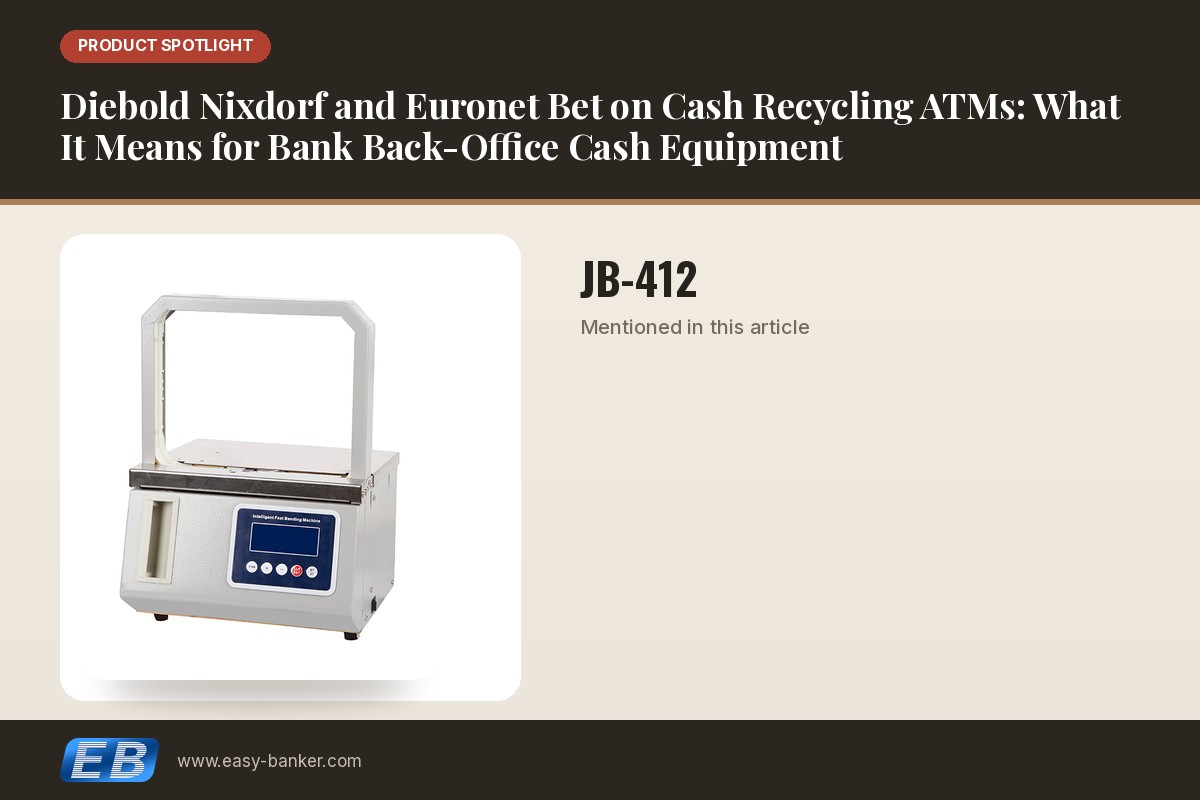
3. Banding machines for deposit-ready bundles. Once counted, cash must be strapped consistently. The JB-412 currency banding machine bands in under 2 seconds per tie, heats instantly, has adjustable tightness, and works with both OPP film tape and hot-melt paper tape, with a binding range from 20×10 mm up to 200×160 mm.
Start with the cash flow, not the machine catalogue. Practical steps:
The announcement fits a broader pattern in which banks treat ATM fleets as shared or managed infrastructure and use recyclers to reduce the cost of keeping cash available. For equipment buyers, the takeaway is balanced: the front-end ATM may increasingly be someone else's asset, but responsibility for the quality and accuracy of the cash behind it remains. Reliable sorting, counting and banding is the foundation that makes a recycler-based network work.
Is the Diebold Nixdorf–Euronet collaboration final?
No. As of the 26 October 2026 release, the companies have entered a non-binding letter of intent; definitive agreements are still to be negotiated.
What is a cash recycling ATM?
A self-service machine that accepts and authenticates deposited notes and re-dispenses them to later customers, reducing replenishment visits.
Why does recycling increase the need for fitness sorting?
Recycled notes go straight back to customers and machines, so unfit or suspect notes must be removed upstream to avoid jams, rejects and complaints.
Can a desktop counter replace a sorter?
For teller-level counting and mixed-value totals, a counter such as the LD-1910 is often enough; for fit/unfit separation across several output pockets, a sorter such as the BS-631 is the better fit.
How can I get specifications or a quotation?
Each product page lists full specifications; contact Easy-Banker through the inquiry button on the page for configuration, currency support and commercial details.