
How do you choose the right counterfeit money detector? Start with how many notes you check and where you check them. If staff verify a few large notes at a counter, a desktop UV and magnetic detector with a magnifier is usually enough. If notes are checked one by one away from a power socket, choose a model with a rechargeable battery. If you count bundles every day, a banknote counter that runs UV, magnetic (MG) and infrared (IR) checks while it counts saves the most time. Then match the detector to the security features of the currencies you actually handle, and train staff to read what the machine shows them.
Modern banknotes carry several layers of security features, and each detection method looks at a different layer. No single check catches every fake, which is why good detectors combine several:
Most buyers choose between three groups of equipment.
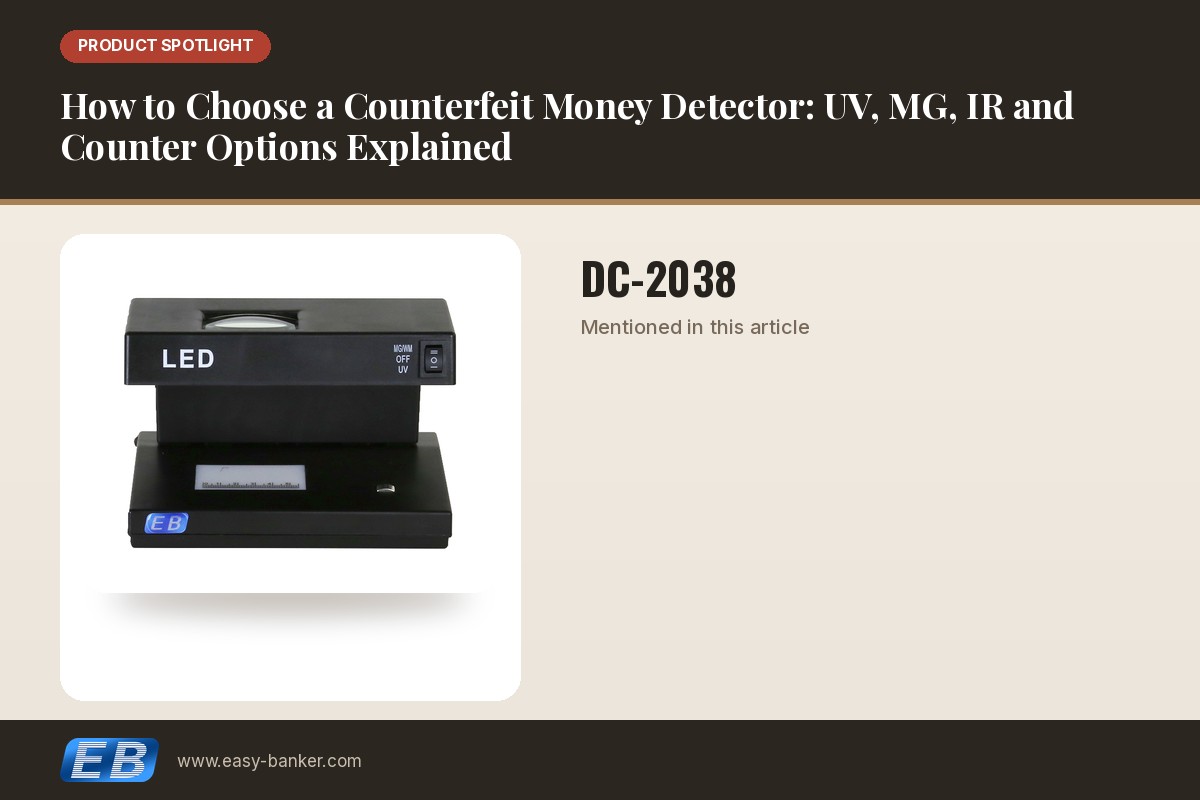
These are the simplest and most common choice for shops, hotels, petrol stations and exchange counters. The cashier places a note under the UV lamp, looks for the expected fluorescent features, and uses the magnetic probe and magnifier for a second opinion. Easy-Banker's DC-2038-LED UV/MG detector is an example: it combines UV LED light, a magnetic sensor and a 5X magnifier, and it can also be used to check credit cards, traveller's cheques, passports and IDs.
Market stalls, delivery drivers, event ticket desks and mobile tellers often have no socket nearby. Here battery life and size matter as much as detection. The DC-5100 UV/MG banknote detector uses a 365nm UV source, a 5X magnifier and a 1200mAh rechargeable battery that gives roughly four hours of use, in a compact 200 × 105 × 105 mm body.
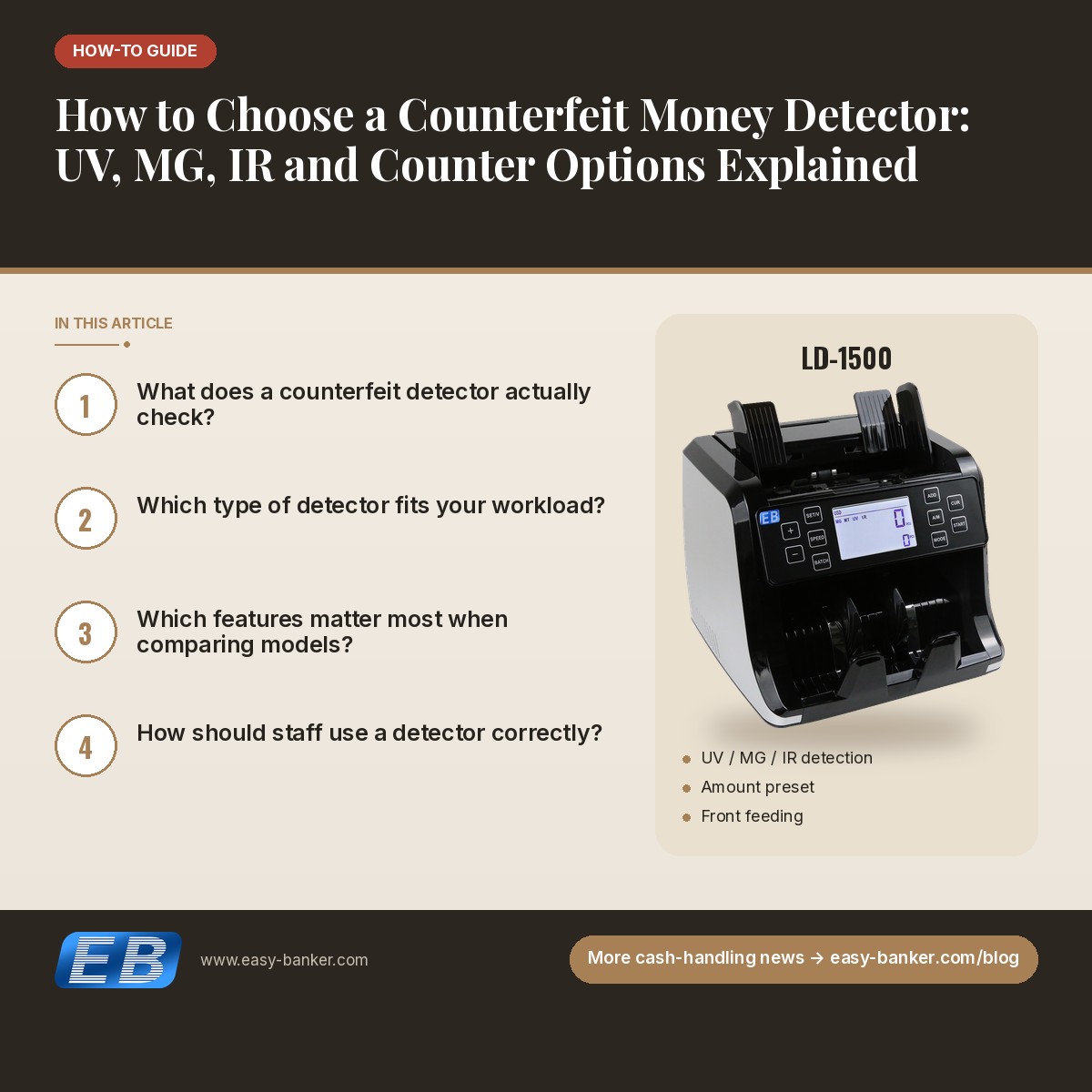
When you handle stacks rather than single notes, checking each note by eye is slow and tiring, and attention drops. A counter with detection checks every note at counting speed and stops when it finds a suspect one. The LD-1500 bill counter counts at more than 1,000 notes per minute while running UV and MG detection, with IR for double-note detection and automatic half-note detection.
Use this short checklist when you compare specification sheets:
A detector is only as good as the routine around it. Keep the UV lamp area out of direct sunlight, because strong ambient light makes fluorescent features harder to see; desktop UV units are designed for normal indoor lighting. Teach staff what a genuine note of each common denomination looks like under UV and magnification, so they notice when something is missing rather than only when something glows. Check high-value notes every time, not just when a note "feels wrong". If a note is flagged, follow your local central bank's guidance on handling suspected counterfeits instead of handing it back to the customer.
A simple rule: if one person checks fewer than a few dozen large notes per shift, a desktop or portable detector is usually the better value. If staff regularly count bundles of 50 or 100 notes, a counter with UV, MG and IR detection pays for itself in time saved and in more consistent checking. Many banks and cash-handling businesses use both: a counter in the back office, and small detectors at each teller or till.
UV catches many fakes printed on ordinary paper, but better counterfeits can pass a UV-only check. Combining UV with magnetic, infrared or magnification checks gives much stronger protection.
Many desktop UV detectors can. For example, the DC-2038-LED is specified for checking credit cards, traveller's cheques, passports and IDs as well as banknotes.
It depends on the model. The LD-1500 counts at more than 1,000 notes per minute while running UV and MG detection.
Check it again manually, compare it with a known genuine note, and follow your local central bank or police guidance for suspected counterfeits.
Need help choosing detection equipment for your currencies and workload? Contact Easy-Banker and tell us how many notes you handle each day.