
Short answer: two central banks are putting refreshed banknotes into circulation this autumn without changing denominations. The Bank of Ghana launches its Heritage Series on 3 November 2026, redesigning all eight cedi notes from GH¢1 to GH¢200, and the National Bank of the Kyrgyz Republic began issuing 2026-dated 20 and 50 som notes on 27 October 2026. In both countries the old notes stay legal tender, so banks, cash centres and retailers will handle two generations of the same denomination side by side. That is the moment when counters and sorters need updated currency data, staff need a quick manual check routine, and buyers should test machines with real samples before they rely on them.
According to the Governor’s statement published by the Bank of Ghana, the upgraded series is called the Heritage Series and carries the theme “The Cedi, Our Future: Secure, Designed to Last.” The bank says its core banknote designs have been in circulation for more than two decades, and that the new notes add enhanced security features, improved durability and designs drawn from Ghanaian heroes, monuments and cultural motifs. The official launch is set for 3 November 2026 at the Bank Square in Accra.
Three details matter most for anyone who counts cash:
The National Bank of the Kyrgyz Republic started circulating 2026-issue 20 and 50 som notes from 27 October 2026, as reported by open.kg. The design, size and colour stay the same as earlier issues, but the notes include modern security features and, for the first time, they were produced inside Kyrgyzstan, at the “Protected Printing House of Central Asia” LLC. The National Bank stresses that notes issued in different years all remain official means of payment and must be accepted.
A same-look note is easy for people to accept, but it can still differ at the sensor level. A new printer and new security features can change how a note responds under UV light, magnetic sensing or image analysis, even when the design looks the same to the eye.
Banknote counters and sorters with authentication rely on stored reference data for each currency, denomination and series. When a central bank issues a new series or a new issue year, the machine has to recognise both the old and the new version of the same denomination. If its data has not been updated, a genuine new note may be rejected as suspect, and in mixed-value counting it may not be valued correctly. Neither failure is dramatic, but both slow the counter down and erode staff trust in the machine during the first weeks of a rollout.
Co-circulation makes this a lasting issue rather than a one-day event. Ghana’s old and new notes will be mixed in deposits for as long as the old notes keep circulating, so any machine in a Ghanaian branch or cash office needs to handle both generations in the same batch.
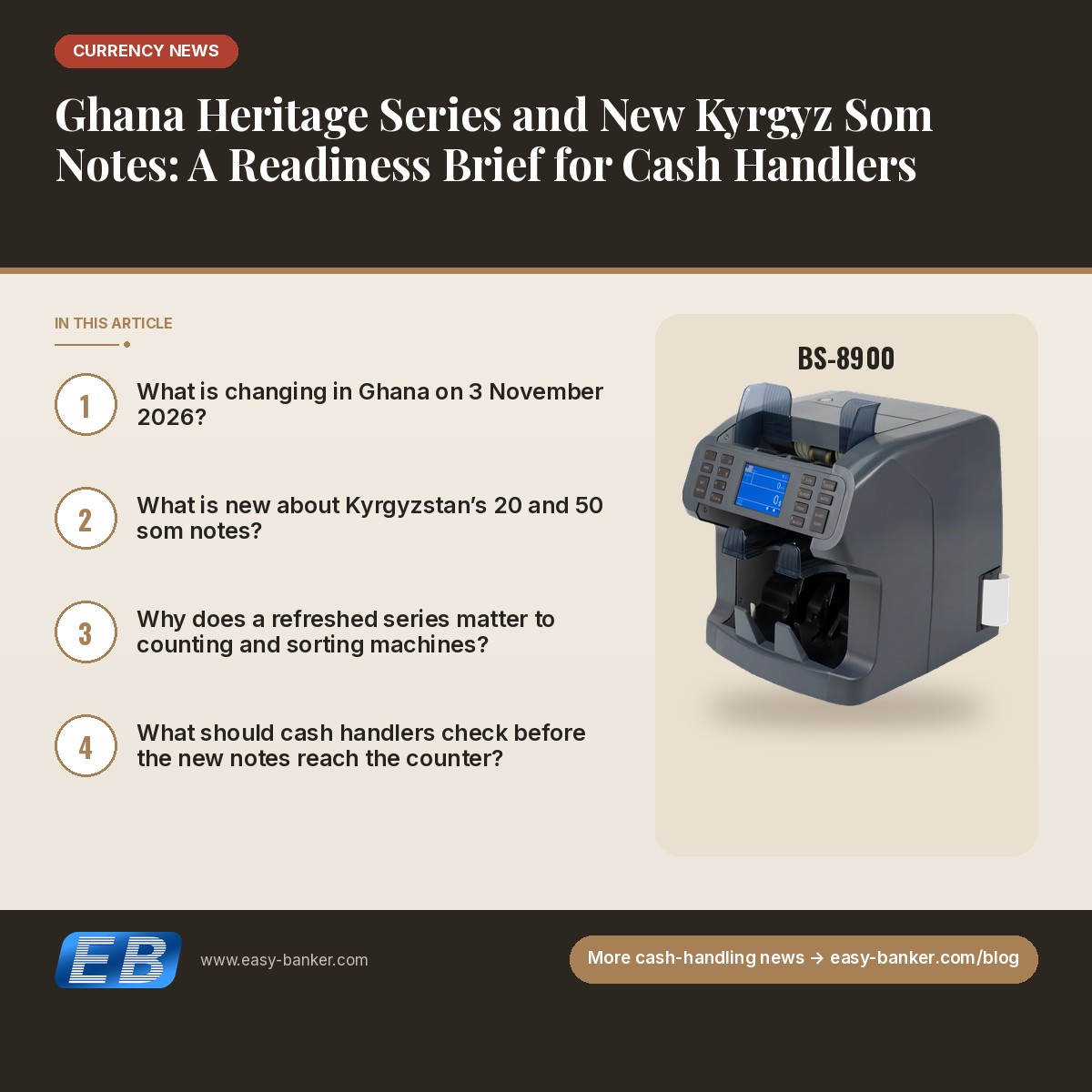
For back-office sorting, the BS-8900 2-pocket currency sorter authenticates, values and sorts notes by denomination, orientation and facing using optical, IR, UV and magnetic sensors. It adds FIT/UNFIT fitness sorting based on a 200 dpi contact image sensor, washed-note checking and tear, tape and double-note detection, runs at 800, 1,000 or 1,200 notes per minute, and has a built-in printer and a 3.5-inch TFT touch screen.
At the teller window, the LD-1910 mixed value money counter combines one CIS sensor with UV and MG detection, mixed-value counting with denomination and version sorting, batch and add functions, and automatic half-note, chained-note and double-note detection at 1,000 notes per minute. Its USB and RS232 ports are the kind of interface you should ask about when planning currency updates.
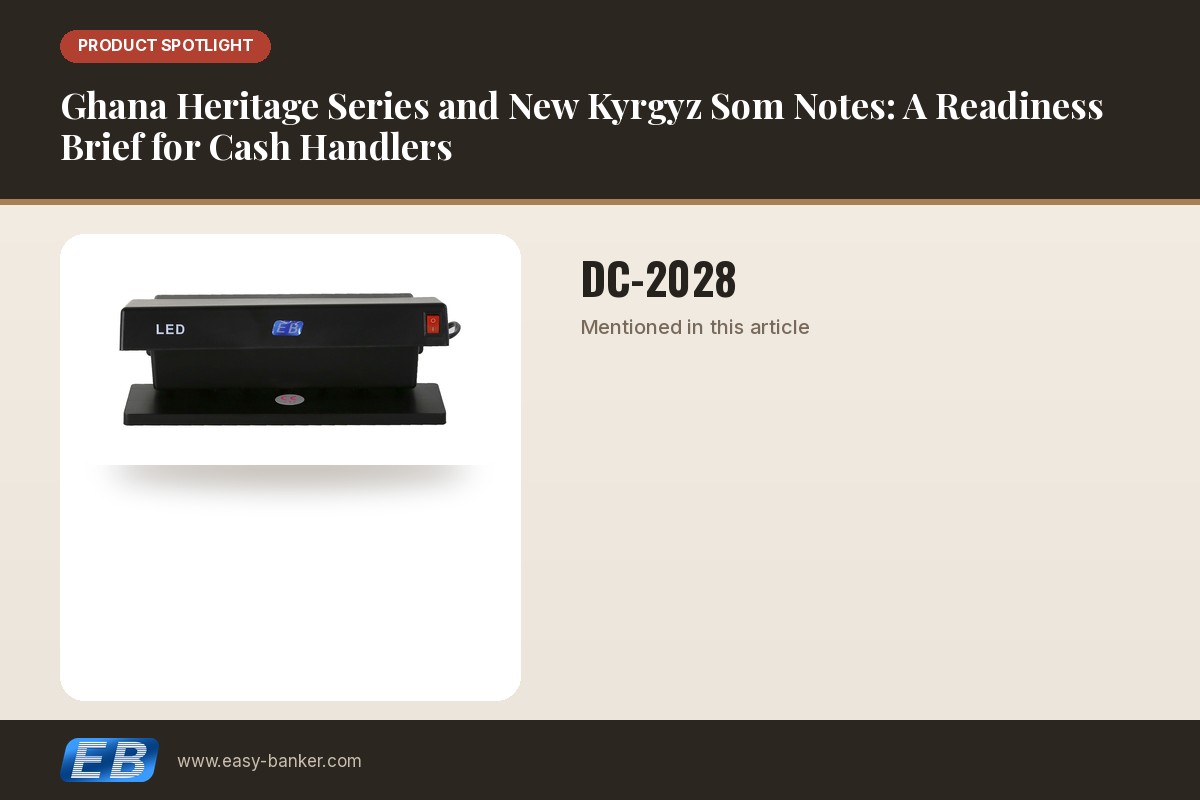
For the manual second check, the DC-2028 LED UV detector provides ultraviolet light for UV feature checks plus a side white LED light for viewing, and also works for credit cards, passports and IDs. It does not include magnetic detection or a magnifier, so pair it with the other checks above.
An honest note: the currency lists on these product pages do not name the Ghana cedi or the Kyrgyz som, and we have not tested any Easy-Banker machine with Heritage Series notes or the 2026 som issue. Neither central bank has published a machine-readability profile for us to cite. If you handle these currencies, contact us with your currency and series, and ask for a sample test with real notes before you buy.
Are Ghana’s old cedi notes still valid after 3 November 2026?
Yes. The Bank of Ghana says the existing notes remain legal tender and will co-circulate with the Heritage Series.
Is Ghana adding a GH¢500 or other higher note?
No. The bank’s Head of Currency said no denomination above GH¢200 is part of the Heritage Series.
Do the new Kyrgyz 20 and 50 som notes look different?
Their design, size and colour are unchanged, but they carry modern security features and were printed in Kyrgyzstan for the first time.
Will my money counter accept the new notes automatically?
Not necessarily. Machines with authentication need reference data for each series, so confirm the update with your supplier and test with real notes.
Sources (consulted 2 November 2026): Bank of Ghana, Statement by the Governor on the Introduction of the Heritage Series of Ghana Cedi Banknotes; Citi Newsroom, “Heritage Series: BoG rules out denomination above GH¢200” (September 2026); Business Insider Africa; open.kg, “New banknotes of 20 and 50 soms are being introduced in Kyrgyzstan” (27 October 2026).