Mixed Denomination Money Counters Explained: CIS, Value Counting and SN Recording for Distributors
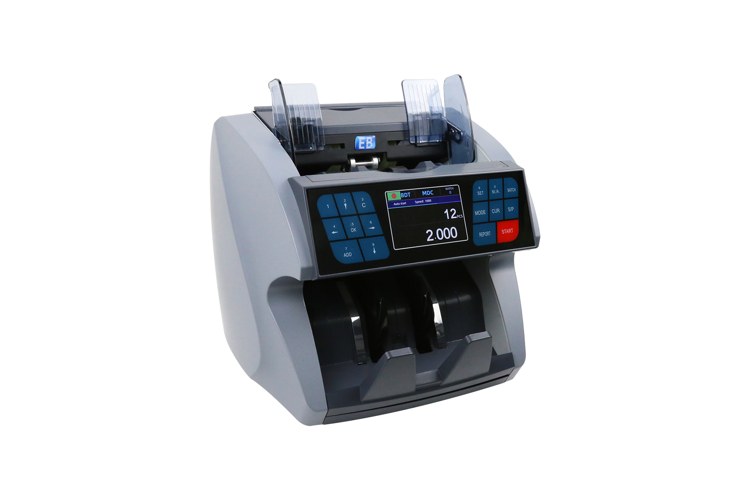
Mixed Denomination Money Counters Explained: CIS, Value Counting and SN Recording for Distributors
A basic money counter answers one question: how many notes passed through the machine. A mixed denomination money counter answers three: how many, which denominations, and what total value. For distributors serving banks, currency exchange houses, supermarkets and cash-in-transit companies, that difference decides whether a machine earns its place on a teller counter or gets retired to the back office within a year. This guide explains what actually happens inside a mixed denomination counter - CIS image analysis, value counting and serial number recording - and gives buyers a specification checklist they can hold any supplier to, using real published figures from Easy-Banker machines.
1. What "Mixed Denomination" Really Means in a Counter
Piece counting treats every banknote as identical. Mixed denomination counting - also called value counting or mix-value counting - requires the machine to identify each note’s denomination as it passes, then accumulate a running total per denomination and an overall value. Two sensing families make this possible. Optical CIS (Contact Image Sensor) arrays photograph both faces of the note at high resolution and match the image against stored denomination templates; magnetic and infrared sensors read the magnetic ink pattern and IR response as a cross-check. A machine with dual CIS reads both sides simultaneously, which is why dual-CIS models also deliver orientation and facing detection as a by-product.
The practical consequence for a buyer: a mixed denomination counter must be calibrated per currency series. When a central bank issues a new series, the machine needs a firmware or template update. Ask any supplier - including us - how that update is delivered in the field, because it is a lifetime cost that never appears on a quotation.
2. CIS, UV, MG, IR: How the Detection Stack Fits Together
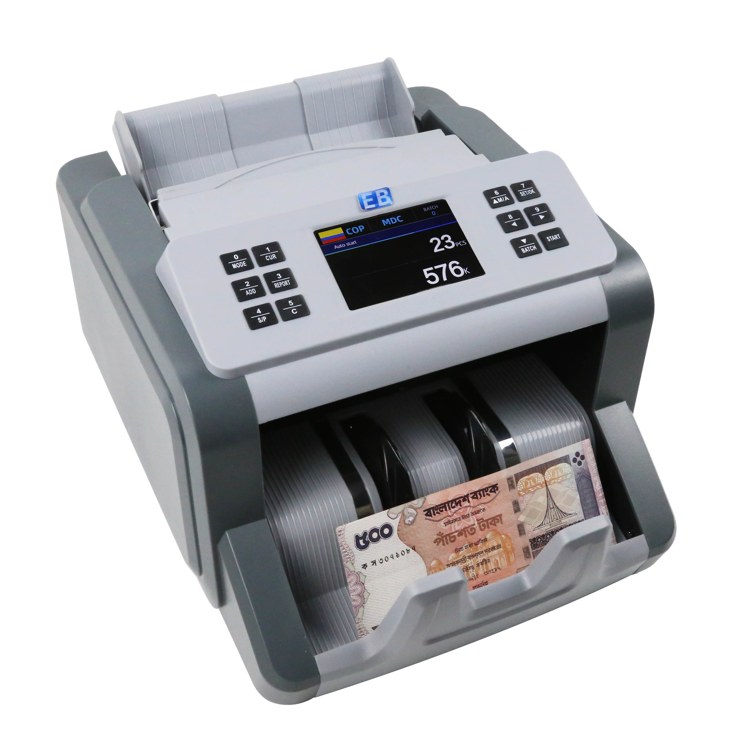
Detection functions are layered, not interchangeable. UV (ultraviolet) flags fluorescent paper and security fibers; MG (magnetic) checks magnetic ink distribution; IR (infrared) verifies IR-absorbing inks; CIS performs full-image authentication and denomination recognition. Automatic half-note, chained-note and double-note detection sits on the transport side and works on any machine class. A credible specification sheet lists which of these are standard and which are optional - and states the CIS count (single or dual).
For reference, Easy-Banker’s published specification tables list, for example, 2 CIS sensors, UV and MG detection, automatic half/chained/double-note detection and mix-value counting with denomination and version sorting on the LD-1687 and LD-1910 series, with a 4.3-inch TFT touch screen for operator feedback.
3. Serial Number Recording: From Counting to Traceability
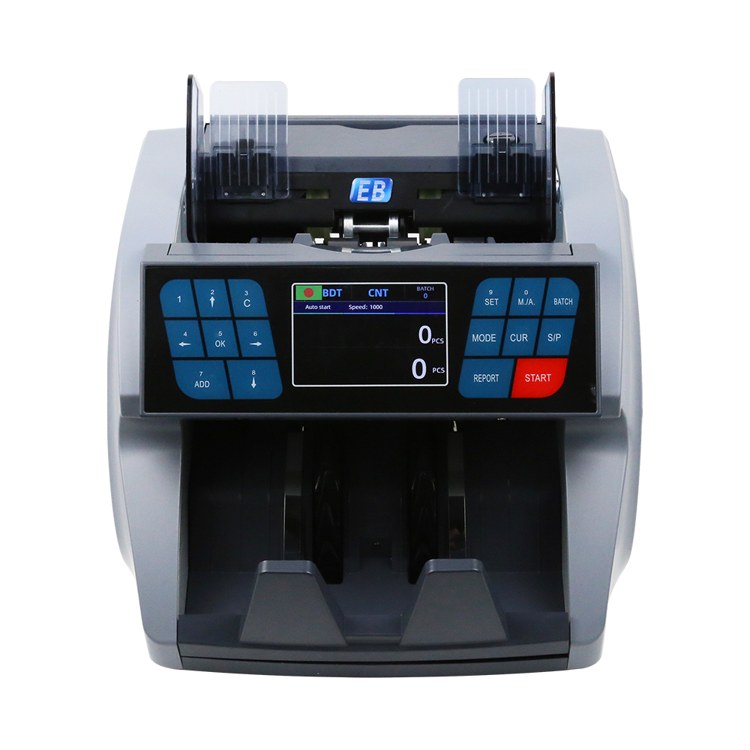
Serial number (SN) recording captures each note’s serial number image during the count and stores or exports the list. For banks and CIT operators this converts a counting machine into an audit tool: a disputed deposit can be matched against the recorded serial list, and suspect notes can be traced back to the bundle they entered in. For retailers it is usually unnecessary cost. The specification questions that matter: is SN recording standard or optional, where is the data stored (USB, SD, internal memory), and which interfaces export it - RS232, LAN, USB or a built-in printer. On the BS-2080/BS-2090 sorter family, Easy-Banker lists LAN/RS232/USB/PC communication with an optional built-in printer; on the LD value-counter family, USB and RS232 are the common export paths.
4. Reading a Specification Table Like a Procurement Officer
Four numbers decide whether a mixed denomination counter fits a customer’s workload, and they are the four most often misquoted in catalogues:
- Counting speed per mode. Piece count, mixed denomination and value count run at different speeds on the same machine. Easy-Banker publishes 800/1000/1200 pcs/min for the LD-6000 and LD-2700 series; always confirm which figure belongs to which mode.
- Hopper and stacker capacity. A 200-note stacker means re-stacking every few minutes in a busy cash office; teller lanes tolerate it, cash centers do not.
- Note size and thickness range. Published ranges such as 110-185 mm length, 50-85 mm width and 0.075-0.15 mm thickness cover most paper currencies; polymer notes and worn, soft notes sit at the edges of these windows.
- Power and environment. AC100-240V 50/60Hz wide-range supplies matter for distributors serving multiple markets from one stock pool; 0-40 °C operating range and noise below 60 dB matter at the counter.
5. A Distributor’s Checklist Before Quoting a Mixed Denomination Counter
Before you quote a mixed denomination model to an end customer, verify five things in writing: the exact detection set per mode (UV/MG/IR/CIS count), which counting modes support value and denomination output, the SN recording and export path, the currency firmware update policy for new series, and the spare-parts interval for rollers and sensors. Machines that pass this checklist behave predictably on circulated cash; machines that fail it generate the service calls that destroy a distributor’s margin.
Easy-Banker manufactures mixed denomination bill counters, CIS banknote sorters, currency detectors and bundling equipment for distributors in the USA, Southeast Asia, South America, Africa, the Middle East and Europe. OEM/ODM programs cover logo printing, custom currency firmware sets, packaging and manual languages. If you are specifying a mixed denomination counter for a bank or retail tender, request the full specification table and detection matrix for the shortlisted models - we will send datasheets, MOQ terms and lead times with the quotation.