Retail Cash Handling Workflow: From Supermarket Till to Cash Office to Bank Deposit
In a supermarket or retail chain, cash does not sit in one place - it moves. It enters at the till, rests briefly in a safe or drop box, gets counted and verified in the back-office cash room, and finally leaves in an armoured bag for the bank. Every handover in that chain is a point where money can go missing, get miscounted, or accept a counterfeit note. A well-designed retail cash handling workflow closes those gaps with procedure plus the right equipment at each stage. This guide walks the full route - till, safe drop, cash office, banking - and shows where a money counter, a currency detector and simple discipline earn their keep.
Stage 1: The till - where cash enters

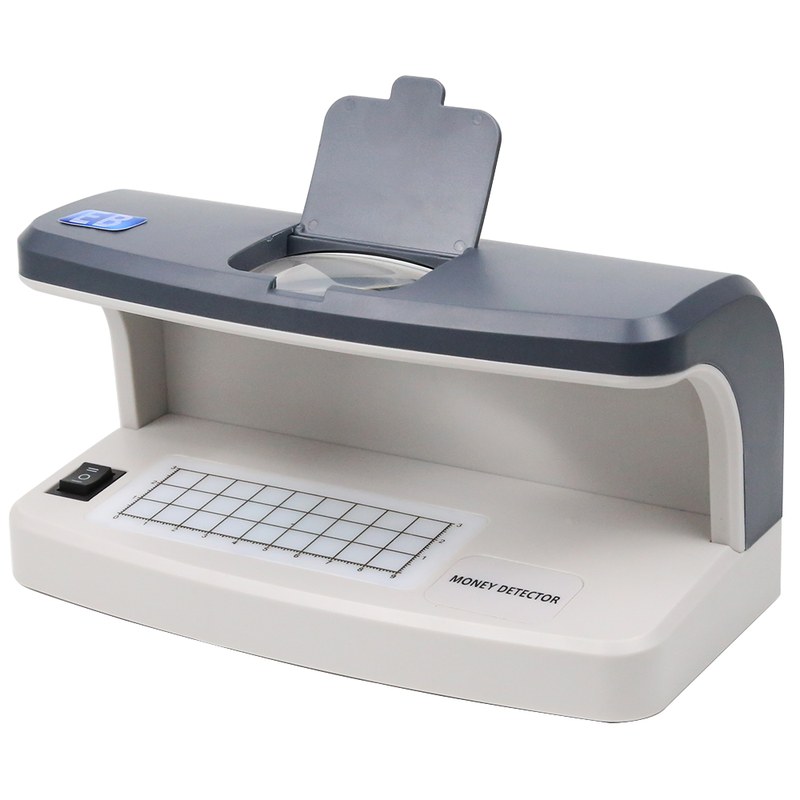
The first control is at the point of sale. Cashiers should verify suspect notes immediately rather than at the end of the shift, when the customer is gone and the note cannot be traced to a transaction. A compact UV/MG currency detector at the checkout or service desk gives a three-second yes/no on a doubtful note without holding up the queue. Rechargeable handheld verifiers also cover market stalls, kiosks and delivery-on-collection payments where mains power is unavailable.
Procedure matters as much as hardware: define a maximum float per till, require blind counts at shift change (the cashier declares the count before seeing the expected figure), and log every till variance the same day. Variances that are explained on the day are noise; variances discovered a week later are losses.
Stage 2: Safe drops - shrinking the target
Cash left in a till is cash at risk - from robbery, from skim-the-drawer theft, and from simple miscounting under pressure. Scheduled safe drops move surplus notes out of the till into a time-delay safe or drop box at fixed intervals, ideally triggered by value rather than by clock (for example, whenever the till exceeds a set amount). Each drop goes in a sealed, numbered bag with the till number, time and declared value written on it by the cashier - unverified at drop time, verified at count time. That separation of duties is the single cheapest control in retail cash management: the person who took the money is never the person who confirms the amount.
Stage 3: The cash office - counting, verifying, bundling
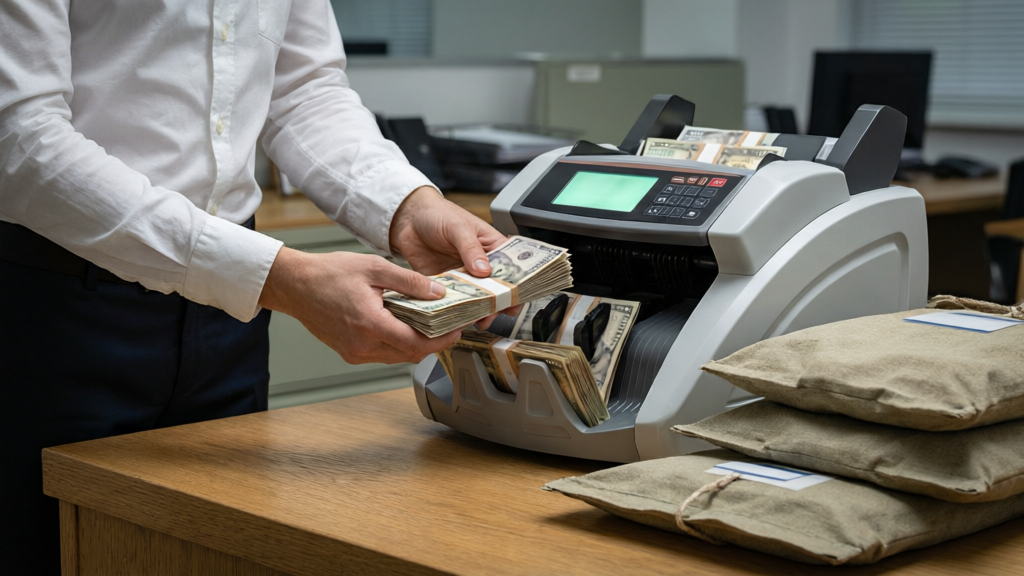
The back office is where the workflow earns or loses money. Bags from all tills are opened under camera coverage, counted on a banknote counter, and reconciled against the declared values and the POS sales report. For this stage a commercial counter with batch (preset) and add functions is the workhorse: preset 100-note straps for bundling, use add mode to accumulate a bag total across several runs. A model such as the LD-1500 bill counter adds UV, MG and IR detection plus amount preset, so the count run doubles as a counterfeit sweep; stores that deposit mixed notes and want denomination totals should look at value-counting machines like the LD-1100 with Euro value counting, which reports total value, not just pieces.
Two habits keep this stage honest. First, count twice on variance: any bag that disagrees with its declaration is recounted by a second person before anyone touches the paperwork. Second, quarantine suspect notes properly - bag them, log them, and hand them to the bank or police per local regulation instead of recirculating them into change floats. If your counter starts rejecting good notes frequently, the cause is usually dirty sensors or worn notes rather than a broken machine; our guide on why money counters reject banknotes covers the cleaning routine step by step, and the daily, weekly and quarterly maintenance checklist keeps rejection rates low between services.
Counted notes are then strapped or banded - by hand with paper bands for low volume, or with an automatic banding machine where bundles run into the hundreds per day - and the verified totals are entered into the cash management record.
Stage 4: Banking - the deposit run
The final stage converts counted cash into bank credit. Deposit bags are prepared to the bank's specification (denomination order, strap colours, sealed and signed), the deposit slip matches the cash-office record exactly, and the armoured carrier or bank run is logged with bag numbers. Reconcile the bank's credited amount against your record within one business day; discrepancies at this stage are rare but expensive to chase later.
Where the money actually leaks
Across retail operations the loss pattern is consistent: unexplained till variances that are never investigated, safe drops without declared values, single-person counting, and counterfeit notes accepted at the till and discovered only when the bank rejects the deposit. None of these require expensive technology to fix - they require a written workflow, two signatures at every handover, and a counter that detects as it counts. Equipment sizing follows volume: a single-store back office is well served by one 900-1,000 notes/minute counter with UV/MG; a chain cash centre processing deposits from many stores needs value counting, higher stacker capacity and, at sufficient volume, denomination sorting.
Choosing equipment for the workflow, not the brochure
Match each stage to a tool: handheld verifier at the till, time-delay safe for drops, batch-capable counter with detection in the cash office, banding machine for bundling. If you are specifying equipment for a chain or distributing to retail customers, our money counter buying guide lists the specification points that matter in B2B tenders - speed, detection mix, display type, note size range and service support.
Easy-Banker manufactures banknote counters, currency detectors, banding machines and complete cash handling equipment for retail, banking and distribution customers worldwide, factory-direct with OEM/ODM options. Contact our sales team for workflow specification support and distributor pricing.