The Polymer Banknote Wave of 2026: What Plastic Cash Means for Money Counters, Sorters and Detectors
The Polymer Banknote Wave of 2026: What Plastic Cash Means for Money Counters, Sorters and Detectors
Over the past year a striking number of central banks have moved toward polymer — plastic — banknotes, and several more have concrete plans on the table. For anyone who buys, sells or operates cash-handling equipment, this is not a cosmetic change of material. Polymer notes behave differently in a counting machine, a sorter and a detector than cotton-paper notes do, and a hardware fleet specified only for paper cash will reject, mis-count or fail to authenticate the new notes. This article collects the verified 2026 developments, explains the engineering differences polymer introduces, and gives distributors a practical specification checklist.
All event facts below are drawn from central-bank announcements and press reporting accessed in October 2026; sources are named in-line.
1. The Verified 2026 Polymer Developments
- India (Reserve Bank of India). In July–August 2026 the Indian government approved an RBI proposal to introduce one billion pieces each of ₹10 and ₹20 polymer banknotes for field trials, with regular issuance to follow if trials succeed. The RBI's printing subsidiary BRBNMPL floated a global Expression of Interest for BOPP-based polymer substrate; reporting (The Hindu, 11 August 2026) indicates paper and polymer notes will circulate in parallel.
- Canada (Bank of Canada). On 3 September 2026 the Bank of Canada unveiled the design of a new vertical $20 polymer note featuring King Charles III, continuing Canada's fully polymer currency.
- Oman (Central Bank of Oman). Oman issued its first-ever polymer banknote — a One Rial commemorative note on polymer substrate — entering circulation on 11 January 2026, with a large transparent window among its security features.
- United Kingdom (Bank of England). The Bank confirmed its next series (£5/£10/£20/£50) will remain polymer and shift reverse designs from historical figures to British wildlife, with a new Chief Cashier taking office on 19 October 2026 to lead the multi-year transition; the Bank states the key driver is counterfeit resilience.
None of these issuers is abandoning paper overnight. The consistent pattern is a parallel or phased introduction, which is precisely the condition that stresses cash-handling hardware: machines must accept both substrates, in the same denomination, in the same mixed bundle, without operator intervention.
2. Why Polymer Is Harder for Cash Machines Than Paper
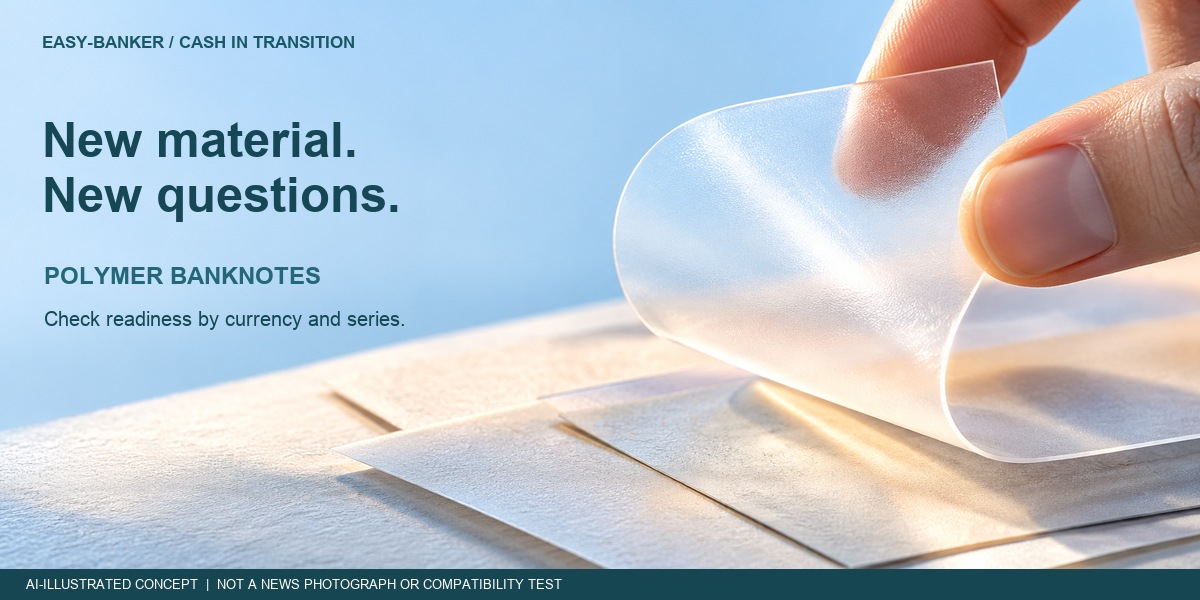
A polymer note is a thin biaxially-oriented polypropylene (BOPP) film with printed layers and, usually, a transparent window. Compared with cotton-paper currency it differs in the ways that matter most to a machine transport:
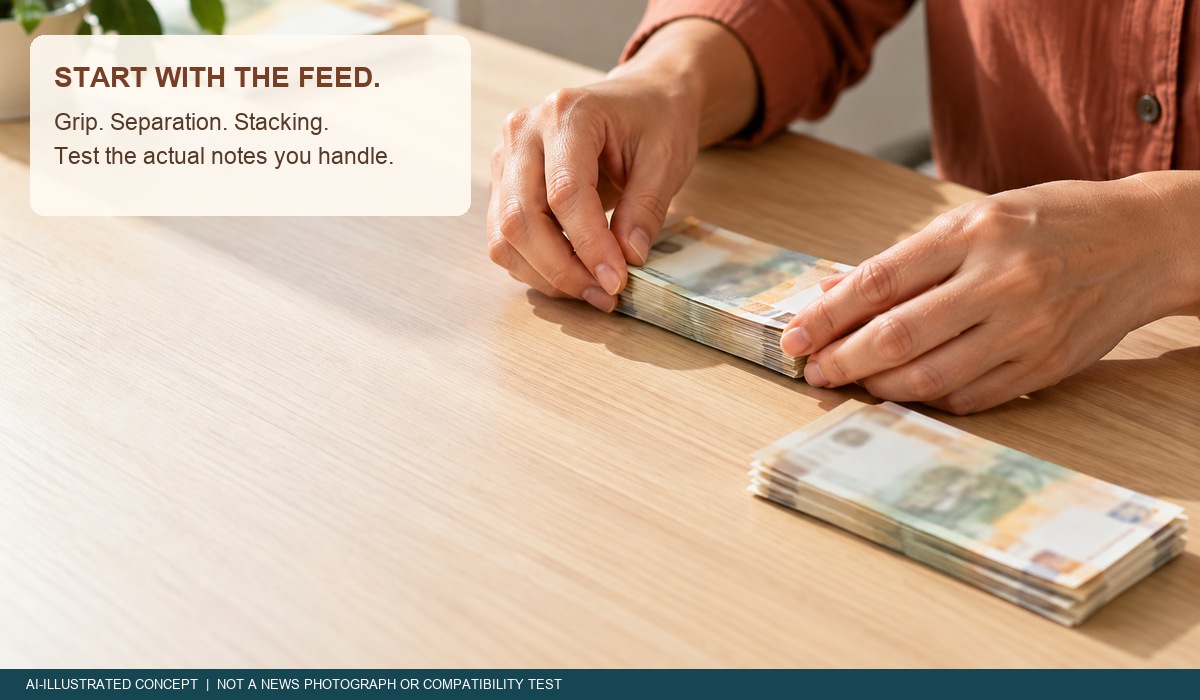
- Surface friction and slipperiness. Polymer is smoother and more slippery than paper. Feeding rollers tuned for paper grip can over-feed (two notes at once) or under-feed on plastic, so reject rates and chained-note errors rise unless roller pressure and feed timing are re-tuned.
- Thickness and stiffness. Polymer notes are typically thinner and stiffer than paper of the same size. A machine whose countable-thickness range is set for paper can flag genuine polymer notes as out-of-spec or as doubles. The countable-note thickness range in a specification sheet must cover polymer.
- Static electricity. Plastic builds static charge, causing notes to cling and stack. Anti-static treatment and transport design matter more with polymer.
- Soiling and cleanliness. Polymer resists moisture and dirt better and generally stays cleaner longer — a point in its favour — but transport-path grime interacts differently with a glossy plastic surface.
- The transparent window. The clear window is a genuine security feature but also an optical challenge: reflection and transmission sensors must be calibrated to read around a see-through region rather than a uniformly opaque note.
3. What Changes for Detection and Authentication

The counterfeit-resistance argument for polymer is real. Central banks emphasise that the transparent window and polymer-specific features are difficult to reproduce with common copier and inkjet methods. For equipment, that shifts the detection mix:
- UV fluorescence. Polymer substrates fluoresce differently from cotton paper, so UV thresholds calibrated only on paper can mis-flag genuine polymer notes. UV firmware must recognise the polymer response.
- Magnetic (MG) and infrared (IR) signatures. The magnetic-ink and IR-absorbing patterns are re-laid-out on a new series. A machine's template library has to be updated for the polymer note's specific MG/IR map, or the authentication layer will not match.
- CIS image recognition. For value-counting and denomination/version sorting, the Contact Image Sensor template library must include the polymer design — portrait position, window location, micro-text — or mixed-denomination counting degrades the moment polymer enters the bundle.
- Serial-number capture. Sorters that record serial numbers need their image-capture geometry re-checked against the polymer layout, since printing positions change with a new series.
The through-line: polymer is a firmware and calibration event as much as a hardware one. A machine can transport plastic notes yet still reject them because its currency template library has not been updated for the new series.
4. The Counterfeit Context Behind the Push
Counterfeit resistance is a stated driver of the polymer push, and the 2026 statistics show why the theme stays relevant even as absolute counterfeit volumes fall. The European Central Bank reported (press release, 27 February 2026) that some 444,000 counterfeit euro banknotes were withdrawn from circulation in 2025, a 20% decrease on the prior year — about 14 counterfeits per million genuine notes. Germany's Bundesbank reported for the first half of 2026 approximately 30,007 counterfeit euro notes with a nominal value of €1.75 million, down 4.3% on the second half of 2025, but with counterfeit €100 notes up 61% while the €50 remained the most-faked denomination. Falling totals do not mean detection matters less: the fakes that do circulate concentrate in specific denominations, and polymer raises the reproduction bar precisely on those high-value targets.
5. A Specification Checklist for Distributors and Cash Centres
When you evaluate a counter, sorter or detector for a market moving to polymer, put these questions to the supplier in writing:
- Does the machine's countable-note thickness and size range explicitly cover polymer notes (thinner, stiffer film), not just cotton paper?
- Are the feed rollers and transport path rated or re-tunable for low-friction plastic to keep double-feed and reject rates down?
- Is there anti-static handling for plastic notes that cling?
- Can the UV / MG / IR detection thresholds be configured for a polymer substrate, and are the currency templates updated when a new polymer series issues?
- For CIS value-counters and sorters, does the image template library include the polymer design, and how are firmware/template updates delivered (USB, SD, network, dealer) and for how long?
- Is serial-number capture re-calibrated for the polymer layout where your market requires SN recording?
- Has the model been field-tested on the actual polymer note of your market, not just on paper equivalents?
Easy-Banker manufactures money counters, currency detectors, banknote sorters, coin machines and bundling equipment for distributors and cash centres in the USA, Southeast Asia, South America, Africa, the Middle East and Europe. Because polymer readiness is a per-market, per-series question, we quote detection and firmware configurations against the currencies and substrates your customers actually handle, and our OEM/ODM programme covers firmware currency sets, logo printing and manual languages. Send us your target currencies — including any polymer denominations — and we will return the countable-note range, detection matrix, firmware-update policy, MOQ terms and lead times with the quotation.