UV, MG, IR or CIS? How Banknote Detection Technologies Differ and What Your Business Actually Needs

UV, MG, IR or CIS? How Banknote Detection Technologies Differ and What Your Business Actually Needs
Every banknote counter and currency detector on a specification sheet lists a string of detection abbreviations: UV, MG, IR, CIS, sometimes DD or MT. To a procurement officer they look like interchangeable badges; to a service engineer they are completely different physical measurements, each catching a different family of counterfeit. Buying the wrong combination means either paying for layers your cash mix will never use, or - worse - shipping a machine to a customer whose local forgeries slip straight through the one layer it does have. This guide explains what each technology actually measures, what it cannot catch, and which combination fits each type of cash business.
1. Why Detection Is Layered, Not Single
Counterfeiters work with whatever printing technology they have: colour copiers, inkjet printers, offset presses, or genuine notes chemically washed and reprinted. A colour copier cannot reproduce fluorescent fibres, so ultraviolet inspection catches it. An inkjet forgery has no magnetic ink at all, so a magnetic head catches it. But a high-quality offset counterfeit on genuine paper stock can pass both - which is why credible machines stack independent layers and raise an alarm when any one layer disagrees.
2. UV: Fluorescent Paper and Security Fibres
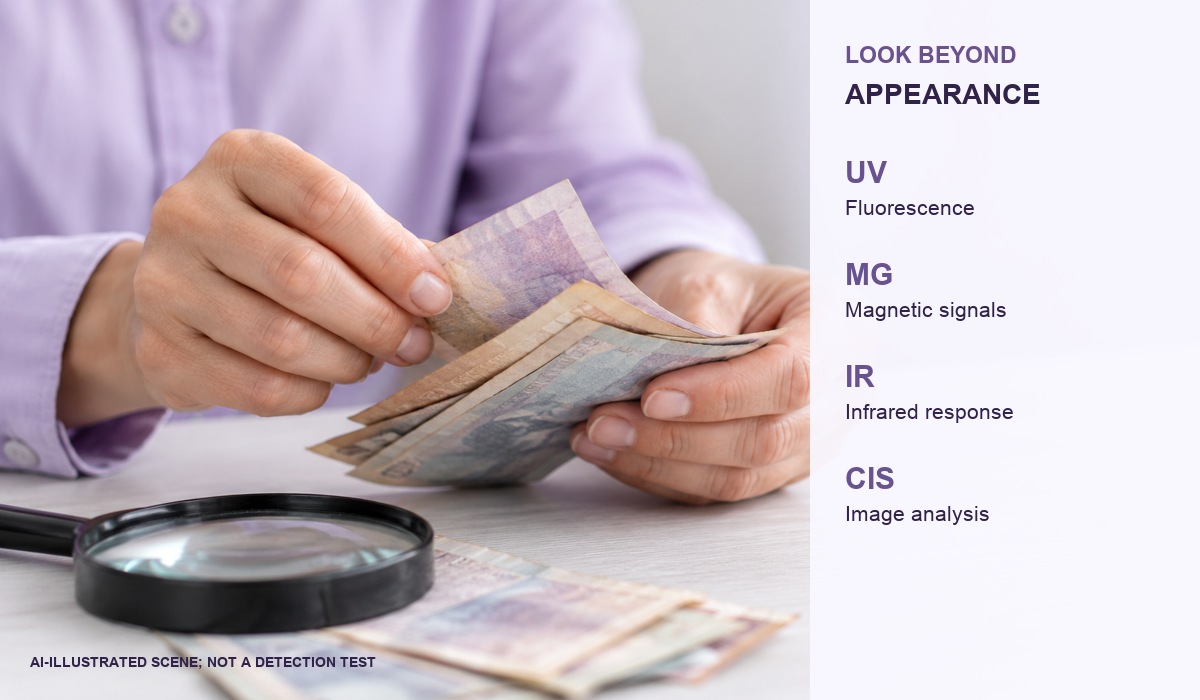
Genuine banknote paper is designed not to fluoresce, while embedded security fibres and specific printed patches glow in defined colours under ultraviolet light. A UV sensor floods the note with UV and reads the reflected fluorescence: a bright overall glow means ordinary paper, i.e. a fake. UV is inexpensive and catches the crudest forgeries - home-printed and photocopied notes - but it is blind to counterfeits printed on genuine or washed paper stock, and strong ambient light can weaken its reading, which is why detectors hood the UV chamber.
3. MG: The Magnetic Ink Signature
Most currencies print specific areas with magnetic ink - patterns that are part of the design but invisible to the eye. A magnetic head reads the distribution and strength of that magnetism as the note passes. Because reproducing the exact magnetic pattern requires the original ink and printing process, MG is a strong authenticity check, and it also enables denomination recognition on value-counting machines, since each denomination carries a different magnetic signature. Its limit: some currencies and some denominations carry little or no magnetic ink, so MG coverage must be verified per currency, not assumed.
4. IR: Infrared-Absorbing Inks
Under infrared light, parts of a genuine note disappear and other parts stay dark, according to how the inks absorb IR. An IR sensor pair (emitter and receiver) reads that pattern as the note travels. IR catches forgeries that pass UV and MG - particularly offset prints on genuine paper - because the counterfeit inks absorb infrared differently. Like MG, IR patterns are currency-specific, so a machine’s IR layer is only as good as its firmware library for the notes it claims to support.
5. CIS: Full-Image Authentication and Denomination Recognition

A Contact Image Sensor is a linear camera: it photographs the entire face of the note at high resolution as it moves, and the processor compares the image against stored templates. CIS is the only layer that sees the note the way a human does - portrait, watermark position, printed micro-text, series and version - which is why CIS machines deliver mixed-denomination value counting, orientation and facing detection, and version sorting as by-products of the same image. Dual-CIS designs read both faces simultaneously. The cost side is real: CIS machines are more expensive, and their accuracy depends on keeping the sensor glass clean and the template library updated when a central bank issues a new series.
6. Dimensional and Thickness Checks (DD/MT)
Width, length and thickness sensors are not authenticity checks in the strict sense - they are transport integrity checks that also catch half-notes, chained notes, doubled notes and folded corners. A note that is the right size but made of the wrong paper still needs UV/MG/IR/CIS; a genuine note fed double still needs the dimensional layer to stop the count error. In practice every serious machine combines both families.
7. Matching the Stack to the Business
- Retail and supermarket tills: UV + MG + dimensional is the workhorse combination; the forgeries encountered are usually crude, and cost per lane matters.
- Currency exchange and forex counters: add IR, and prefer value counting - mixed foreign denominations are counted by value all day, and washed-paper forgeries are a known risk in exchange flows.
- Bank branches and cash centres: CIS-based value counters or sorters, because version sorting, fitness grading and serial-number recording ride on the image layer.
- Cash-in-transit and depots: CIS sorters with full-image authentication and SN recording; the audit trail matters as much as the count.
- Markets with high counterfeit pressure or frequent new series: prioritise machines whose firmware library is updated actively, whatever the sensor stack.
8. Three Questions to Put to Any Supplier
- Which layers are standard and which are optional on this exact model - and is the CIS single or dual?
- How are currency template updates delivered (USB, SD, network, dealer visit), and for how many years after purchase?
- What is the published false-rejection behaviour on circulated notes, and which sensitivity settings exist for worn cash?
Easy-Banker manufactures currency detectors, UV/MG/IR bill counters, CIS value counters and mixed-denomination sorters, coin machines and bundling equipment for distributors in the USA, Southeast Asia, South America, Africa, the Middle East and Europe. Detection configurations are quoted per market: we build the sensor stack and firmware set around the currencies your customers actually handle, and OEM/ODM programmes cover logo printing, custom firmware and manual languages. Send us your target currencies and cash mix and we will return the detection matrix, datasheets, MOQ terms and lead times with the quotation.