


Europe’s central banks published two important counterfeit-money reports in 2026, and read together they send a clear signal to everyone who handles cash professionally: totals are down, but the threat mix is shifting. For distributors of money counters, banknote detectors and sorters, a shifting threat mix is exactly what customers pay to be protected against — and a reason to review what the installed machine fleet actually detects.
All event facts below are drawn from central-bank publications and press reporting accessed in October 2026; sources are named in-line and listed at the end.
On 7 August 2026 the Deutsche Bundesbank released its half-year counterfeit report for Germany. In the first half of 2026 the Bundesbank identified approximately 30,007 counterfeit euro banknotes with a total nominal value of €1.75 million in German payments. Compared with the second half of 2025, the number of seized forgeries fell 4.3% and the associated losses fell 5.0%. Statistically that works out to around seven fake notes per 10,000 inhabitants per year — a level Executive Board member Lutz Lienenkämper summarised by saying that levels of counterfeit money in Germany are low.
The averages, however, hide the real story. The €50 note remained the most counterfeited denomination with 14,222 detections, about 47% of all fakes, despite a 6% decline. The €20 followed at 7,355 (down 13%), then the €10 at 1,494 (down 16%), the €5 at 638 (down 10%), the €200 at 850 (down 48%) and the €500 at 405 (down 21%). Against that across-the-board decline, counterfeit €100 notes jumped 61% to 5,043 pieces — the only denomination that rose. “Recently, there have been more counterfeit €100 banknotes in circulation,” Lienenkämper noted, while the €50 “remains in the ignoble first place for counterfeits.”
Coins moved in the opposite direction: around 64,878 counterfeit euro coins were detected in the same period, up 8.6% from 59,700 in the second half of 2025, with 2-euro coins accounting for 91.1% of all fake coins. Coin counters and coin sorters should not be left out of the conversation when retailers upgrade their note detection.
What kind of fakes are filling the statistics? The Bundesbank reports that a rising share are simple counterfeits — sheets printed with markings such as “MovieMoney”, “Prop copy” or “Facsimile”, lacking basic security features entirely. These low-effort notes mainly catch out under-attended checkouts and machines running thin detection settings.
At the other end of the quality spectrum, law enforcement closed in on organised forgers. In September 2026 authorities reported a Europol-coordinated operation against a transnational cell — press reports dubbed it the “Naples group” — executing six arrest warrants and sixteen simultaneous searches across Italy, Germany and Spain. Investigators describe the network as producing high-fidelity cloned euro banknotes shipped from laboratories near Vesuvius into circulation in Germany and Spain. High-quality cloned notes are precisely the category that defeats single-layer UV checks and slips past machines that were never calibrated for the newest genuine-series security inks.

The German numbers sit inside a calmer European picture. In its annual report published on 27 February 2026, the ECB recorded roughly 444,000 counterfeit euro banknotes withdrawn across the euro area in 2025 — a 20% fall from the 554,000 detected in 2024, and one of the lowest levels ever measured in proportion to notes in circulation: 14 fakes per million genuine banknotes. The €20 and €50 denominations again made up about 80% of all seizures, and 96.8% of counterfeits were found inside euro-area countries.
Low national totals can tempt buyers to treat detection as a solved problem. That reading is backwards: when volumes fall, each surviving fake tends to be harder, and professional cash-handling machines are the net that catches them. The Eurosystem explicitly frames successfully type-tested banknote-processing machines as part of the defence — machines that “reliably identify counterfeits and withdraw them from circulation”.
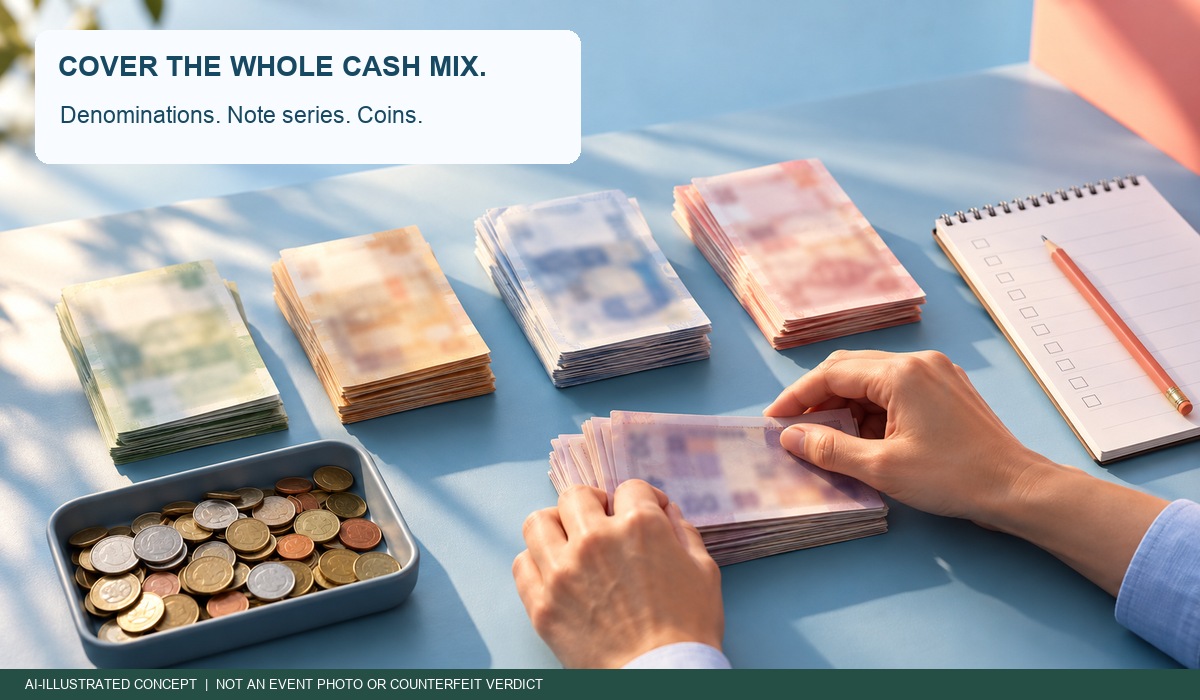
For distributors and end users, the 2026 reports translate into a practical checklist:
The counterfeiting landscape of 2026 is a barbell: masses of crude prop notes on one side, a handful of very good laboratory fakes on the other, and ordinary criminals drifting toward the high-value €100 slot in between. Cash acceptance equipment that only solves one end of the barbell is now a documented weak point in Europe’s largest economy.
Easy-Banker builds money counters, banknote detectors, banknote sorters, coin counters and bundling machines for distributors in more than 40 markets, with configurable UV/MG/IR/CIS detection layers and updatable counterfeit firmware. If your local central bank’s latest counterfeit report surprised you, contact us to discuss which detection profile fits your market’s denomination mix.
Sources: Deutsche Bundesbank press release “Fewer counterfeits in circulation”, 7 August 2026; European Central Bank press release “Number of counterfeit euro banknotes remains low in 2025”, 27 February 2026; Europol-coordinated Italy–Germany–Spain counterfeit-network operation reported September 2026.