
Short answer: The first Island Nations Currency & Payments Summit, held on Denarau Island in Fiji from 26 to 28 October 2026, sent a clear message: island economies are planning for a hybrid future in which cash and digital payments coexist, not a cashless one. Organiser Currency Research, which co-hosted the event with the Reserve Bank of Fiji, reports more than 230 delegates from 29 countries. For banks, cash centres and retailers on islands, the practical takeaway is that cash handling has to stay resilient when power, telecoms or shipping links are disrupted, and equipment has to cope with mixed paper and polymer notes, mixed coins and long resupply times. Machines such as the Easy-Banker BS-8900 banknote sorter, the BS-611 fitness sorter and the CS-9500 coin sorter address these needs at different scales.
It was a new, dedicated forum for the currency and payment challenges of island economies. According to Currency Research, the summit drew on the legacy of its Currency Conference and Central Bank Payments Conference and brought together central banks, regulators, market infrastructures, retail banks, payment service providers, fintechs and banknote and coin suppliers. Participating countries ranged from Fiji, Samoa, Tonga, Vanuatu, the Solomon Islands and Papua New Guinea to the Bahamas, Bermuda, Saint Kitts & Nevis, the Philippines and the Marshall Islands, alongside larger economies such as Australia, Canada and the United Kingdom.
The published themes were critical infrastructure, payment rails, cash logistics for banknotes and coins, energy and telecoms, cross-border payments, tokenisation, fraud and scams, and the role of cash for resilience and privacy.
The keynote message from Fiji was coexistence. As reported by The Fiji Times, Deputy Prime Minister and Minister for Industry and Commerce Manoa Kamikamica told the summit that the future of money relies on coexistence rather than a complete shift to a cashless society. "Cash continues to play an important role in our economies and communities, it is trusted, generally anonymous, universally accepted and accessible," he said. He also noted that the Reserve Bank of Fiji has introduced new polymer banknotes with advanced durability and protection measures, while fintech innovation continues through platforms such as the Fiji Innovation Hub.
A second thread was cash visibility. In a podcast recorded live at the summit, ECM's managing director Jamie Cockerell described how ECM and the Central Bank of Solomon Islands are digitising cash deposits and withdrawals, moving away from paper forms and email, as a possible blueprint for other Pacific nations that must coordinate currency movements across difficult geographies.
Several of the summit themes describe constraints that mainland cash operators rarely face at the same time:
The right machine depends on volume and on how far the cash travels after counting.
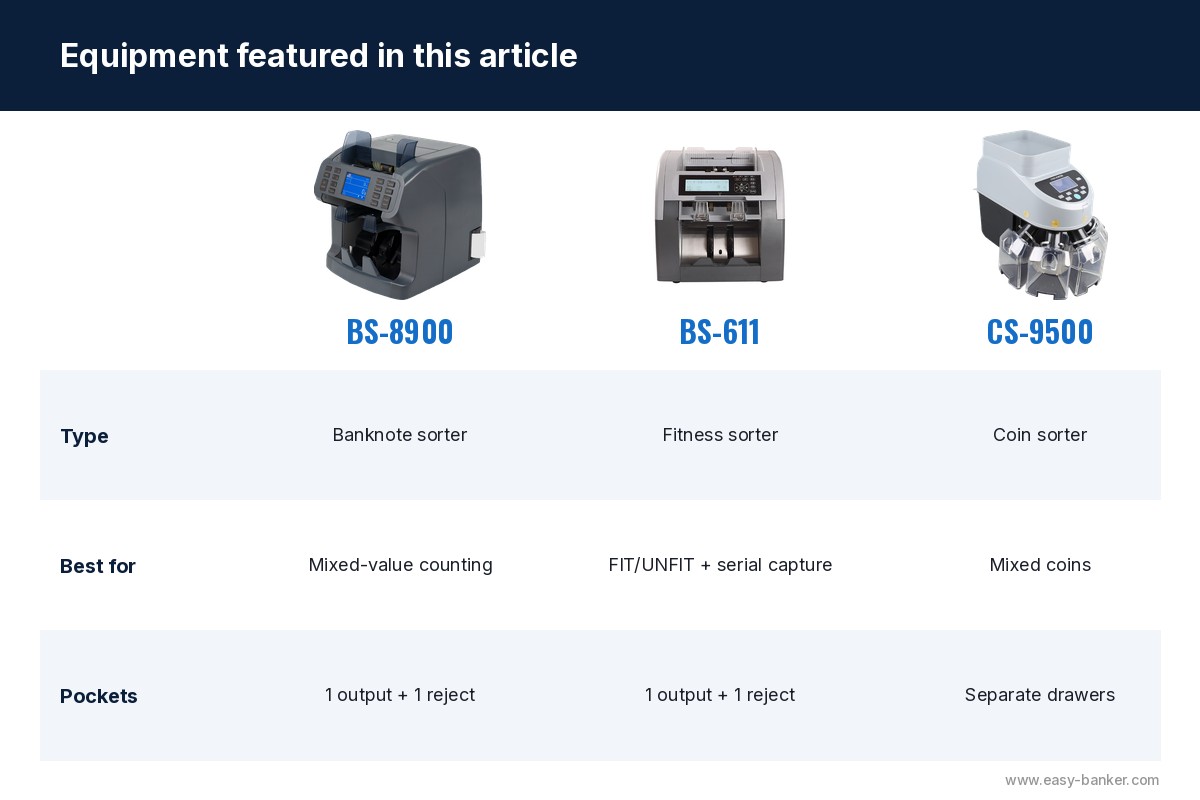
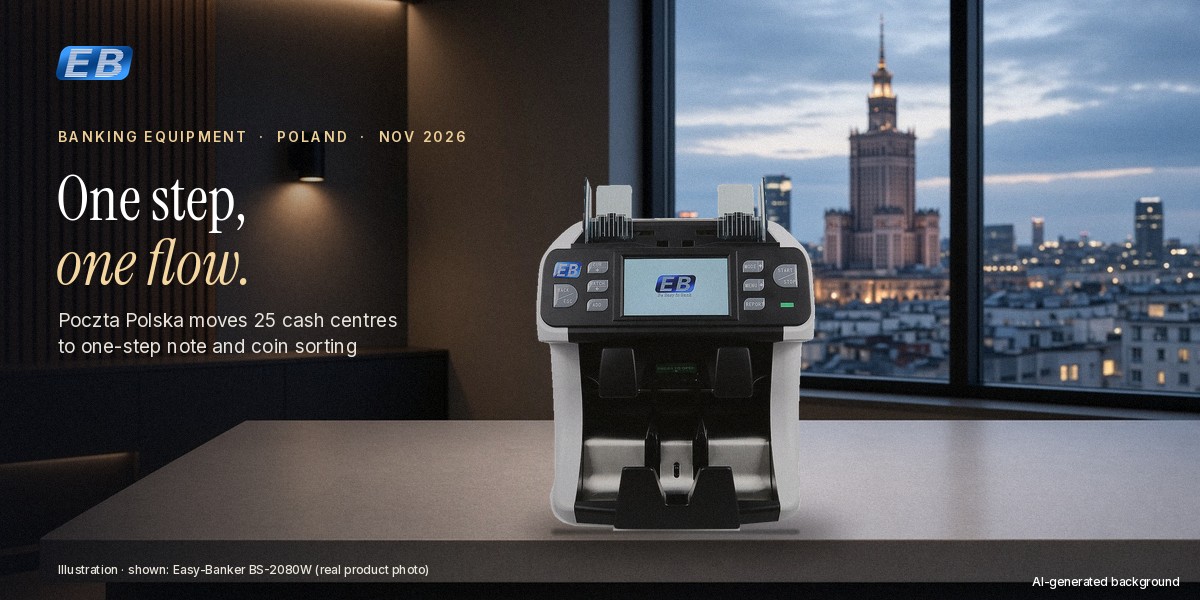
Branches, exchange counters and retailers. A compact two-pocket sorter that counts mixed denominations by value is usually the first upgrade. The BS-8900 counts mixed values of multiple currencies, uses IR, MG, RGB, white-light and IR-image detection, detects half, double and chain notes, and has a VER mode that automatically differentiates paper and plastic notes when they are mixed in one stack. It has one output pocket and one reject pocket, an external display and a printer.
Banks and cash centres that re-issue notes. When notes are sent back into circulation across islands, note quality matters. The BS-611 adds FIT/UNFIT fitness sorting using a 200 dpi contact image sensor, UV, RGB and mechanical thickness checking for tears, tape and double notes. It captures serial numbers that can be printed or stored on an SD card, which supports the kind of cash visibility discussed in Fiji, and it connects through RS232, USB and LAN.
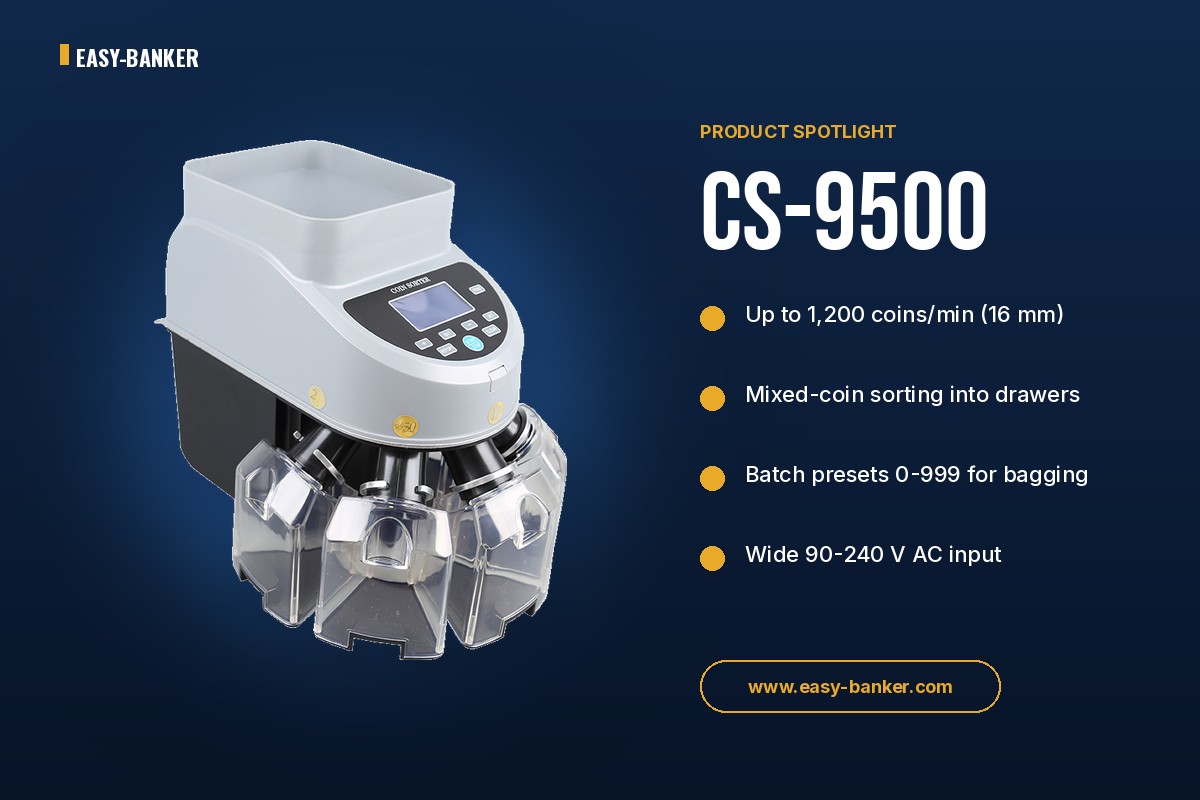
Coin-heavy businesses. The CS-9500 counts and sorts mixed coins into separate drawers, totals both value and quantity per denomination, supports batch presets from 0 to 999 pieces and runs on a wide 90-240 V AC supply. Its rated speed is 1,200 coins per minute for 16 mm coins and 1,000 for 20 mm coins. Coin support is currency-specific, so island operators should confirm their coin series with us before ordering.
It took place from 26 to 28 October 2026 on Denarau Island, Nadi, Fiji, organised by Currency Research in partnership with the Reserve Bank of Fiji.
Currency Research reports more than 230 delegates from 29 countries.
No. Fiji's Deputy Prime Minister described a future of coexistence between cash and digital payments rather than a complete shift to cashless.
Some can. The Easy-Banker BS-8900 has a VER mode that automatically differentiates paper and plastic notes in a mixed stack. Always confirm support for your specific currency series before buying.
A two-pocket mixed-value sorter such as the BS-8900 suits most counters, the BS-611 suits branches that need fitness sorting and serial capture, and the CS-9500 handles mixed coins. Contact Easy-Banker with your currency and daily volume for a recommendation.