
Short answer: Central Banking's Currency Benchmarks 2026 report, published on 5 November 2026, finds that polymer banknotes now account for 31.8% of notes — up from 23.3% in 2024 and almost double the 2023 share. The same research programme shows that one-fifth of 37 responding currency departments plan to issue new banknotes within a year, that damaged-note withdrawals rose, and that 34 central banks removed an average of 40,533 counterfeits over the past 12 months. For banks and cash centres, that means mixed paper and polymer in the same hopper, more unfit notes pulled by official fitness tests, and new series with clear windows to authenticate at first handling. The Easy-Banker BS-8900 two-pocket sorter, which distinguishes paper notes from plastic notes in VER mode, and the BS-611 fitness sorter, which grades FIT and UNFIT notes, are built for that mix.
The report, titled Cash in a digital world, is Central Banking's first full currency benchmark in two years. Its public findings describe how cash is made, tested and taken out of circulation, not a sudden end to notes and coins.
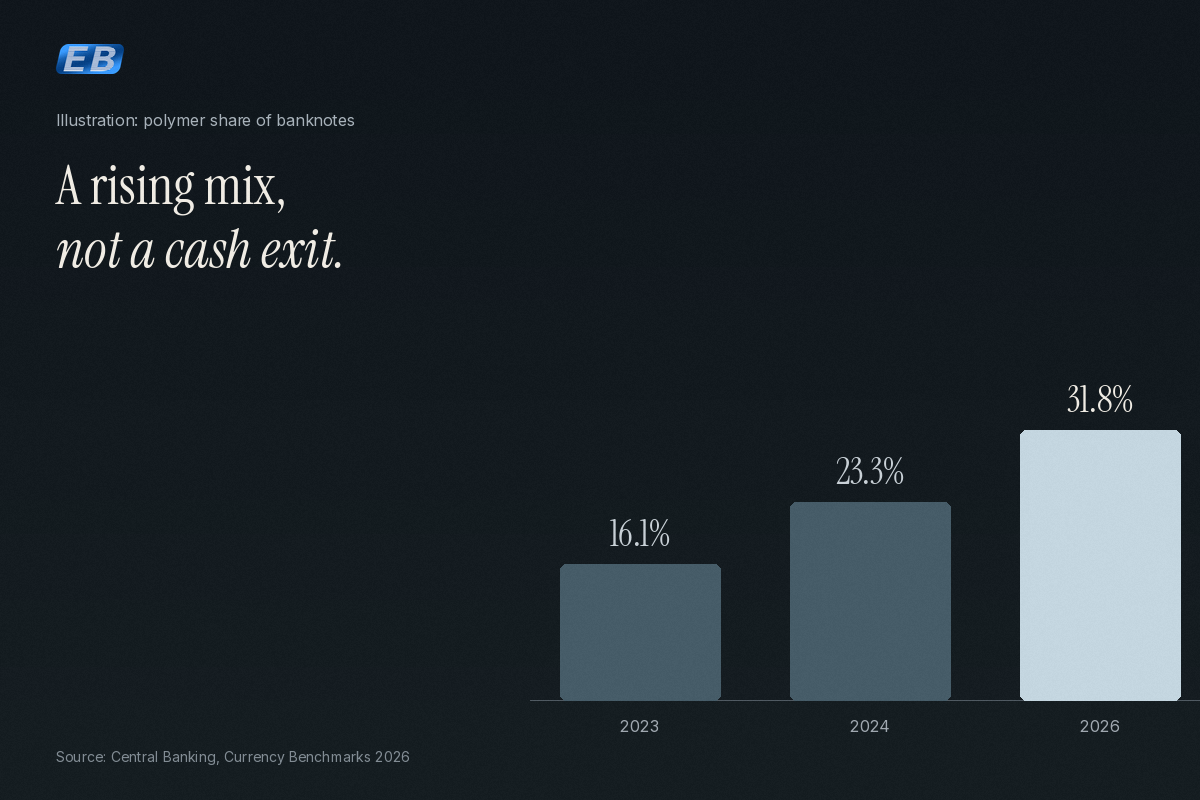
On substrates, a companion article dated 21 October 2026 states that the polymer share has nearly doubled in three years: 31.8% of banknotes are now printed on the synthetic substrate, compared with 16.1% in 2023 and 23.3% in 2024. Paper and textile-based notes remain a majority, at 62%, down from 68% in 2024.
Issuance plans are moving. According to data published on 19 October 2026, seven of 37 responding currency departments — one-fifth of the sample — plan to issue new banknotes within 0–1 years. A further 27% aim to do so in 2–5 years, and 43.2% say they have no plans currently.
Polymer is no longer a niche. When almost a third of notes are on a synthetic substrate and paper still makes up most of the rest, many counters will open a single deposit and find both in the same stack. The two substrates flex and pick differently, and a sensor setup tuned only for cotton paper can misread a polymer note.
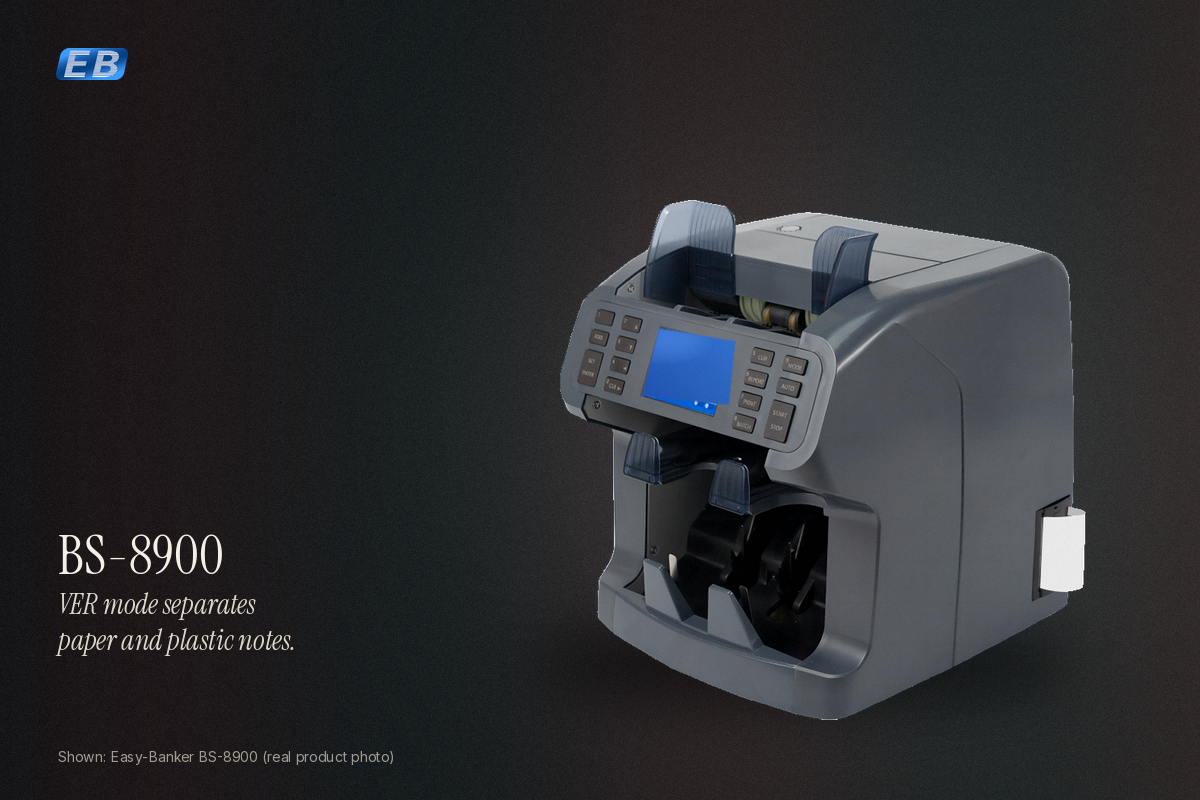
The BS-8900 is built for that mix. It offers mix-value counting of multiple currencies; detection by IR, MG, RGB, white light and IR-image; automatic checks for half, double and chain notes; and a VER mode that automatically differentiates banknotes and plastic notes when they are mixed. Speed is 800, 1,000 or 1,200 notes per minute, with one output pocket and one reject pocket (output stacker 100 notes, extendable to 200 by software). Any counter treating polymer as an exception is already behind the 2026 mix.
Data published on 23 October 2026 show that central banks that issued new banknotes between 2021 and 2026 are more likely to include transparent sections or clear windows. Eleven of the 17 respondents that produced a new series in those years — 64.7% — say this feature is part of the design, compared with 45.5% of those that produced series between 2015 and 2020.
A clear window is easy for the public to see and harder for a simple UV lamp or a single magnetic sensor to treat as a normal paper field. Machines that image both sides and read visible and infrared patterns are better placed to authenticate these notes instead of rejecting them as errors. The BS-611 uses a 200 dpi contact image sensor for visible and infrared analysis, magnetic reading of strong and weak patterns and the metal thread, RGB and UV checks for washed notes, and mechanical thickness checking for tears, tape and double notes. It sorts by denomination, orientation, facing, authentication and fitness (FIT/UNFIT) and can capture serial numbers to an SD card. Speed is 800 or 1,000 notes per minute, with one output pocket and one reject pocket. Where a central bank plans a new issue inside a year, counters should be updated before those notes arrive.
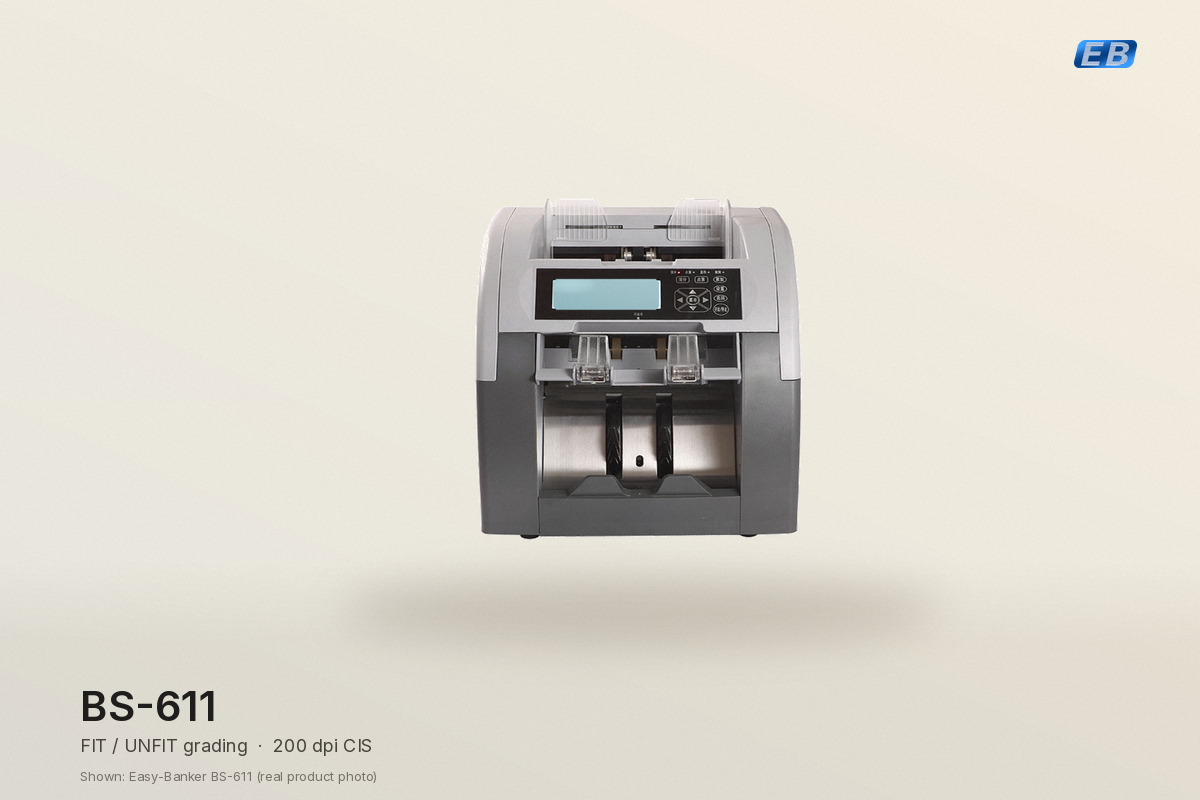
Fitness work is increasing. On 20 October 2026, Central Banking reported that respondents removed an average of 166.1 million mutilated banknotes from circulation in the past year, about 20% higher than the 137.9 million average in the 2024 benchmark (a slightly different sample). The same article notes that the frequency of official fitness tests tends to have a bearing on how many damaged notes are removed. If tests are stricter, worn notes recirculated from the branch are more likely to come back as unfit. Grading FIT and UNFIT at first handling, as the BS-611 is designed to do, reduces that return traffic.
Counterfeit withdrawals also rose. According to figures published on 22 October 2026, currency departments at 34 central banks withdrew an average of 40,533 counterfeit banknotes over the past 12 months, substantially higher than the 16,785 average in the 2024 benchmark. Most of the detected counterfeits were in series issued from 2015 to 2020. Averages hide wide differences between countries, but authentication still has to happen when the note is first accepted, using more than one sensor.
The main report, Cash in a digital world, was published by Central Banking on 5 November 2026, with supporting articles in late October 2026.
31.8% in the 2026 benchmark, up from 23.3% in 2024 and 16.1% in 2023. Paper and textile-based notes remain the majority, at 62%.
Seven of 37 responding currency departments plan to issue new banknotes within 0–1 years. A further 27% plan an issue in 2–5 years.
Some can. The Easy-Banker BS-8900 has a VER mode that automatically differentiates paper and plastic notes in a mixed stack. Confirm support for your currency series before buying.
The BS-611 grades FIT and UNFIT notes using a 200 dpi contact image sensor, UV, magnetic and mechanical thickness checks, and can capture serial numbers. Contact Easy-Banker with your currencies and volume.