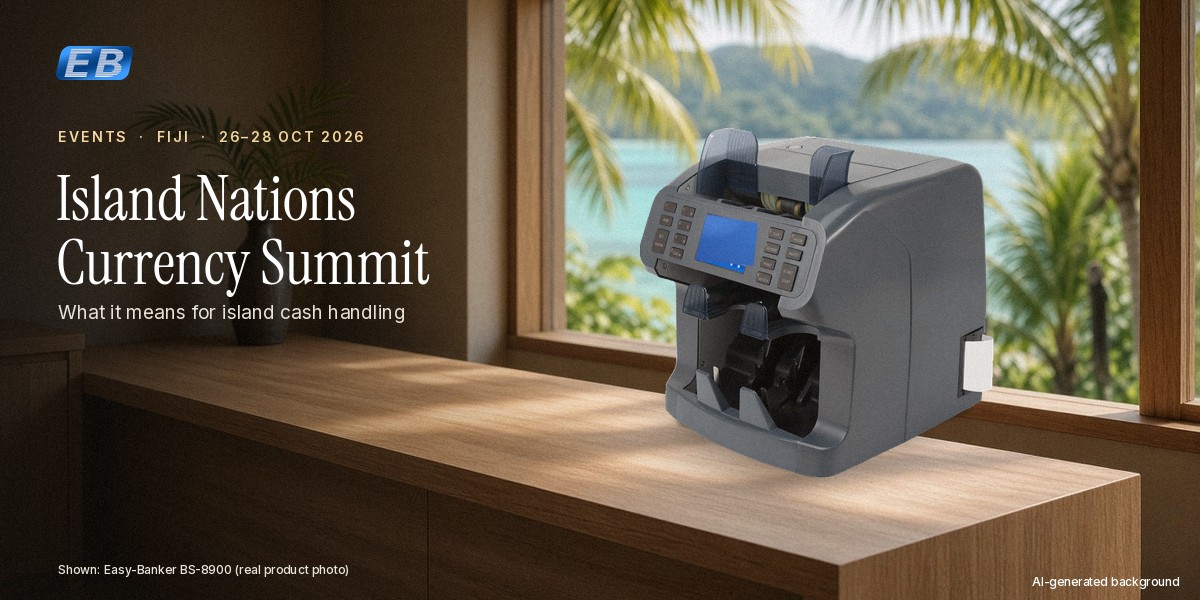

Short answer: Choose a banknote sorter by working backwards from the job. Count how many notes you process per day and how many separate outputs you need in a single pass, then decide whether you only need value counting and authentication or also FIT/UNFIT fitness sorting and serial-number capture. A compact two-pocket machine such as the Easy-Banker BS-8900 suits branches, exchange counters and retailers that mainly count mixed denominations. A fitness sorter with serial capture such as the BS-611, or a multi-pocket model such as the BS-631, suits banks and cash centres that must return clean, traceable bundles.
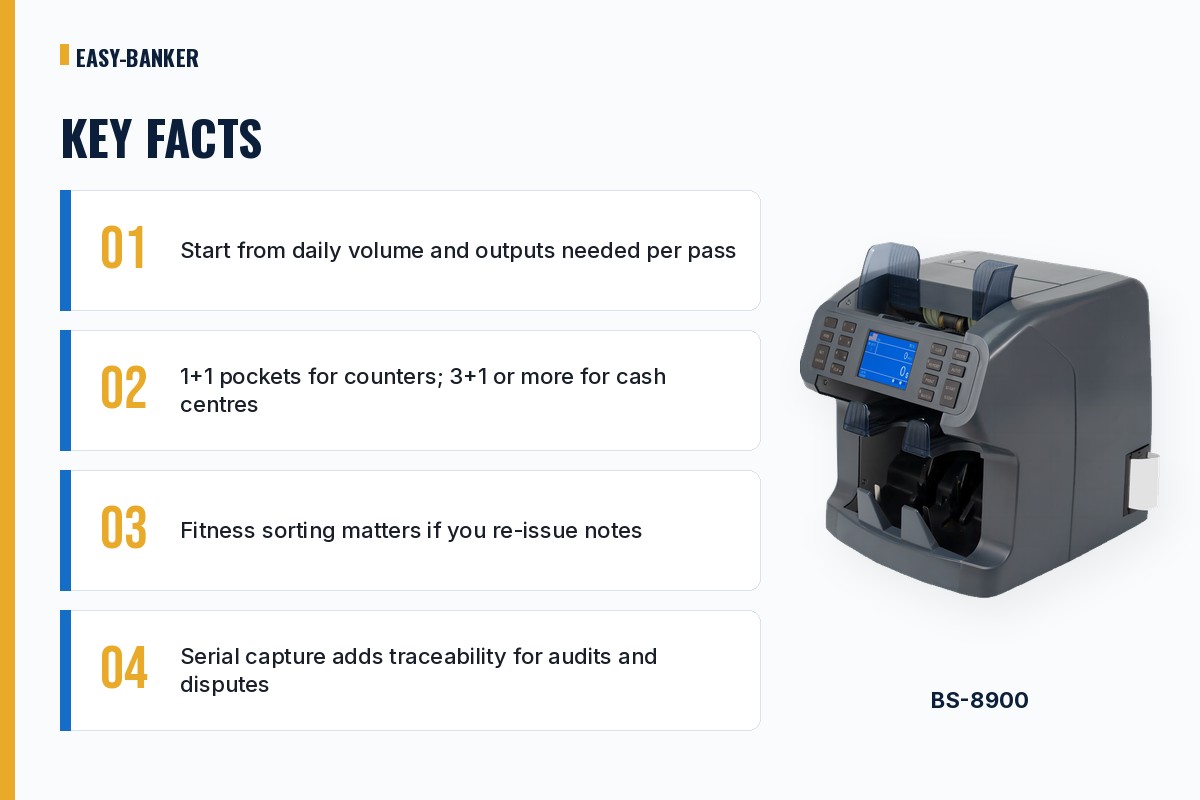
A money counter counts notes and checks them for counterfeits, usually one denomination at a time. A banknote sorter reads every note it feeds: its denomination, its face and orientation, and often its condition. It can then count a mixed stack by value and send notes that do not belong in the batch to a reject pocket. The extra sensors and image analysis are what you pay for. If your tellers only ever count single-denomination straps, a good counter may be enough. If you receive mixed deposits and must face, orient or grade notes before re-issuing them, you need a sorter.
Pockets decide how much work the machine finishes in one pass.
A simple rule: if operators regularly run the same stack two or three times to separate it, extra pockets will pay back in labour.
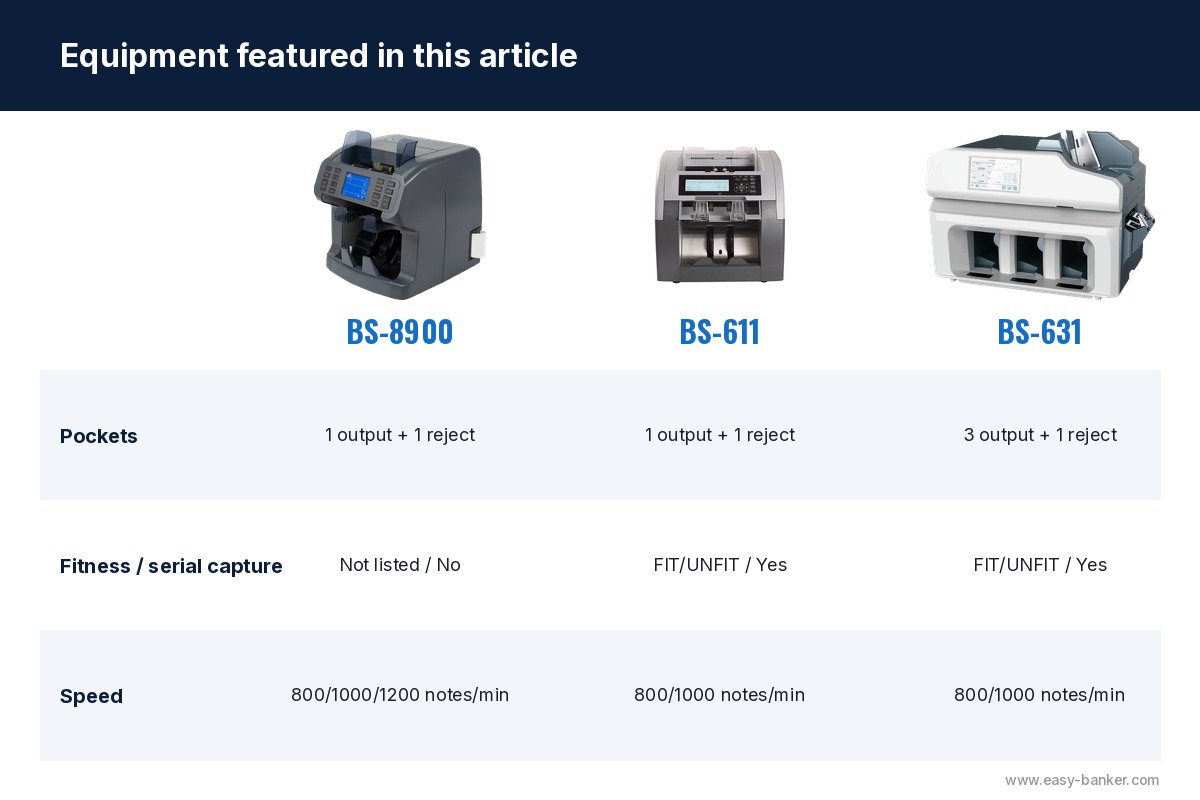
Fitness sorting checks whether a genuine note is still good enough to go back into circulation. Banks and cash centres that re-issue notes usually need it; shops and exchange counters usually do not. On the BS-611 and BS-631, fitness sorting uses a 200 dpi contact image sensor that reads both sides of the note by reflection and by transmission in visible and infrared light, UV and RGB sensors that check for washed notes, and mechanical thickness checking that catches tears, adhesive, tape and doubles. If your central bank or your bank customers publish fitness rules, ask the supplier which criteria the machine can be configured for before you buy.
Serial-number capture turns a sorter into a record-keeping tool. The BS-611 and BS-631 can capture note serial numbers, print them and store them on a memory card, and both offer RS232, USB and LAN connections. This matters when you must trace a counterfeit back to a deposit, settle a dispute with a customer, or keep an audit trail for a cash-in-transit job. If you do not have to answer those questions, you can skip the feature and buy a simpler machine.
Look for several independent checks, not one. Typical combinations include:
Also confirm that the currencies you handle are supported in the configuration you order. The BS-611 and BS-631 currency lists include USD, EUR, GBP, CNY, JPY, KRW, RUB, INR and IDR, among others. For anything else, ask before ordering rather than assuming.
Rated speed is only part of the story. The BS-8900 runs at 800, 1,000 or 1,200 notes per minute, and the BS-611 and BS-631 run fitness sorting at 800 or 1,000 notes per minute. In practice, hopper size and pocket size often limit throughput more than speed does, because the operator must stop to refill and empty. The BS-631 feeder takes up to 1,000 notes and each of its three output pockets takes 100 notes, extendable to 200 by software. Small pockets are fine for counting at the counter; large feeders and pockets matter for back-office runs.
Size and weight differ a lot between classes. The BS-8900 measures 285 x 281 x 313 mm and weighs 7.9 kg, so it fits on a teller counter. The BS-631 measures 650 x 420 x 450 mm and weighs 58 kg, so it needs a dedicated desk in a back office. Think about the screen too: a larger colour touch screen with clear menus, as on the BS-631, shortens training for new staff. Accessories such as an external customer display and a printer help where customers watch the count or need a receipt.
Is a two-pocket sorter enough for a bank branch?
For many branches, yes. A 1+1 machine counts mixed deposits by value and rejects suspect notes. Choose a fitness model if the branch re-issues notes and must remove worn ones.
Can one sorter handle several currencies?
Yes, multi-currency sorters are common, but the supported list depends on the machine and its configuration. Always confirm your exact currencies with the supplier.
Does serial-number capture slow the machine down?
On machines designed for it, serial capture runs during normal sorting. Check the rated speed for the mode you will use.
How do I get a recommendation for my volume?
Send Easy-Banker your daily volume, currencies and the outputs you need, and we will suggest a suitable sorter model.