
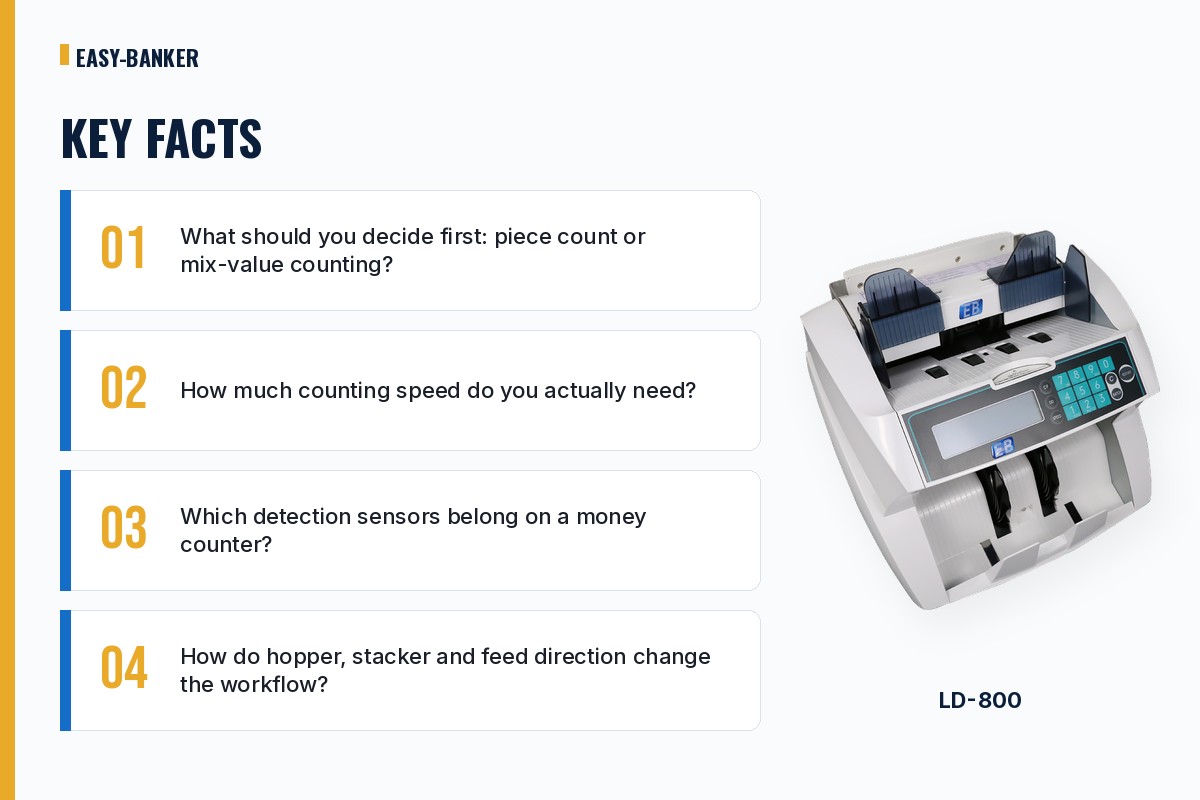
Short answer: Choose a money counter by four decisions: piece count or mixed-denomination value total; how fast the desk moves cash; which detection sensors should run on every pass; and how many notes the hopper and stacker must hold between reloads. A piece-count machine such as the LD-800 or the LD-1500 counts notes and can stop on a preset batch, but it does not add up mixed denominations. A mixed-value machine such as the LD-1910 reads each note with a contact image sensor (CIS) so it can total value and sort by denomination or version in the same pass.
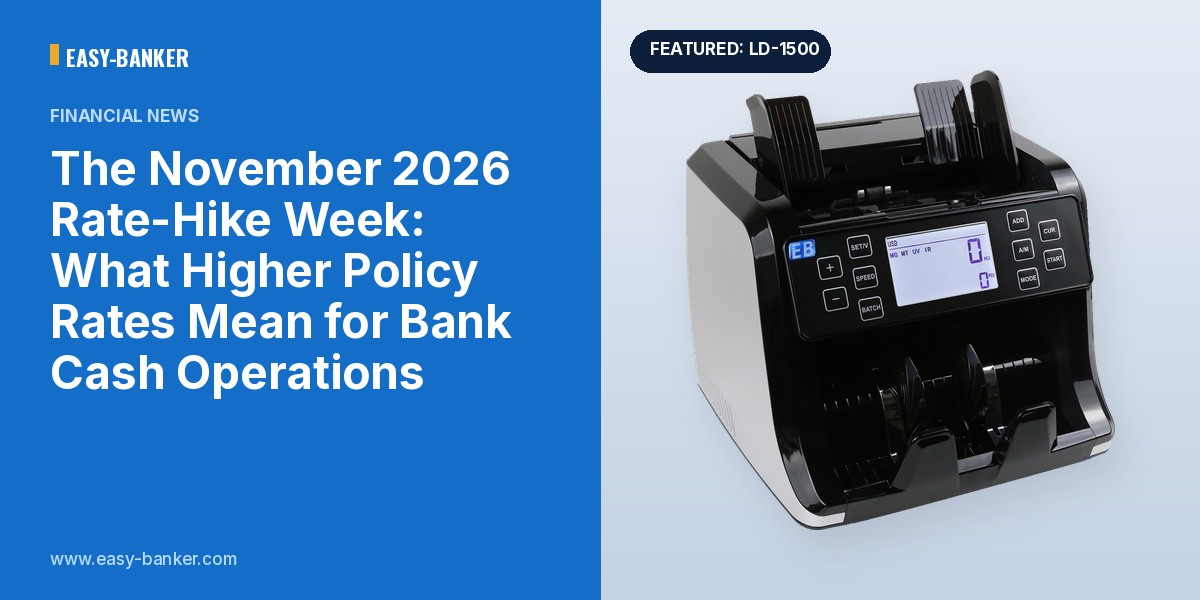
If the till is already sorted by denomination, a piece counter is enough. You count the notes, use batch to stop at 100 for a strap, and use add to accumulate successive piles up to 999 notes. The LD-800 and the LD-1500 both list batch and add, and both mark mix-value counting as not available. The LD-1500 page also states that it does not support denomination recognition or mixed-value totals.
If the pile is mixed — a retail close, a bureau-de-change till, or unsorted deposits — you need mix-value counting. That requires a CIS that can recognize denomination and, on the LD-1910, version, so the machine reports a value total rather than only a piece count. The LD-1910 lists mix-value counting and denomination or version sort as available, with 1 CIS plus ultraviolet (UV) and magnetic (MG) detection.
Speed is notes per minute, not value per minute. The LD-800 offers four selectable speeds: 800, 1,200, 1,600 and 1,900 notes per minute. The LD-1500 is listed at more than 1,000 notes per minute. The LD-1910 counts at 1,000 notes per minute. A small retail desk rarely saturates 1,000 notes per minute; the higher LD-800 speeds help with large, pre-sorted back-office bundles. Hopper capacity and how quickly staff reload usually cap throughput before the motor does.
UV detection looks at how paper responds to ultraviolet light. MG detection looks for the magnetic ink used on most genuine notes. The LD-800 feature table lists UV and MG. The LD-1500 lists UV, MG and infrared (IR) as triple detection, plus DD width detection: the first note is the reference width, and “Width Different” appears when a later note does not match. That can catch a stray denomination in a sorted pile; it is not the same as reading printed value. The LD-1910 lists UV and MG together with its 1 CIS, which images the note so the machine can recognize denomination and version.
All three machines list automatic half-note, chained-note and double-note detection, plus automatic start, stop and clear. For standalone viewers, see our guide to choosing a counterfeit money detector.
The hopper is how many notes you can load; the stacker is how many counted notes it holds before you empty it. The LD-800 has a hopper of 300 and a stacker of 200. The LD-1500 lists both as 100 old bills or 200 new bills, because worn notes take more space. The LD-1910 has a hopper of 200 and a stacker of 200. Batch stops at a preset number so a teller can build a 100-note strap; add accumulates successive counts up to 999. The LD-1500 lists an amount-preset function for a target quantity or amount.
The LD-1500 is a front-feeding counter. The LD-1910 is listed under back-feeding bill counters. Feed direction changes how the machine sits and how staff load it; it does not decide whether the machine can mix-value count. See our front-feeding versus back-feeding buying guide.
A single-output money counter counts — and, with a CIS, values — a pile and returns the notes to one stacker. A currency sorter has multiple output pockets so it can separate denominations, facing, or fit versus unfit notes in one pass. Stay with a money counter to count a till, prepare straps, or value a mixed pile. Choose a sorter when notes must go into separate pockets, as in a bank cash centre or a cash-in-transit room. See our guide to choosing a currency sorter and how to use a money counter.
The LD-800 is a piece counter: speeds 800, 1,200, 1,600 or 1,900 notes per minute; UV and MG; batch and add up to 999; hopper 300 and stacker 200; mix-value counting not available; 5-digit LCD count and 3-digit LCD batch; notes from 130 × 50 mm to 180 × 100 mm at 0.075–0.15 mm thickness; AC 100–240 V, 50–60 Hz, at or below 60 W; 276 × 242 × 245 mm; 4.9 kg net.
The LD-1500 is a front-feeding piece counter: UV, MG and IR plus DD width detection and amount preset; mix-value counting not available; more than 1,000 notes per minute; hopper and stacker each 100 old bills or 200 new bills; 4-digit TFT count and 3-digit TFT batch; notes 50 × 110 mm to 90 × 180 mm at 0.075–0.15 mm thickness; AC 220 V, 50/60 Hz, at or below 80 W; 250 × 240 × 220 mm; 5.5 kg net; noise below 60 dB; continuous working time more than 30 minutes.
The LD-1910 is a mixed-value counter: 1 CIS plus UV and MG; denomination or version sort; 1,000 notes per minute; hopper 200 and stacker 200; TFT display; USB and RS232; notes 110–180 mm long and 50–90 mm wide at 0.075–0.15 mm thickness; 90–240 V, 50–60 Hz, 95 W; 347 × 262 × 192 mm; 5.5 kg net; noise below 60 dB; continuous working time more than 30 minutes.
None of these three product pages list Eurosystem or similar official test-lab approval. Check the official list for your market, or contact Easy-Banker for a matching specification.
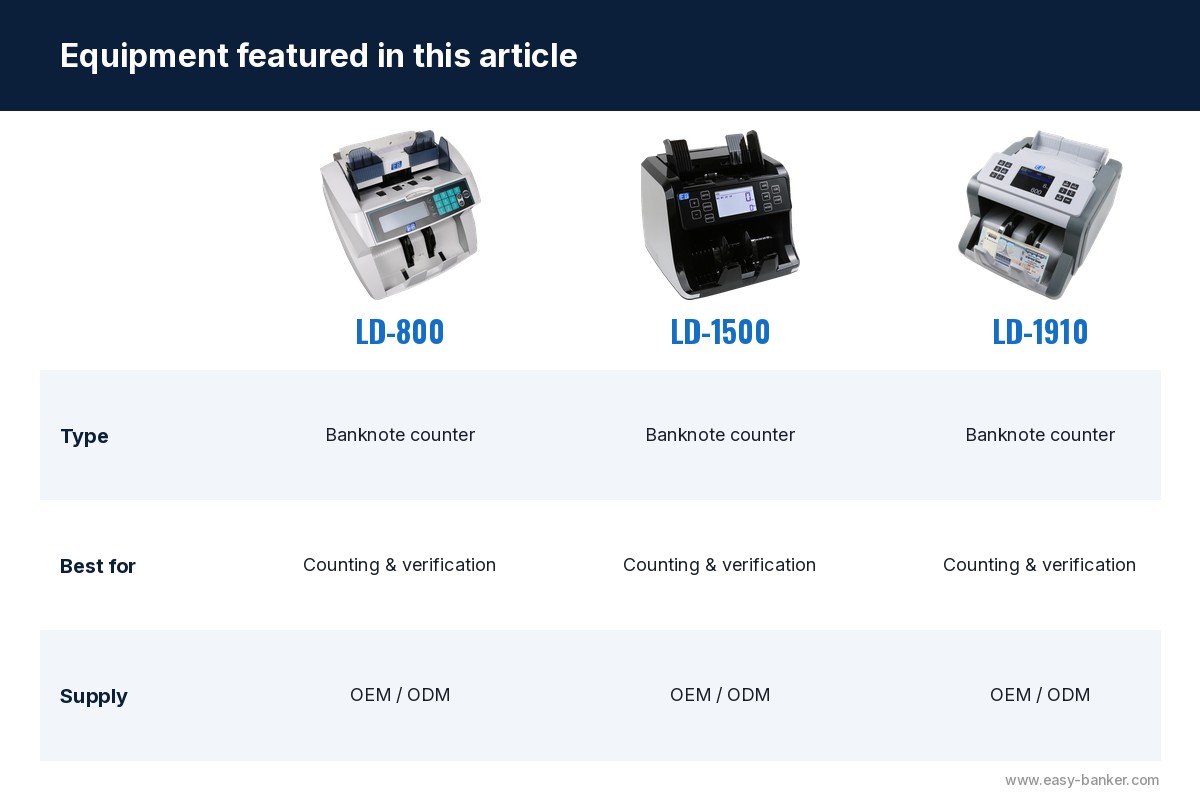
A piece-count machine reports how many notes passed through it. A mixed-value machine uses a CIS to recognize denomination — and, on the LD-1910, version — so it can also report a value total. The LD-800 and LD-1500 are piece counters; the LD-1910 is a mixed-value counter.
No. The LD-800 feature table lists UV and MG. The LD-1500 lists UV, MG and IR, plus DD width detection. The LD-1910 lists 1 CIS plus UV and MG. None of the pages claim official test-lab approval.
Most cashier desks are served by 1,000 notes per minute. Choose the LD-800’s higher speeds of 1,600 or 1,900 notes per minute when a back office counts large, pre-sorted bundles and can keep the hopper fed.
Choose a sorter when you need separate output pockets for denomination, facing or fitness in one pass. Choose a money counter to count a pile, prepare a strap, or — with a CIS model — value a mixed pile into one stacker.