Americas Cash Cycle Seminar 2026 in Miami: What Cash Equipment Buyers Should Watch
What is the 2026 Americas Cash Cycle Seminar, and why should cash equipment buyers care? The Americas Cash Cycle Seminar runs in Miami, Florida, from 16 to 19 November 2026, with its welcome reception at the Hyatt Regency Coral Gables. Organised by Currency Research, it brings together central banks, commercial banks, cash management companies (CMCs) and cash-in-transit (CIT) operators to discuss how cash is circulated, secured and processed across North, Central and South America. This year's theme, "Cash in Transition – Resilience, Innovation, and Inclusion Across the Americas", is a useful signal for anyone who buys, distributes or services banknote counters, sorters and banding machines: the conversation is no longer about whether cash survives, but about how to process it more efficiently and securely. (Source: Currency Research – The Americas Cash Cycle Seminar; registration page: eventscloud.com.)
What is the Cash Cycle Seminar?
According to the organiser, the first seminar took place in 1995, and the event, formerly known as ICCOS, has grown into one of the main global meeting points for commercial cash management, distribution and circulation. It is educational rather than a pure trade fair: sessions are built around shared perspectives, cost-saving technologies, strategies, best practices and case studies. The Americas edition focuses on the full cash cycle, promoting efficiency and security in cash operations for central banks, commercial banks, CMCs/CITs and their suppliers.
The Miami meeting is one of several Cash Cycle Seminars on the late-2026 calendar. A separate EMEA edition follows in Cape Town at the end of November, which means the operational topics raised in Miami are likely to be discussed in other regions within weeks.
Why does the theme "Cash in Transition" matter for back-office operations?
The three words in the theme — resilience, innovation and inclusion — map neatly onto everyday problems in a cash room.
- Resilience means cash must keep working when digital channels go down, during natural disasters, or in regions with limited connectivity. That puts a premium on reliable, easy-to-maintain processing equipment in branches and cash centres.
- Innovation is about doing more with fewer staff hours: faster counting, automatic denomination recognition, fitness sorting and data capture that feeds reconciliation systems.
- Inclusion recognises that many people across the Americas still rely on cash for daily life. Banks and retailers that serve them need cash handling that is accurate and affordable at scale.
For an equipment buyer, this translates into a simple question: does each step in your cash flow — counting, authenticating, sorting and bundling — have the right machine behind it?
Which processing steps are most likely to be discussed?
Cash cycle discussions typically follow the path of a banknote after it leaves the customer: deposit, counting and authentication, fitness sorting, bundling, storage and recirculation. Several practical topics tend to come up in this kind of forum:
- Fitness sorting — separating notes that can be reissued (FIT) from worn notes that must go back to the central bank (UNFIT). Recirculating fit notes locally reduces transport and handling costs.
- Traceability — capturing serial numbers so that a disputed deposit or a counterfeit can be traced back to a specific batch.
- Multi-currency handling — especially relevant in the Americas, where US dollars circulate alongside local currencies in many markets.
- Secure, standard bundles — banding notes into consistent straps so they can be audited, stored and shipped by CIT partners.
How can mid-sized banks and cash operators apply these ideas?
Not every institution runs a large cash centre, but the same workflow logic applies to a regional bank, a currency exchange or a CIT depot. Easy-Banker's range covers each stage with machines whose specifications come straight from our product data sheets.
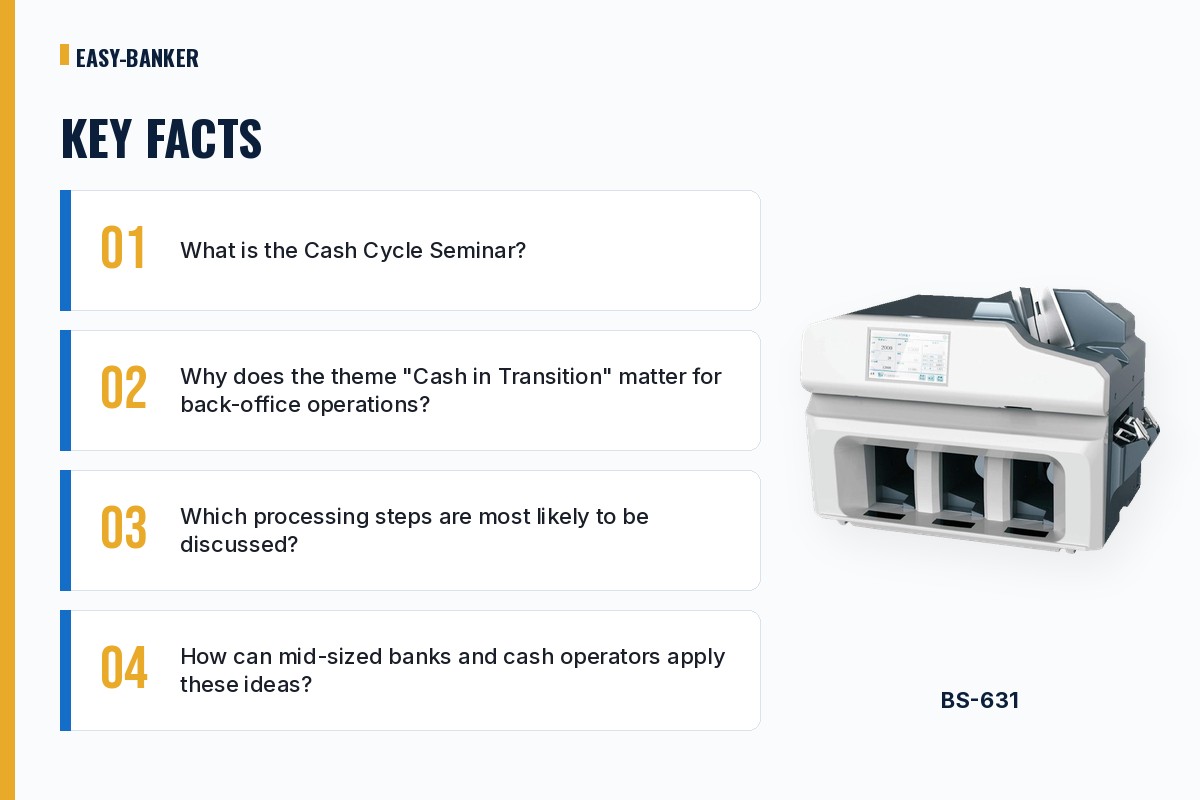
For sorting and traceability, the Easy-Banker BS-631 four-pocket banknote sorter sorts notes three ways in a single pass, with three output pockets plus one reject pocket. It performs FIT/UNFIT fitness sorting using a 200 dpi CIS (Contact Image Sensor), UV, IR, magnetic (strong and weak pattern) and full-width mechanical thickness checking, and it can capture serial numbers, print them and store them on an SD card. Process speed is 1000/800 notes per minute, with a hopper of up to 1000 notes, and connectivity includes RS232, USB 2.0 and Ethernet/LAN. Supported currencies listed on the data sheet include USD, EUR, GBP, CNY, JPY, KRW, RUB, INR, IDR and TWD.
For counting mixed denominations at the teller or in a smaller back office, the LD-1910 mixed-value money counter counts at 1000 notes per minute, supports up to 8 currencies on one machine, offers mixed-currency counting (MIX.C), automatic currency recognition and per-denomination reports, and uses UV and MG detection. It has a TFT display, a USB port for upgrades and an RS232 port for an external printer.
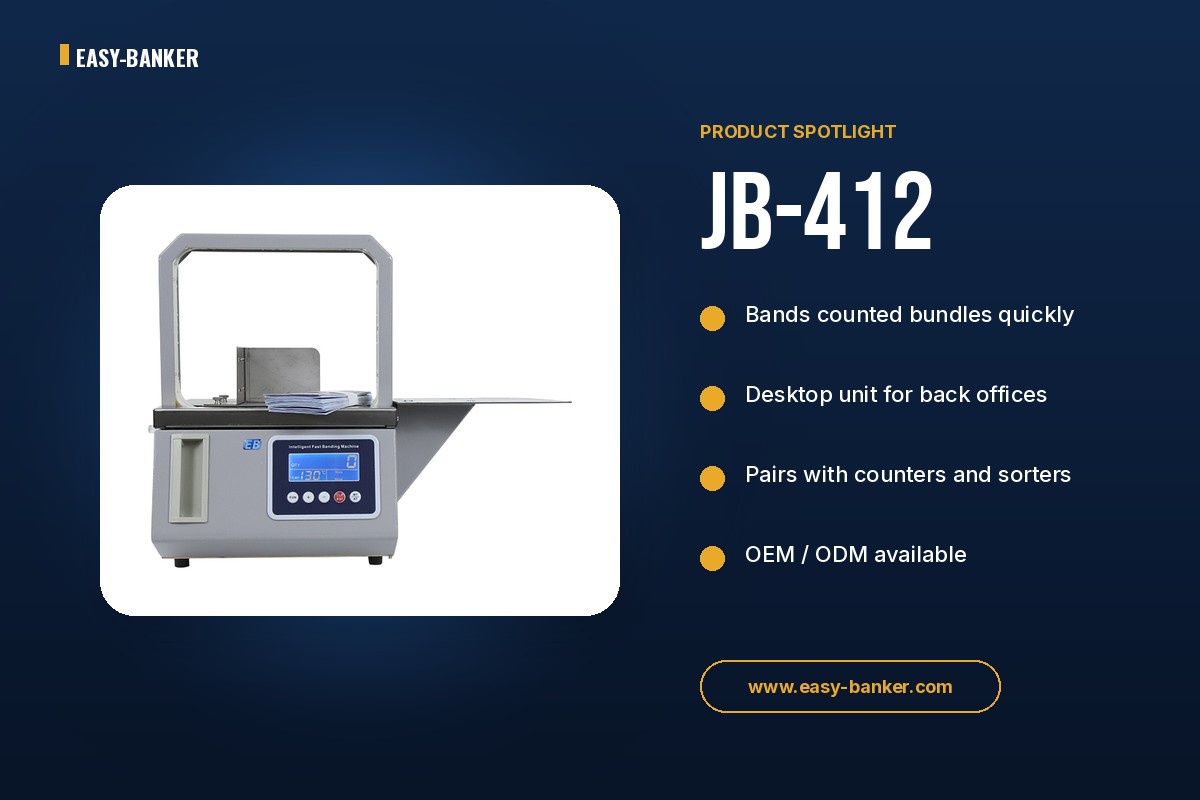
For the final step, the JB-412 currency banding machine binds bundles in under 2 seconds per tie, heats instantly, works with both OPP film tape and hot-melt paper tape, and offers automatic-sensing and manual modes with a real-time tie counter. Note that the JB-412 is a banding machine only and has no counterfeit detection function — authentication should happen upstream on a counter or sorter.
What should distributors take away from Miami?
Events like the Cash Cycle Seminar shape what bank and CIT customers ask for over the following year. If the conversation in Miami centres on resilience and efficiency, expect more tenders and enquiries that specify fitness sorting, serial-number capture, multi-currency support and data interfaces rather than basic counting alone. Distributors who can explain how a counter, a sorter and a bander fit together into one documented workflow will be better placed than those selling single machines on speed figures.
A practical approach is to map each customer's cash flow on one page — where notes arrive, who counts them, where they are sorted, and how they leave — and then match equipment to each gap. That is exactly the kind of process thinking the seminar promotes.
FAQ
When and where is the 2026 Americas Cash Cycle Seminar?
16–19 November 2026 in Miami, Florida, with the welcome reception at the Hyatt Regency Coral Gables on 16 November, according to the organiser Currency Research.
Who attends the seminar?
Central banks, commercial banks, cash management companies, cash-in-transit operators and technology suppliers involved in cash circulation.
What is fitness sorting?
Fitness sorting separates banknotes that are in good enough condition to reissue (FIT) from worn or damaged notes (UNFIT). Sorters such as the BS-631 do this automatically during authentication and denomination sorting.
Does a banding machine check for counterfeits?
Not necessarily. The JB-412, for example, has no detection function; notes should be authenticated on a counter or sorter before banding.