ECB Says Cash Remains the Most Resilient Payment: What Euro Changes Mean for Banks
Short answer: On 5 November 2026, ECB Executive Board member Piero Cipollone told a payments conference in Tirana that cash is "the most resilient form of payment we have," confirmed that the next generation of euro banknotes should enter circulation gradually from the early 2030s, and said existing notes will remain valid. Europe is investing in both cash and a digital euro, not choosing between them. For banks, cash-in-transit firms and retailers, the message is clear: physical cash handling stays a long-term operation, and the equipment that counts, checks and sorts it should be planned for a multi-year transition in which old and new notes co-circulate.
What exactly did the ECB say about cash?
In his keynote, "Shaping the future of money," delivered at the eighth International Conference of Regional Card Schemes and Retail Financial Market Infrastructures, Cipollone argued that describing cash as a technology of the past is "a mistake." He pointed to cyber risks, hybrid threats and system outages as reasons why physical money still matters, and noted that more than 31 billion euro banknotes, worth over €1.6 trillion, are in circulation.
He also described cash as inclusive, simple to use without a device or an intermediary, protective of privacy and a guarantee of freedom of choice. That is why, in his words, "Europe is not choosing between cash and digital payments. We are investing in both."
What is changing with euro banknotes, and when?
According to the speech, the next generation of euro banknotes will incorporate enhanced security features, have a smaller environmental impact and improve accessibility. Almost ten million people took part in the ECB's public survey on ten shortlisted design proposals this summer, with two-thirds of responses coming from people under 35.
The ECB's Governing Council expects to decide on the final design concept around the end of 2026. The new notes should then enter circulation gradually from the early 2030s, while current notes remain valid. In practice, that means a long period in which two families of euro banknotes circulate side by side.
How does the digital euro fit alongside cash?
Cipollone presented the digital euro as a complement to banknotes and coins, not a replacement. It would work online and offline, with basic use free for consumers. The Council of the EU agreed its position in December 2025, the European Parliament adopted its position in July 2026, and trilogue negotiations are under way. Assuming legislation is concluded by the end of 2026, the ECB aims to be ready for a potential first issuance in 2029, with a 12-month pilot planned from the second half of 2027 involving 36 selected payment service providers.
The same Single Currency Package also contains a proposed regulation on the legal tender status of euro banknotes and coins, which is in interinstitutional negotiations. For cash operators, the significance is that legal protection for cash is being pursued in parallel with digital innovation.
Why does a long co-circulation period matter for cash operations?
When a new banknote series arrives while the old one stays valid, every counting and checking step has to handle both. Branches, cash centres and retailers typically face three practical questions:
- Recognition: Can machines identify and value both old and new designs, and can they be updated when new note data becomes available?
- Authentication: New series bring new security features. Detection methods such as UV, magnetic and infrared checks need to be configured for each note family.
- Sorting and fitness: During a transition, cash centres often need to separate series and pull worn or unfit notes out of circulation so that quality stays high.
Cipollone's emphasis on resilience also reinforces a quieter point: if cash is the fallback when digital systems go down, the people and equipment handling it must be ready on short notice, not only on ordinary days.
Which equipment matters most during a banknote transition?
The answer depends on volume and on where notes are handled.
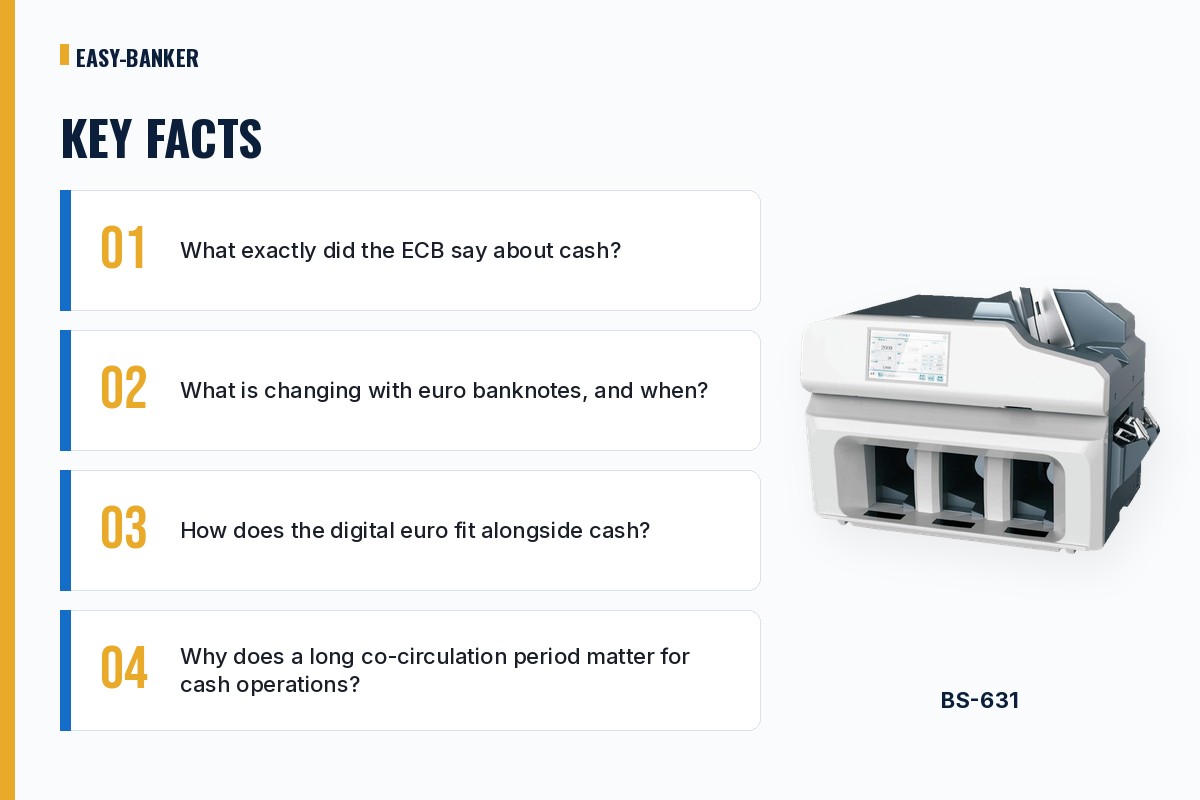
For cash centres and larger branches, a multi-pocket sorter does the heavy lifting. The Easy-Banker BS-631 four-pocket money sorter sorts through three output pockets plus one reject pocket in a single pass, combining denomination, verification and FIT/UNFIT fitness sorting. It uses a 200 dpi contact image sensor with visible and IR analysis, magnetic pattern and metal thread detection, RGB and UV checks for washed notes, and mechanical thickness checking for tape, tears and doubles. It can also capture serial numbers and store them on an SD card, which helps with audit trails when two series are mixed.
For teller counters and back offices, a value counter is the daily tool. The LD-1910 mixed-value money counter counts at 1000 notes per minute, supports mixed-denomination (mix value) counting and denomination/version sorting, uses 1 CIS plus UV and MG detection, and offers USB for upgrades plus RS232 for a printer. Upgradeability is the feature to watch when new note designs are on the horizon.
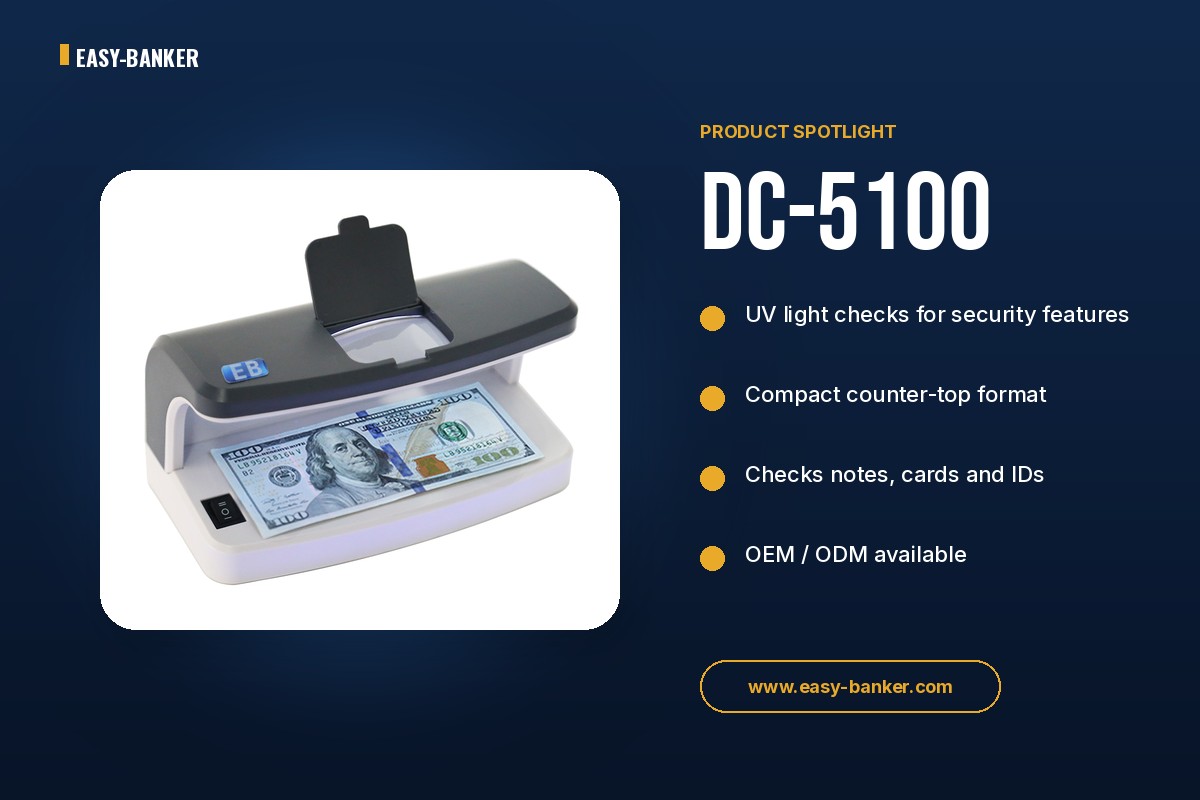
For shops and cashiers, a simple second check is often enough. The DC-5100 portable UV/MG detector combines a 365 nm UV light with magnetic ink detection in a rechargeable handheld unit, useful for spot-checking unfamiliar notes at the till.
What should banks and distributors do now?
- Audit the installed base. List counters and sorters by model, and confirm which can receive currency updates.
- Plan for co-circulation. The ECB has said existing notes remain valid, so machines must handle both series, not just the new one.
- Keep resilience in the budget. If cash is the fallback during outages, spare capacity in counting and authentication is a risk-management item, not a luxury.
- Follow official timelines. The final design decision is expected around the end of 2026; plan purchases around confirmed milestones, not rumours.
FAQ
When will new euro banknotes be in circulation?
According to the ECB, gradually from the early 2030s. The final design concept is expected to be decided around the end of 2026.
Will the current euro notes stop being valid?
No. The ECB said existing banknotes will remain valid when the new series is introduced.
Will the digital euro replace cash?
No. The ECB describes it as a complement to banknotes and coins. A potential first issuance is targeted for 2029, subject to the legislative process.
Do I need new machines immediately?
Not necessarily. The priority is to make sure current equipment can be updated and can handle mixed old and new notes once the new series is issued.
Source: European Central Bank, "Shaping the future of money," keynote speech by Piero Cipollone, Tirana, 5 November 2026. ecb.europa.eu