Ghana Heritage Series Banknotes: What 12 November Co-Circulation Means for Cash Handlers
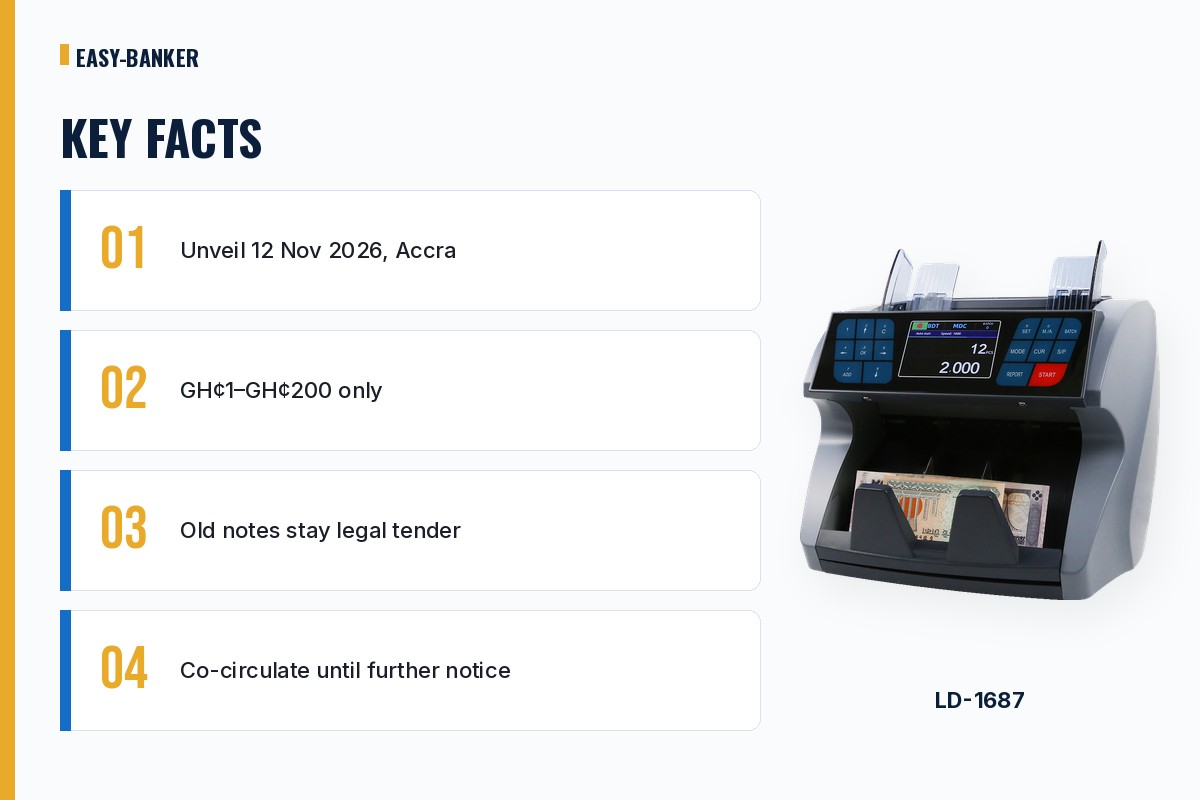
Short answer: The Bank of Ghana will publicly unveil its new Heritage Series cedi banknotes on Thursday, 12 November 2026 at Bank Square in Accra. The unveiling is not the same as general circulation. All eight existing denominations (GH¢1 through GH¢200) are covered, no higher denomination is planned, and existing notes remain legal tender and will co-circulate with the new series until further notice. For banks, cash-in-transit firms, retailers and equipment distributors in West Africa — and for anyone who handles Ghanaian cedi elsewhere — the practical job is to prepare machines and staff for a long period in which old and new designs sit in the same till.
What is the Bank of Ghana announcing?
Governor Dr Johnson Pandit Asiama first outlined the Heritage Series at the Monetary Policy Committee press briefing on 24 September 2026. Local reporting in early November 2026, including Graphic Online and 3News, confirms that the public show date has moved to 12 November 2026 from the earlier early-November window. The bank's Director of Currency Management, Dominic Owusu, has stressed that 12 November is when the notes are shown, not when they flood into everyday use.
The series is themed "The Cedi, Our Future: Secure, Designed to Last." Designs celebrate Ghanaian heritage, culture and national heroes. The bank says the notes carry enhanced security features and are built for longer life in circulation, but it has not yet published the full feature-by-feature technical list for the public. That detail matters for machine makers and buyers: until official authentication guidance is out, treat any "ready for Heritage Series" claim with caution and wait for BoG materials plus live-note tests.
Which denominations are changing?
All eight notes already in use are covered: GH¢1, GH¢2, GH¢5, GH¢10, GH¢20, GH¢50, GH¢100 and GH¢200. The bank has ruled out introducing any note above GH¢200. Different sizes by denomination remain, which helps visually impaired users, and tactile marks have been strengthened according to Owusu. The bank is also exploring a mobile app that can announce a note's value aloud, and a separate authenticity-check app.
Why does co-circulation matter more than the unveil date?
Asiama has repeatedly told the public not to rush to exchange or withdraw existing notes. Owusu has said old and new notes will continue as legal tender together until further notice. There is no published swap deadline. For cash operations, that is the real planning signal:
- Recognition: Counters must identify and, where relevant, value both series. Version or series sorting becomes useful when branches want to separate old and new stock.
- Authentication: Staff and machines need updated checks once BoG publishes the security feature card. Until then, train tellers to follow official BoG guidance only and ignore social-media rumours about higher-value notes.
- Fitness and durability: A stated goal of the series is longer life in circulation. Cash centres will still need to pull torn, taped or heavily soiled notes, because fitness rules do not disappear when a new design arrives.
What should cash equipment buyers check before the notes hit tills?
Start with three questions for every counter and detector on site.
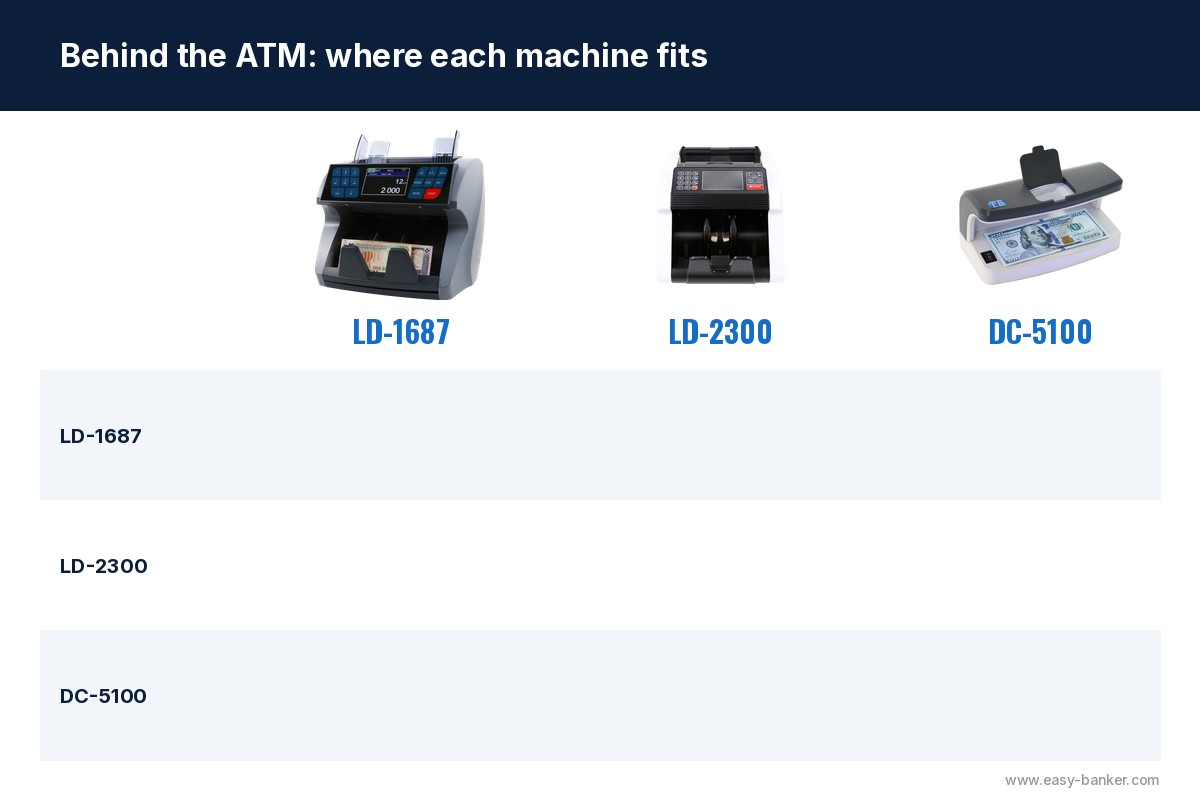
1. Can the machine be updated? Multi-currency value counters with USB or RS232 ports are easier to keep current when a central bank changes a series. The Easy-Banker LD-1687 2-CIS money counter offers mix-value counting and denomination/version sorting, serial-number scanning, UV and MG detection, automatic half/chained/double-note stop, 800/1000/1200/1500 notes per minute, a 300-note hopper and 200-note stacker, TFT touch screen, USB and RS232 (net weight 6.52 kg; note size 110–180 × 50–90 mm, thickness 0.075–0.15 mm). Version sorting helps when two visual families share a face value.
2. Does the feeder tolerate the substrate you actually receive? Redesign programmes often change paper, polymer or composite feel. The LD-2300 portable counter is specified for polymer and paper note compatibility, runs at 900 notes per minute with UV, MG and DD (width) detection, automatic half/chained/double-note detection, 130-note hopper and stacker, 4+3 digit TFT displays, countable size 50×110–90×180 mm and thickness 0.075–0.15 mm, AC 220–110 V ≤80 W, under 60 dB, 295×235×190 mm and 5.5 kg. Its mix-value line on the live product page is marked unavailable, so do not expect denomination value totals from this model — use it as a reliable piece counter with detection, and pair it with a value counter where needed.
3. Can cashiers make a quick second check? When a new series first appears, a simple UV/MG desk check reduces disputes. The DC-5100 UV/MG detector combines 365 nm ultraviolet light, magnetic-ink sensing, a 5X magnifier and a ruler area in a rechargeable 200×105×105 mm unit (1200 mAh, about 4 hours, 0.55 kg). It is a spot-check tool, not a high-speed sorter.
What should distributors in Ghana and neighbouring markets do this week?
- Watch official BoG channels for the feature card. Do not invent UV patterns or thread positions from social posts.
- Inventory update paths. List which counters accept currency library updates and which are fixed firmware.
- Plan for dual-series tills. Train staff that old notes stay valid; the risk is false rejects and customer friction, not a sudden demonetisation.
- Test with live notes after release. Easy-Banker does not claim that any model is on a Bank of Ghana tested-machine list. Buyers who need formal recognition should ask BoG or their bank for approved equipment guidance and run acceptance tests on real Heritage Series notes once they circulate.
- Keep fitness discipline. Longer-life notes still age. Sorter and reject workflows for tears, tape and soil remain part of daily cash quality.
FAQ
When will the Heritage Series enter general circulation?
The Bank of Ghana has set 12 November 2026 as the public unveiling date at Bank Square in Accra. It has not published a general-issue start date in the early-November reporting; modalities are expected around the unveil.
Do old cedi notes become invalid?
No. The Governor and Currency Management have said existing notes remain legal tender and will co-circulate with the Heritage Series until further notice. There is no announced swap deadline.
Will there be a note above GH¢200?
No. The bank has ruled out denominations above GH¢200. The eight existing face values are the ones being redesigned.
Should I replace every money counter before 12 November?
Not automatically. Prioritise machines that can receive currency updates, that can separate or recognise versions when two designs share a face value, and that your team can re-train on once BoG publishes authentication guidance. Then validate with live notes.
Sources: Graphic Online, "BoG postpones new cedi notes launch to November 12" (Nov 2026); 3News / JoyNews reporting of Bank of Ghana Currency Management remarks; Bank of Ghana Governor statements on the Heritage Series (Sept–Nov 2026). Verify dates and feature details on bog.gov.gh before purchasing decisions.