How Do Coin Sorters Separate Mixed Coins? Inside Size-Based Coin Sorting Technology
How does a coin sorter tell mixed coins apart? A desktop coin sorter separates a loose pile of mixed coins mainly by their physical size: coins are fed from a hopper onto a rotating disc, travel along a sorting track, and drop out at the point where an opening matches their diameter (and thickness), landing in the drawer for that denomination. As each coin passes, the machine counts it and adds its face value, so one run gives you both the number of pieces per denomination and the total value. The practical result for banks, retailers and cash-handling operators is that a job that used to mean hand-sorting and stacking becomes a single feed-and-read operation.
Why do coins still need dedicated sorting technology?
Banknote counters and sorters get most of the attention in cash centres, but coins create a different kind of workload. They arrive mixed, they are heavy, and every coin has a low value relative to the time it takes to handle by hand. Shops, vending and amusement operators, charities, post offices and bank branches all collect bags of mixed change that must be separated by denomination before they can be bagged, deposited or reconciled.
Unlike a banknote, a coin cannot easily be imaged on both sides at speed by a small desktop machine. Coin sorting technology therefore relies on what coins do reliably differ in: their geometry. Each circulating denomination in a currency series is designed with its own diameter and thickness, and that physical difference is what a mechanical sorter exploits.
What happens inside a coin sorter, step by step?
Although designs vary between manufacturers, most desktop coin sorters follow the same basic sequence:
- Hopper: the operator tips a quantity of mixed coins into the hopper. Capacity matters because it decides how often the operator has to refill during a run.
- Rotating disc: a spinning disc spreads the coins out and pushes them, one by one, to the edge so they enter the track in single file rather than as a jam.
- Sorting track: coins travel along a rail past a series of openings arranged from the smallest to the largest. A smaller coin falls through the first opening it fits; larger coins ride past until they reach their own opening.
- Counting sensors and drawers: sensors register each coin as it is diverted, the controller adds its denomination value, and the coin drops into the drawer assigned to that size.
Because the track is matched to a currency's set of coin sizes, a sorter has to be configured for the currencies it will handle. This is why manufacturers publish a list of supported currencies rather than claiming that one machine fits every coin in the world.
Which specifications actually matter when comparing coin sorters?
Product sheets can look similar, so it helps to focus on a few figures that directly change daily throughput and fit:
- Sorting speed (coins per minute) — the main driver of how long a bag takes. Note whether speed is quoted for a specific coin size; smaller coins usually run faster.
- Hopper capacity — how many coins can be loaded at once.
- Coin diameter and thickness range — the physical limits the track accepts. This is the real compatibility check for a given currency.
- Display — whether value and quantity are shown together, and how many digits are available for totals.
- Batch preset and memory — the ability to stop at a preset count so coins can be bagged or wrapped in standard quantities.
- Power supply — dual 110V/220V or wide-voltage designs matter for export markets.
How do Easy-Banker coin sorters compare?
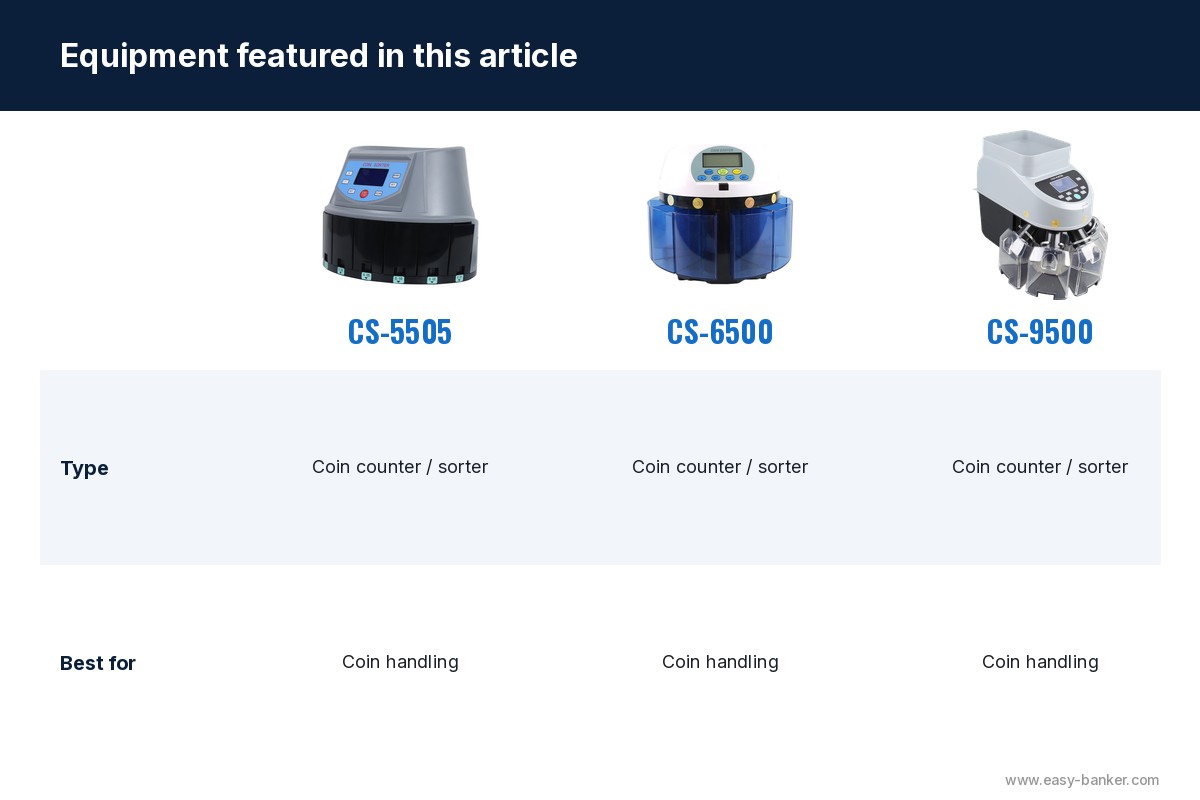
Easy-Banker's desktop coin sorter line illustrates how these specifications trade off. All three models below count and sort mixed coins into separate drawers, total both value and quantity per denomination, and support a freely preset batch of 0–999 pieces with a memory function.
- The CS-5505 coin sorter is the compact entry point: 350 coins per minute, a 500–700 coin hopper, and a big LCD screen that shows value and coin quantity on one screen. It runs on AC220V/50Hz or AC110V/60Hz at 45W.
- The CS-6500 coin sorter steps up to 650 coins per minute with a 350–1000 coin hopper and 150–500 coins per drawer. Its catalogue states the accepted coin range directly: 15.5–27 mm in diameter and 1.3–2.5 mm in thickness. The display uses 3 digits per denomination and 7 digits for total value or quantity.
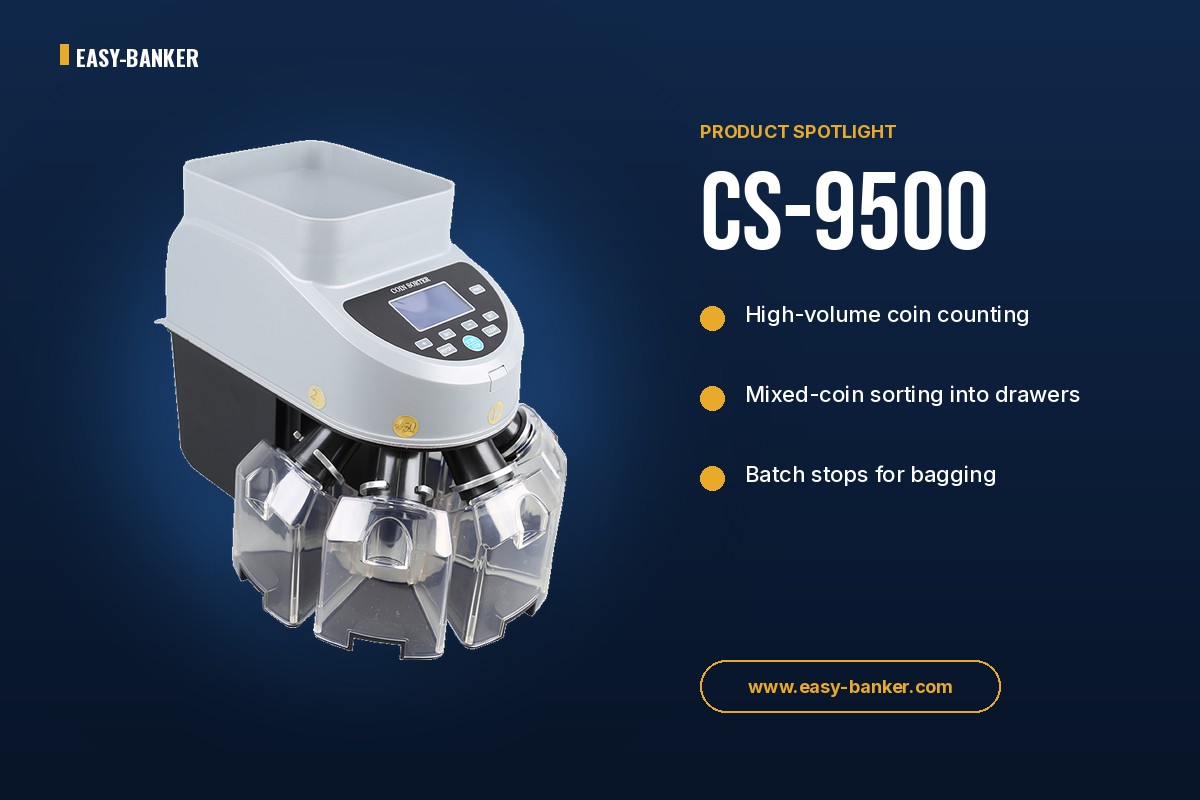
- The CS-9500 coin sorter is the high-speed option at 1200 coins per minute for 16 mm coins and 1000 per minute for 20 mm coins, with a 500–1000 coin hopper and a wide-voltage 90–240V AC power supply, which simplifies deployment across different national grids.
The catalogues for these models list a range of supported currencies including the Euro, US dollar, Canadian dollar, British pound, Australian dollar, Mexican peso and many others. Because coin series change over time, buyers should always confirm the exact currency configuration before ordering.
Where do coin sorters fit in a cash-handling workflow?
In practice, a coin sorter sits at the start of the coin process. Mixed coins from tills, vending machines or deposit bags are sorted and counted; the batch function then stops at a set number so coins can be bagged or wrapped in standard quantities; finally, the per-denomination totals are reconciled against the expected amount. Pairing coin sorting with banknote counting at the same station gives a complete cash count for a till, a machine route or a branch deposit.
For smaller operators, the biggest benefit is usually accuracy rather than raw speed: a machine count removes the arithmetic errors that creep in when tired staff count large volumes of change by hand.
FAQ
Can a coin sorter detect counterfeit coins?
A basic desktop sorter separates coins by physical size and counts them; it should not be treated as a counterfeit detector unless the manufacturer specifically states an authentication feature.
Will one coin sorter work with any currency?
No. The sorting track is matched to a currency's coin sizes, so each machine supports a defined list of currencies and a physical diameter/thickness range. Confirm your currency before purchase.
What does the batch function do?
It stops counting at a preset number (0–999 pieces on the models above), so coins can be bagged or wrapped in consistent quantities.
Is a faster sorter always better?
Not necessarily. High-volume cash centres benefit from 1000+ coins per minute, while shops and small operators often value a compact footprint and clear display more than top speed.