How Does a Banknote Banding Machine Work? OPP Heat Sealing, Tension and Cycle Time Explained
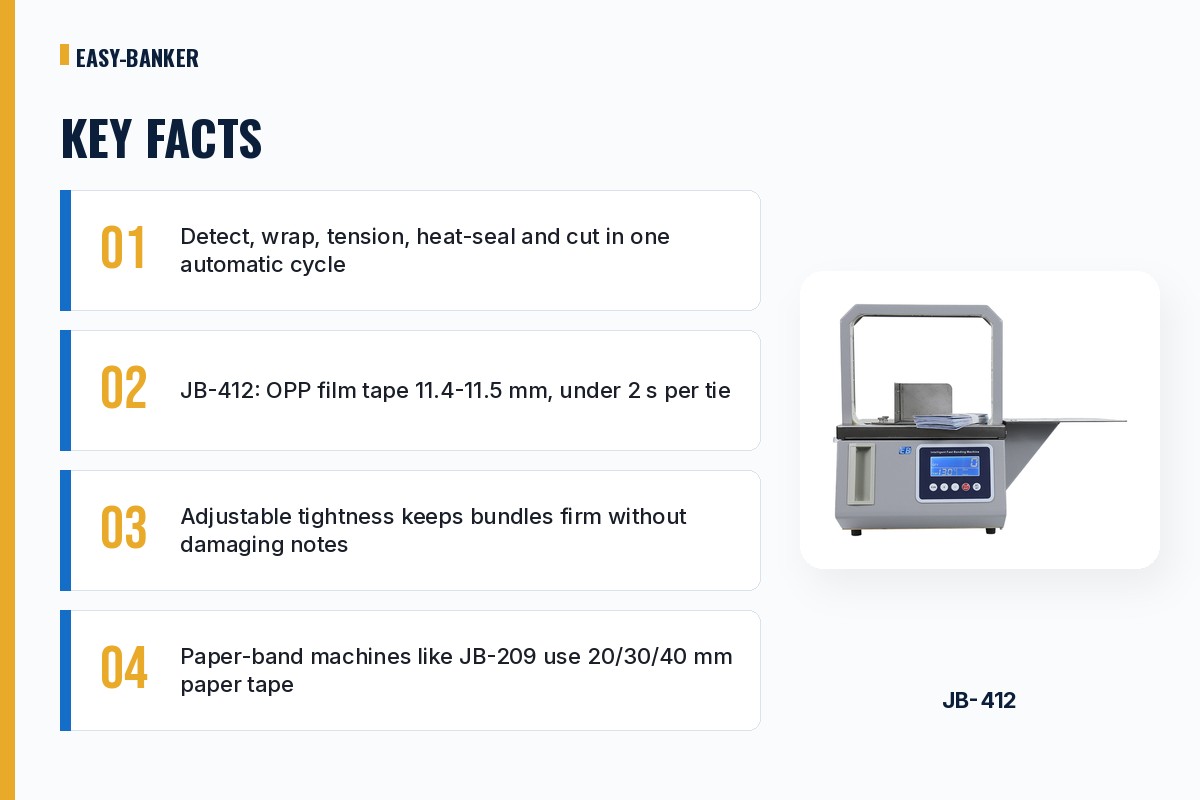
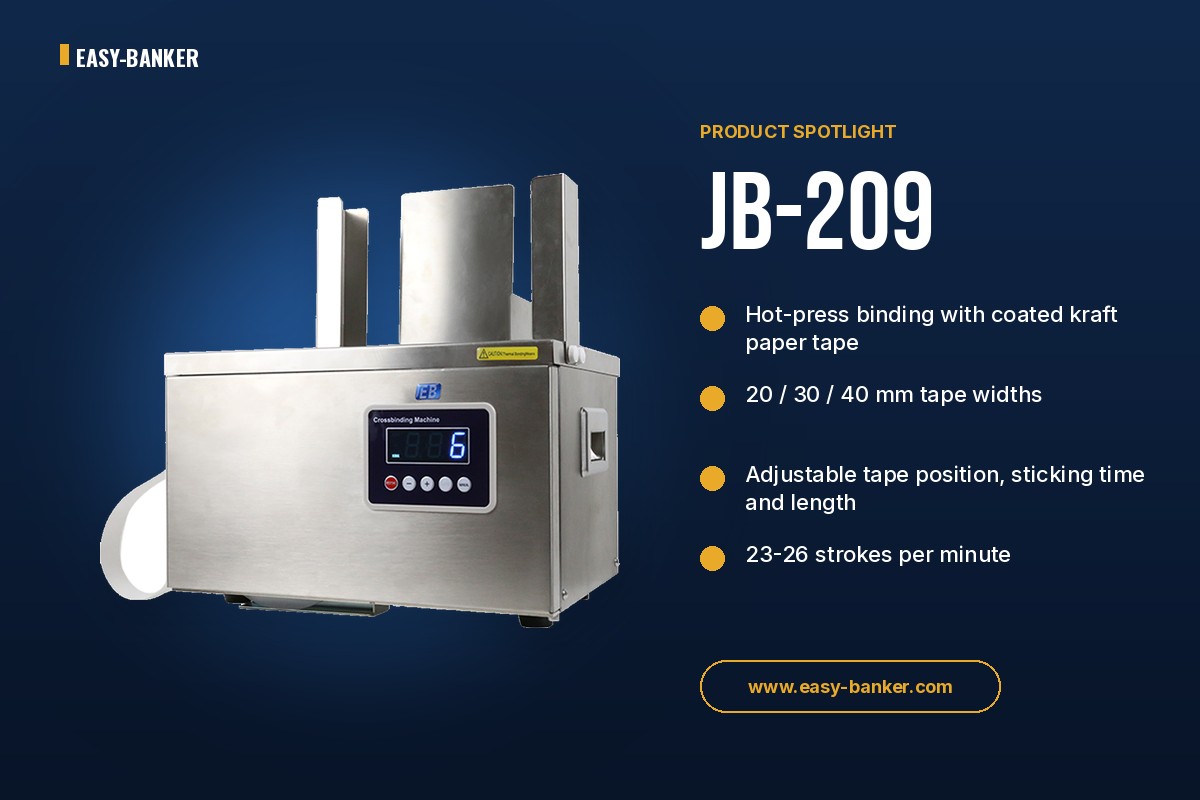
Short answer: A banknote banding machine wraps a thin strap around a counted stack of notes, pulls it to a set tightness, joins the two ends with heat and cuts the strap free, all in a single automatic cycle. On an OPP banding machine such as the Easy-Banker JB-412, the strap is a narrow OPP plastic film and one tie takes less than 2 seconds. Paper-band machines such as the JB-209 follow the same basic sequence with a wider coated kraft paper band that is hot-pressed into place. The machine you choose, and the tape you buy for it, should match the bundles you band and the finish your bank or customer expects.
What happens inside one banding cycle?
Most desktop banding machines repeat the same four steps every time a bundle is placed in the frame:
- Detect and start. The operator places the stack in the banding frame. In automatic mode the machine senses the bundle and starts the cycle by itself; in manual mode the operator starts each tie.
- Feed and wrap. Tape is drawn from the roll and guided around the bundle so that the strap encircles the stack.
- Tension. The tape is pulled back so the strap closes firmly around the notes. How hard it pulls is the tightness setting.
- Seal and cut. The overlapping ends are joined by heat and pressure, the strap is cut from the roll, and the finished bundle is released.
Because every step is controlled by the machine, each bundle comes out with the same strap position and the same tightness. That consistency is the main reason cash offices move from hand-wrapped bands to a machine.
How does OPP heat sealing hold a bundle together?
OPP (oriented polypropylene) film is a thermoplastic. When the two overlapping layers of the strap are pressed against a heated element, they soften and bond together, then set as they cool. No glue or adhesive tape is involved; the strap itself becomes the joint.
On the JB-412 the consumable is OPP film tape 11.4–11.5 mm wide and 0.1–0.13 mm thick. Width and thickness matter because the tape path, the heating element and the cutter are all built around that tape size. Tape that is too wide, too narrow or too thick may jam, seal badly or fail to cut cleanly. Before buying tape, check the consumable specification printed for your machine.
The JB-412 heats instantly and is ready to use. It uses OPP film tape; if you want paper bands, choose a machine built for paper tape (see below).
Why does band tension matter?
Tension is the setting operators adjust most often. If it is too loose, notes can slide out of the bundle while it is moved or stored. If it is too tight, the strap can crease or damage the edges of the notes, which is a problem for currency that will be counted and paid out again.
The JB-412 has an adjustable tightness setting so that bound items are not damaged. On the JB-209, the tape position, sticking time and tape length can be adjusted. A sensible routine is to check the settings on a test bundle at the start of each shift, then leave them alone unless the stack size or note type changes.
What determines cycle time and throughput?
Cycle time is how long one tie takes, from the start of the cycle until the strap is cut. It is mainly limited by how quickly the machine can feed and tension the tape, and how long the seal needs heat and pressure to bond.
- JB-412 (OPP film): less than 2 seconds per tie.
- JB-209 (coated kraft paper or OPP film strip): 23–26 strokes per minute, with an adjustable sticking time.
In practice the operator usually sets the pace: counting, squaring and placing the stack take longer than the tie itself. Automatic start helps because the operator does not have to press a button for every bundle. The JB-412 and JB-209 both offer automatic induction and manual operation. Both also show a running count of ties on the display, which helps the operator reconcile the number of bundles at the end of a batch.
Which sensors and controls should a banding machine have?
A banding machine does not need to check whether notes are genuine, and that is not its job. The JB-412 is explicitly specified without a detection function, so counterfeit checks belong on the counter or sorter before banding. The useful controls on a bander are about handling the bundle:
- Bundle detection for automatic start (automatic induction mode).
- Tie counter showing the number of ties in real time.
- Fault detection and prompts; the JB-412 detects faults automatically and shows a prompt so the operator knows why it stopped.
- Display language; the JB-412 interface can be switched between Chinese and English.
What bundle sizes and power options are supported?
The frame limits what fits. The JB-412 has a 220 × 170 mm frame and bands items from 20 × 10 mm up to 200 × 160 mm. That covers banknote stacks as well as bills and vouchers. It is supplied for 220 V/50 Hz or 110 V/60 Hz, weighs 13 kg and ships in a 320 × 300 × 400 mm package. The JB-209 takes tape 20, 30 or 40 mm wide on a 50 mm roll core, is available for 220 V/50 Hz or 110 V/60 Hz, and weighs 19 kg. Always confirm the voltage version when you order.
OPP tape or paper strapping tape: which should you use?
The choice starts with the machine, not the tape. An OPP banding machine needs OPP film tape of the right width, such as Easy-Banker OPP-12 strapping tape. A paper-band machine needs paper strapping tape, such as PTHY-25 money band paper. Paper bands give a traditional paper-strap finish, while OPP film gives a fast, compact tie. Paper strapping tape is a separate consumable for paper-band machines; it is not a substitute tape for an OPP-only machine. When you order, give the machine model so the tape width and roll core can be matched.
FAQ
How long does it take to band one bundle of banknotes?
On the JB-412, less than 2 seconds per tie. The JB-209 runs at 23–26 strokes per minute.
Which tape does the JB-412 use?
OPP film tape, 11.4–11.5 mm wide and 0.1–0.13 mm thick. For paper bands, choose a paper-band machine such as the JB-209.
Does a banding machine detect counterfeit notes?
No. The JB-412 has no detection function. Verify notes on a counter or sorter before banding.
Why do my bands come out loose or crush the notes?
Adjust the tightness setting on a test bundle, and check that the tape matches the machine's consumable specification.
Need help matching a banding machine with the right OPP or paper strapping tape? Contact Easy-Banker with your bundle size and voltage.