The November 2026 Rate-Hike Week: What Higher Policy Rates Mean for Bank Cash Operations
Short answer: In the first week of November 2026, several central banks tightened policy at once. The Reserve Bank of Australia lifted its cash rate to 4.85 per cent on 3 November, Sweden’s Riksbank raised its policy rate to 2 per cent on 4 November, and the Bank of England raised Bank Rate to 4 per cent at the meeting ending 4 November, while Norges Bank held at 4.5 per cent. For banks, cash centres and retailers, higher rates make idle cash more expensive to hold, which puts a premium on fast, accurate processing with tools such as the LD-1910 mixed-value counter and the JB-209 banding machine.
What did central banks decide in early November 2026?
The decisions came close together. According to the Reserve Bank of Australia statement of 3 November 2026, the Board increased the cash rate target by 25 basis points to 4.85 per cent, by a six-to-three majority. The Board said inflation remains elevated and broadly based, partly because of higher fuel and commodity prices linked to the conflict in the Middle East.
The Bank of England’s November 2026 Monetary Policy Summary reports that the Monetary Policy Committee voted 8–1 to raise Bank Rate by 0.25 percentage points to 4 per cent, with one member preferring a larger 0.5 point rise. The Bank expects UK CPI inflation to rise to around 5 per cent by the middle of next year.
In Scandinavia, the Riksbank decision published on 4 November raised the Swedish policy rate by 0.25 points to 2 per cent, applying from 11 November 2026. Norges Bank kept its policy rate unchanged at 4.5 per cent on 4 November, while saying it is prepared to raise it if needed.
Why do interest rates matter to a cash operation?
Cash sitting in a vault, an ATM cassette, a branch drawer or a retailer’s safe earns nothing. When policy rates are near zero, that idle balance costs very little. When they rise, every banknote that waits to be counted, sorted, banded and returned to circulation or deposited carries a larger opportunity cost. The same money could be lent out or placed on deposit.
This is basic treasury arithmetic rather than a new rule, but it changes priorities in practice. Treasury teams start asking how much buffer cash each branch really needs, how quickly takings reach the bank, and how long notes stay in processing before they are credited. Speed and accuracy in the back office become a cost question, not only a convenience.
Where does cash get stuck between the till and the bank?
In most cash cycles, the slow points are the manual ones. Typical bottlenecks include:
- Counting mixed takings. A shift drawer or a customer deposit usually contains several denominations. Sorting them by hand before counting adds minutes per bundle.
- Re-counts and discrepancies. A count that does not reconcile has to be repeated, and the cash waits in the safe while it is investigated.
- Bundling for deposit. Notes have to be strapped into standard bundles before collection or vault storage.
- Counterfeit checks. Every suspect note that slips through is a direct loss, and every manual check slows the line.
Shortening each of these steps means cash moves from the drawer to an earning account faster, with fewer errors to chase.
Which equipment shortens the cash cycle?
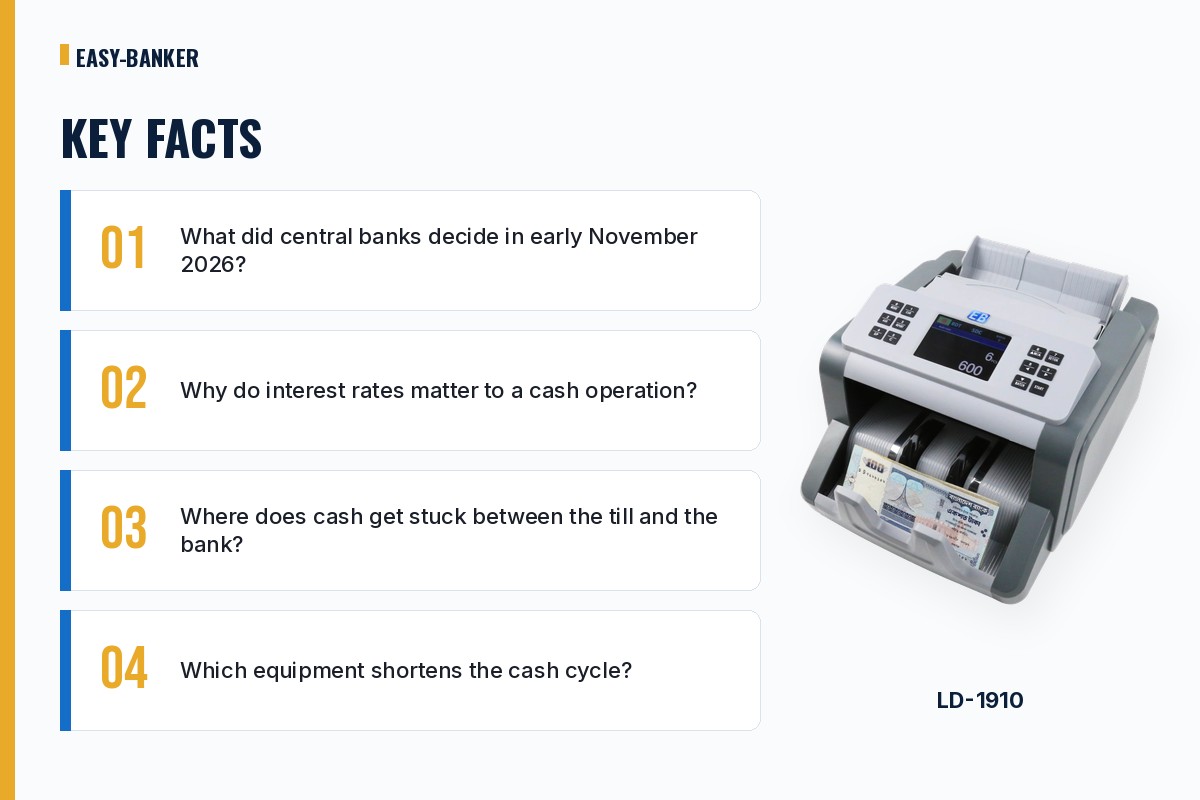
A value counter removes the hand-sorting step. The LD-1910 lists a counting speed of 1,000 notes per minute, a mixed-count mode that totals pieces and amount across denominations, a per-denomination report, UV and MG detection, support for up to eight currencies and an RS232 port for an external printer, so a deposit slip can be backed by a printed count.
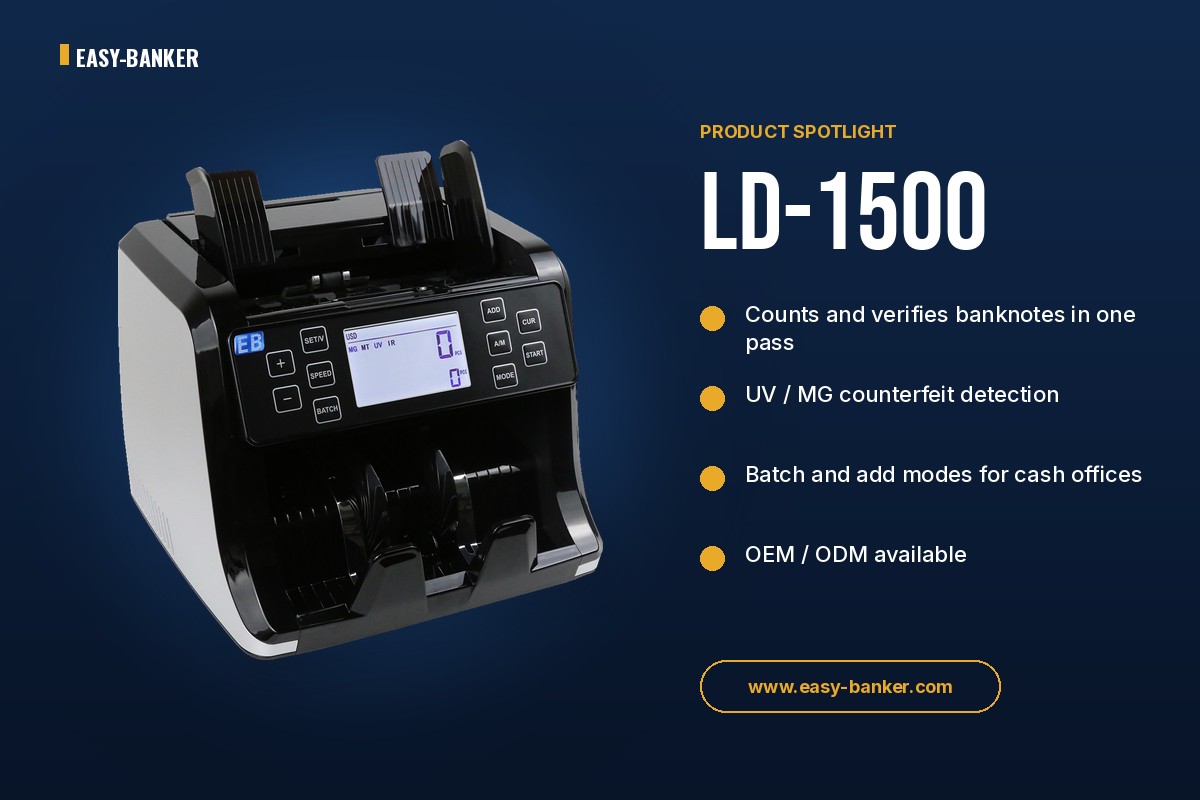
For high-volume counting where notes are already sorted, a fast piece counter such as the LD-1500 with UV and MG detection, infrared double-note detection and a batching function keeps stacks consistent.
The final step is bundling. The JB-209 is a microcomputer-controlled banding machine with hot-press binding, adjustable tape position, length and sticking time, and a real-time display of the number of straps made. Uniform, counted bundles are quicker to hand to a cash-in-transit crew and quicker to verify on arrival.
What should banks and retailers review now?
Higher rates are a good moment to audit the cash cycle. Useful questions include:
- How long, on average, does cash sit between collection and credit?
- How many counts per week fail to reconcile on the first attempt?
- Which sites still sort denominations by hand before counting?
- Are bundles standardised so that the receiving vault can verify them quickly?
- Is counterfeit detection consistent across branches and stores?
None of this requires a large capital project. In many cash offices, replacing an old piece counter with a value counter and adding a bander removes the two slowest manual steps. Distributors who supply banks, retail chains and cash centres can use the current rate environment to frame equipment upgrades as a working-capital saving, not only a hardware purchase.
FAQ
Which central banks raised rates in early November 2026?
The Reserve Bank of Australia (to 4.85 per cent on 3 November), the Bank of England (to 4 per cent, meeting ending 4 November) and Sweden’s Riksbank (to 2 per cent, decision published 4 November). Norges Bank held at 4.5 per cent.
Do higher interest rates reduce cash use?
The central bank statements cited here do not address cash use. Their direct effect on cash operations is the higher opportunity cost of holding idle cash, which rewards faster processing.
Which Easy-Banker model counts mixed denominations?
The LD-1910 lists a mixed-count mode that totals pieces and amount across denominations, plus a per-denomination report.
What does a banding machine add to the cash cycle?
It turns counted notes into uniform strapped bundles. The JB-209 uses hot-press binding and shows the number of straps in real time.
How can I get a quotation?
Please contact Easy-Banker with your market, currencies and daily volume.