How Banknote Fitness Sensors Detect Soil, Stains, Tears and Tape
Short answer: Fitness sensors grade a banknote FIT or UNFIT by measuring how it looks, how thick it is and how light passes through it. An optical contact image sensor (CIS) reflects visible light off both faces and flags soil, stains and graffiti as darker, discoloured or marked areas on a genuine note of that denomination. A mechanical thickness sensor catches extra bulk from tape, repairs, folds and double notes. Transmission imaging in visible and infrared light, often with UV or RGB, finds holes and washed or de-inked notes because damaged or washed paper lets more light through or no longer matches the expected response. The sorter uses those readings in one pass to send the note down a FIT or UNFIT path.
What does “fit” vs “unfit” mean on a banknote?
A fit note can stay in circulation at a teller, an ATM or a till. An unfit note is genuine but too soiled, stained, torn, holed, washed or repaired to issue again.
Decision ECB/2010/14 publishes the Eurosystem defect types: soil, stain, graffiti, de-inked note, tear, hole, mutilation, repair, crumples, limpness, fold and folded corner. That list describes categories; it does not mean every sorter is tested against them. Easy-Banker machines are not on the Eurosystem tested-machine list, nor presented here as appearing on the Reserve Bank of India list. Legal thresholds are covered in our explainer of the ECB fitness rulebook.
How do optical sensors see soil, stains and graffiti?
The main optical tool is a contact image sensor. On the machines below it is specified at 200 dpi and reads both sides by reflection. Light shines on the paper, the sensor records what bounces back, and software compares that image with the expected design for the denomination and facing.
Soil is general dirt from handling. It lowers overall reflectance, so the note looks darker and less uniform than a clean note. Stains are local patches whose colour or brightness does not belong on the printed design. Graffiti — pen marks, stamps or writing — is unexpected content that a clean-note template does not contain.
Reflection CIS is weaker on defects that barely change the surface — a clean hole, a washed note or clear tape — so those need thickness and transmission checks.
How does a thickness sensor catch tape, folds and double notes?
A mechanical thickness sensor feels the note. A full-width mechanism measures thickness as the note passes. A genuine note of a given denomination has a stable thickness; extra layers or two sheets produce a measurable increase.
Tape and other adhesive repairs (the Eurosystem “repair” category) make that area thicker than the surrounding paper. Folds and folded corners double the paper, so the sensor reads roughly two thicknesses. Two notes fed together read as a double. The product pages group tear, adhesive, tape and double detection with this mechanical system.
A tear can also show as a thickness gap, and as a bright line in the transmission image where light leaks through.
How do transmission / IR checks find holes and washed notes?
Transmission imaging places a light source on one side and a sensor on the other, in visible and infrared wavelengths. Holes and many tears appear bright because air passes more light than paper; larger missing pieces (mutilation) produce larger bright areas.
Washing can thin the paper, strip ink and change how optical brighteners respond, so more light transmits, colour fades and the UV response no longer matches a normal note. The BS-2090 and BS-2080W list washed-banknote checking with both-side reflection plus 200 dpi visible and IR transmission. The BS-631 adds RGB and UV sensors for washed-note checks, with the same reflection and visible/IR transmission array.
IR pattern analysis through the CIS is mainly authentication; IR transmission supports fitness when paper is dirty, missing, thinned or washed.
How does a currency sorter use those signals in one pass?
Along a single sensor path the decision order is: can it be read; is it genuine; what denomination and facing is it; does any fitness channel exceed its threshold? Reflection CIS supplies soil, stain and graffiti; thickness supplies tape, folds, doubles and many tears; transmission — with UV and RGB for washed notes — supplies holes, missing paper and washed or de-inked notes. Over a threshold the note is UNFIT; authentic and inside the limits it is FIT. Unreadable or suspect notes go to a reject path.
Menus on the listed machines are configurable, so a cash centre can tighten soil or tape limits to match local rules. Choosing pocket layout and a fitness standard is covered in our guide to choosing a currency sorter.
Which Easy-Banker machines expose these fitness checks?
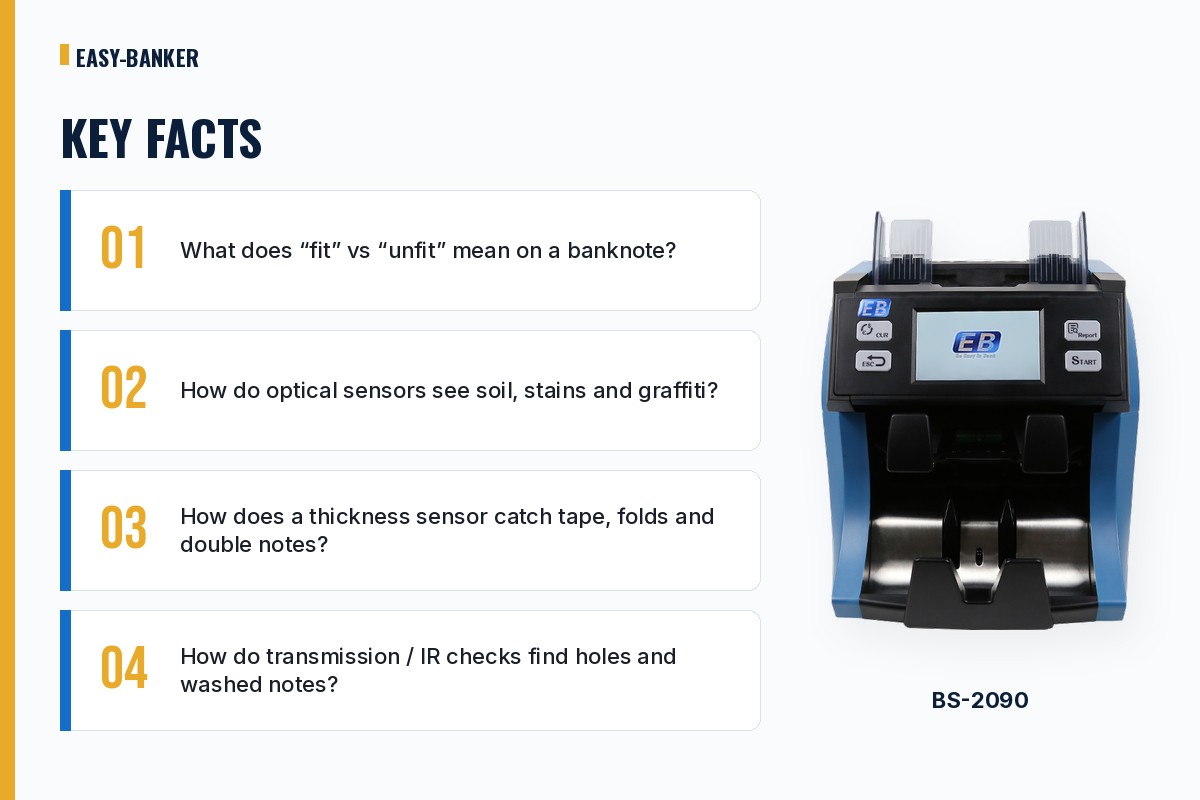
The BS-2090 and BS-2080W list the same fitness sensor set: dual CIS (2CIS) at 200 dpi with both-side reflection and visible/IR transmission, powerful UV, mechanical thickness checking, washed-banknote checking, and tear, adhesive, tape and double analysis. Both also list serial-number capture (printable and storable on a memory card), an optional built-in printer, a 4.3-inch touch TFT, speeds of 800, 1,000 or 1,200 notes per minute, and LAN/RS232/USB/PC. The BS-2090 is 262 × 293 × 302 mm and 10 kg net; the BS-2080W is 260 × 280 × 275 mm and 9 kg net. Pocket count is omitted because each heading says 1+1 pocket while the URL slug says 11-pocket.
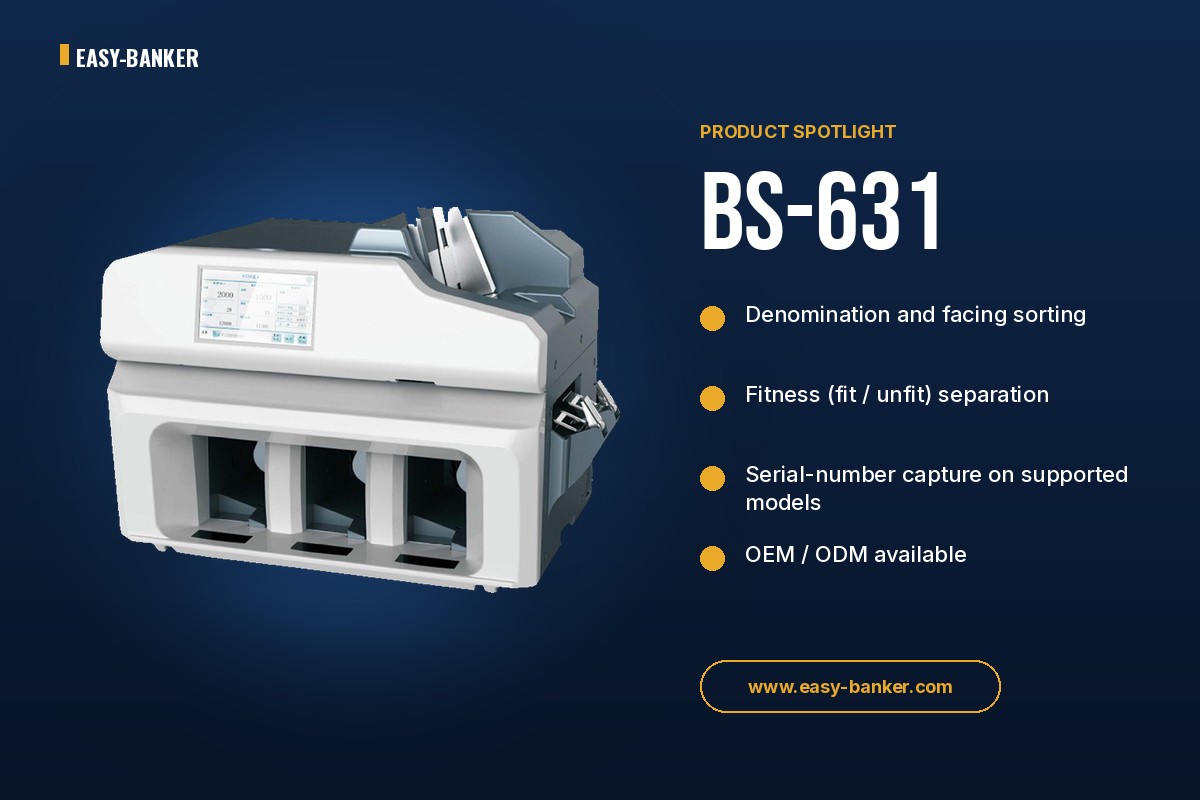
The BS-631 has three output pockets plus one reject and sorts value, verification and classification in a single 3-way pass. Fitness sorting uses a 200 dpi CIS, powerful UV and full-width mechanical thickness checking, with both-side reflection and visible/IR transmission at 200 dpi. RGB and UV sensors check washed notes; thickness is listed for tear, adhesive, tape and doubles. Also listed: strong and weak magnetic patterns and the metal thread; serial-number capture printed or stored on a memory card; 640 × 240 colour touch screen; RS232, USB 2.0 and Ethernet; SD-card storage; 800 or 1,000 banknotes per minute; stackers of 3 × 100 notes, extendable to 200 by software; reject pocket up to 100; feeder up to 1,000; size 650 × 420 × 450 mm. Conflicting weights appear on the page (42 kg, carton net 24.5 kg, carton gross 58 kg), so no weight is stated here.
None of these pages list Eurosystem or RBI test-lab approval. Teams that need a tested machine should check the official list, or contact Easy-Banker for a matching specification.
FAQ
Do fitness sensors also detect counterfeit notes?
Not by themselves. Fitness sensors measure condition. Authentication uses different checks on the same pass: UV, magnetic (strong and weak patterns and the metal thread) and infrared pattern analysis through the CIS.
Which sensor finds tape on a repaired note?
The mechanical thickness sensor. Tape adds a local layer, so that part of the note is thicker than the paper around it.
Can these sorters detect a washed or de-inked banknote?
Yes. Washed-banknote checking is listed on the BS-2090, BS-2080W and BS-631. The BS-631 specifies RGB and UV sensors for that check, supported by visible and IR transmission.
Are Easy-Banker sorters on the Eurosystem tested-machine list?
No. Buyers who need a machine tested against Decision ECB/2010/14 should check the official list.